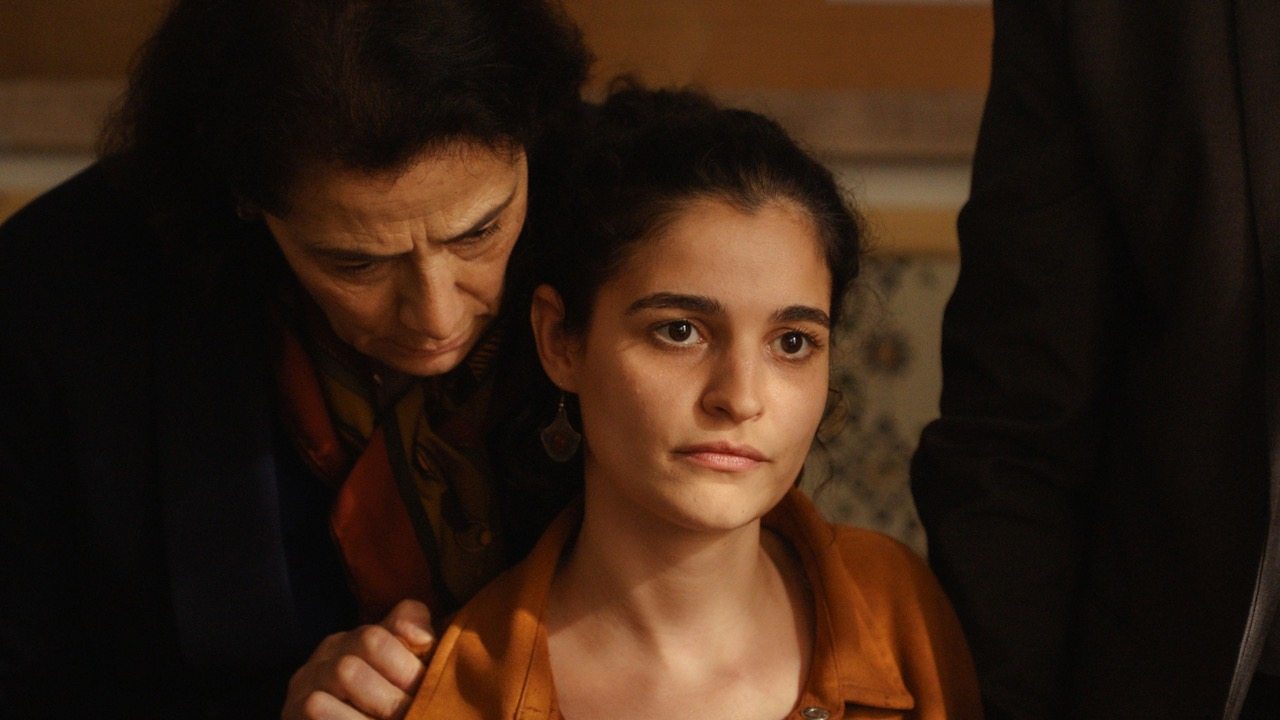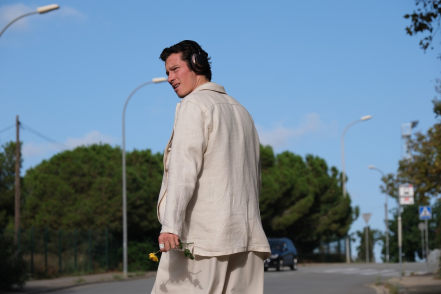
Still from Rosebush Pruning
By Rita Di Santo
At the Berlin Film Festival, Brazilian filmmaker Karim Aïnouz presents in competition Rosebush Pruning. Known for his politically charged narratives, Aïnouz has consistently tackled the themes of anti-patriarchy and societal critique throughout his career. His previous works, including The Invisible Life of Euridice Gusmão and Motel Destino, have responded to Brazil’s increasingly conservative political landscape, particularly during the Bolsonaro administration.
In Rosebush Pruning, Aïnouz shifts focus to an American family—six affluent members who relocate from the U.S. to Spain. This wealthy clan, consisting of three brothers, a sister, a father, and a mother, resides in a lavish villa nestled in the mountains, seemingly detached from the outside world. Their ignorance of broader societal issues is palpable. However, beneath the surface of their luxurious existence lies a blind, cynical, and unethical patriarch.
Central to Rosebush Pruning is the theme of isolation within a privileged family. The narrative draws inspiration from Marco Bellocchio’s 1965 film Fists in the Pocket, which follows a young man with epilepsy plotting the murders of his family. Here the story is narrated by Ed, one of the brothers, who is strikingly disconnected from the world—he neither writes, reads, nor drives. The family dynamic is disrupted when Martha, a young music student, captures the attention of the eldest brother, Jack, leading to a collapse of their fragile equilibrium. Everything is made to appear ordinary, but the more ordinary things seem, the more repellent and shocking we eventually find them.
The father, as the patriarch, represents the toxic masculinity that permeates the family dynamics, wielding power in a way that is both destructive and suffocating. The brothers illustrate the complexities of male relationships, grappling with their identities amidst societal expectations. The family’s lack of intellectual achievement contrasts sharply with their boundless wealth, creating a transgressive narrative that probes politics, sexuality, and the nature of cinema itself. As the story unfolds, it becomes evident that innocence is a rarity among the characters, with no one emerging unscathed by the film’s conclusion.
Aïnouz maintains a controlled melodramatic tone, with deft storytelling, he tackles explicit themes of incest and homosexuality, transforming sibling relationships into deeply intimate, yet unconsummated connections. The film’s characters are marked by moral and physical decay, suggesting an inevitable descent into darkness.
As a chilling exploration of power dynamics, the film delves into a violent sexual landscape marked by control and anger, stripped of desire. It presents a gendered experience heavily influenced by patriarchy, leaving its characters tormented within the suffocating confines of a villa. Despite the surrounding beauty of nature, the space is devoid of hope and allure. The evocative imagery captured by photographer Helene Louvart contrasts sharply with the emptiness of the characters’ words and the sickly nature of their gestures.
The family’s villa is a palace, a fortress of privilege where entry is strictly forbidden, the isolation of this elite world. Jack’s girlfriend Martha (played by Elle Fanning) is emblematic of this impenetrable world, a reign of superficiality, where Martha gets evaluated not by her essence but by the brands she wears. This emphasis on “what is” rather than “how is” reflects a troubling societal malaise.
Jack is the only character who appears to escape this oppressive environment, though this perception may be misleading. While the film is not flawless, it undeniably provokes thought and stirs emotions. It presents a visceral critique of paternal power and the influence of wealthy families, focusing not on the bourgeoisie but on the upper echelons of aristocracy.
It is evocative, prompting viewers to reflect on the unsettling realities of our society and drawing comparisons to high-profile cases of sexual abuse, such as those involving Harvey Weinstein and Jeffrey Epstein.
Ultimately, Aïnouz’ s work challenges us to confront the normalization of patriarchy and its insidious effects, a movie that leaves you questioning much about the world around us. It embodies its provocative ideas, challenging viewers to confront the uncomfortable truths of privilege and power.