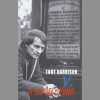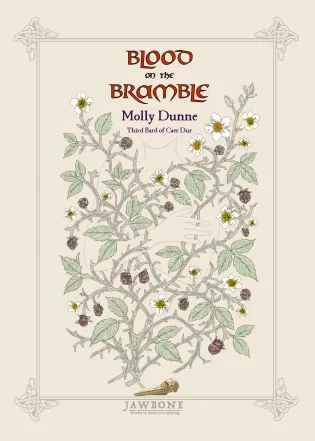
The book is available here
By Nick Moss
This will be an all-too-brief introduction to a powerful new poetic voice, and to the Jawbone Collective. The latter is a Bridport-based creative community, dedicated to giving voice to “marginalised communities, prioritising support for those in the neurodivergent, disabled and LGBTQIA+ communities.” Jawbone function as a Community Interest Community and any profits they make from a publishing initiative are recycled to fund the next one – ie they are a not-for-profit collective. They also run workshops, a Substack, open mic nights, a radio show, as well as publishing to date 12 books of poetry and the Jawbone Journal. They deserve enthusiastic support and serve as a positive example of community-based creative organisation.
Molly Dunne has been 2024-25 Bard of Dorchester, and 2025 Writer in Residence at Dorchester Museum and Art Gallery. Blood on the Bramble is her first full collection, and it demonstrates a willingness to play with and push the possibilities of language that draws on, but takes further, the legacies of Thomas Hardy, Sylvia Plath, Angela Carter, and PJ Harvey. In its willingness to embrace the feral and to take up the resources of myth it is reminiscent of some of Fran Lock’s work, and has a similar energy. But Dunne has a way with language that is unique to her, that gives voice to a literary personality alive with rage and beauty, able and willing to reckon with misogyny and legacies of oppression.
These are poems rooted in, and taking their freedom from, the possibilities offered by wilderness:-
There’s blood on the brambles, a snag in the root,
a girl in the thicket with mud on her boot
She’s bare to the briar , spine full of spite,
nails like nettles and a moth made to bite
(Blood on the Bramble)
Dunne is a poet who wants to reckon with those who would keep in line the spell-weavers and dreamers who will not know their place:-
They hunted her down with their dogs and their drums
with their salt and their sermons, their bells and their sums,
but she bloomed in the blood. She rooted. She ran.
She vanished like virtue in the mouth of a man.
(Ibid)
There is a steely fury to these poems. They are sensual, and playful, and full of a love for language, but they never lose their steel, never fail to take aim at injustice. Dunne is a poet who uses words to indict and, in doing so, wants us also to know that queer justice has all the best tunes:-
Ripe for Ruin, ripe for praise
ripe for hands that set ablaze
She is myth, she’s a feast, she is famine on her knees.
But the plate cracks clean, the girl stands tall,
spits out bone, swallows it all.
Teeth in her grin, steel in her spine,
blade in her fist-now feast on mine.
(Feast)
These are also essentially rural poems, and poems of the sea, “where gulls call to sailors of old, pirates, poets and dreamers”. There is a ramshackle rebelliousness to them, a “tugging at the shore and shingle”, a shifting , protean quality that charges the words. And always the need to call to account those who have always tried to hold women to account and hold in place the inequality propped up by the “holy family”, chained to home and hearth:-
A woman is never merely burned:
she is built into a bonfire of proof .
A woman is never merely blamed;
she is bound by the grammar of fear.
(Malleus Maleficarum)
There is extraordinary nature writing here, “the cold arrives masked, a silver thief”; “there’s a late summer wind that belongs to you – cicada-loud and half-feral, bonfire ash on the skin of my throat”. Maurice Merleau-Ponty says in The Phenomenology of Perception that “Our own body is in the world as the heart is in the organism: it keeps the visible spectacle constantly alive, it breathes life into it and sustains it inwardly, and with it forms a system.” That is what Dunne demonstrates here-being fully in the world, and sensuously aware of it, and reaching to communicate it to us. “And so the secular cold leans in, a thief, its reach from root to stone, quieting beauty’s last bright dare.”
In “Blood on the Bramble”, Molly Dunne gives us both beauty’s bright dare and the refusal to submit to those who would crush it. Sylvia Federici has said that:
Violence against women is a key element in this new global war, not only because of the horror it evokes or the messages it sends but because of what women represent in their capacity to keep their communities together and, equally important, to defend noncommercial conceptions of security and wealth.
In this brilliant first collection, Molly Dunne puts her riposte to such violence simply and effectively:
They say I turn men to stone-
Please.
They do that all on their own.