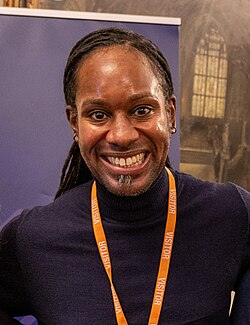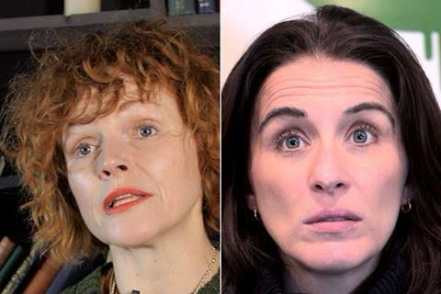
Maxine Peake and Vicky McClure
By Stefan Szczelkun
I woke up early in the morning following the film and Q&A, feeling outraged and angry. They are feelings that are better felt in the open air, in an anti-fascist protest or when resisting being kettled by police. But those are the residual feelings that I had from this film. There are three parts to my thoughts the day after seeing this film – about the film and the film-maker Mark Forbes, what the interviewees said about the film industry and class, and my own thoughts following on from the experience.
The film and the interviewees
Mark Forbes has produced a truly extraordinary collection of interviews which include such working-class stars as the outspoken Vicky McClure, made famous in the films of Shane Meadows and now a regular on primetime TV in Line of Duty. I was starstruck!
There was also the multi-talented Maxine Peake, who starred in the film I Swear last year. Directors included Kaitlyn Boxall of Remember Us (2023) and Killing her Softly (2017 TV mini-series).
Cinematographers were represented by Rachel Clark (Dune Part 1 and most recentlyF1: The Movie) and Damian Paul Daniel (Fearless). Writers interviewed were Paul Laverty who wrote I, Daniel Blake. Older actors I recognised included the stalwart Christopher Fairbank (Eastenders and others). The list goes on…. sixteen people in all.
I’m listing these people somewhat exhaustively because firstly, they are worth knowing in themselves, and secondly to underline how impressed I was that Mark had managed to interview so many significant working-class people at the forefront of the film industry, considering he was unfunded, is poor, and did the whole job single-handedly. It is a huge and almost unbelievable ‘lifetime’ achievement. To someone like myself who has made simple videos in the past it is a feat equivalent to running the length of Africa.
His finished film has been shown at a few festivals but otherwise has so far been stonewalled in terms of getting a slot on TV, getting a distributer or streaming platform. As Mark himself says, he doesn’t have ‘the right’ connections – I can relate to that! It’s not really surprising that the media execs ‘don’t want to know’. After all, this is a film that challenges the power of their class. This is where the Culture Matters community might be able to help? If any of you have got contacts with a streaming platform, please get in touch with Mark.
The film industry and class – the basics
How many state-educated people are in the UK film industry? 5% identify as working-class which is a ten-year low, and 60% report being from middle or upper-class backgrounds. Private schooling might be a more objective indicator. Private school educated people are just 7% of the population but make up 35 – 45% of the higher-level creative roles in film and TV. Also 38% of BBC executives are from Oxbridge, and 43% of all personnel were privately educated.
The feeling aired in the film is that there has been a decline of working-class representation over the last 30 or more years. There was a heyday of mostly male voices in the Sixties through to the Eighties. Jimmy McGovern was mentioned, who was part of the Federation of Worker Writers and an inspiration to me. Andrew Tiernan remembered when Albert Finney and Michael Caine burst on the scene – how they frightened the establishment with their brash confidence! The last 30 or 40 years has seen a gradual exclusion of the majority, and a quiet reassertion of the dominance of the elite.
It is 188 years since Dickens outraged the managerial class by having a boy dare to ask for, what we would call ‘seconds’. Some of the interviewees reminded me of the young Oliver – “We’re not asking for a big slice of the film-making cake, just a little bit to be fair.” He might as well have been dressed in rags and asked for crumbs! What ever happened to Shelley’s image of the working class from his Mask of Anarchy? Updated to a feminine, nurturing but fierce force that insists on collective justice – something to be taken and assumed as a birthright, rather than begged for.
Some of the interviewees did ask politely for fairness rather than angrily invoking a demand for social justice. Some people had sweet schemes to help young people gain a foothold, funded out of their own pockets, which might help a few literally poor souls to get job (a nod to Alan Bleasdale’s Yosser Hughes comes to mind). The small scale of such efforts was touching, even if it exuded vapours of pathos and the lack of collective power in the face of the scale of the problem. Vicky McLure was more positive in being clear she was talking about a working class that was ‘the majority of the population’.
Why should we still be reduced to begging for work like little Oliver Twist or Yosser Hughes? Master Twist would be 197 years old today! Let’s aim to celebrate his 200-year anniversary by agreeing to never again be begging for more. One thing working-class people are good at is understanding what is enough, and not wanting a ridiculous and obscene accumulation of goods. Collective bargaining works – the trick is to achieve the necessary solidarity and organisation.
Precarity, classism, and nepotism
People talked about the barrier of debt incurred in taking a university path into the film industry. Another hindrance is precarity – even when young people were successful in getting their foot in the door, employment is by nature so erratic it is only people with rich parents who can survive the inevitable periods of unemployment.
I suppose this points to the cause of inequality being outside of the industry, and that changing industry policies can do little to address it. But the industry, or even just the BECTU union, is rich enough to provide funds to challenge such barriers directly as well as to find the most talented and committed working-class trainees.
For working-class young people the standard approach is to get a low-paid job as a runner, and then work your way into helping in an editing suite or on location. But this can lead to dead-end commercial jobs that are well-paid but soul-destroying.
There were also more basic barriers mentioned, such as discrimination against regional accents. Traditionally you were expected to speak RP unless you are acting a working-class role, and Shona McWilliams noticed how middle-class gatekeepers would even shrink from shaking her hand in interviews.
Then there are the negative effects of keeping working-class people out of film production – an increasingly beige film culture, recently dubbed beigevision. On the other hand, when the reins are handed over to a working-class person like Stephen Graham, the whole world bows to the power of his artistry – viz Adolescence! In a recent interview he pointed out the largely unexplored humour and warmth in working-class culture, but depressing kitchen-sink stereotypes still cling on.
Maxine Peake made a good point that class oppression had to be tackled early in education – at an elementary level rather than at secondary school. This is a point echoed by Brett Gregory and is part of the remit of ScreenSkills.
It makes me smile to imagine how school inspectors would react to teaching six-year-olds about class oppression. But teaching them how to make a better video or be critical viewers is feasible. Lottery funded IntoFilm have a remit of film in education.
Another point made was that misplaced efforts at ‘diversity’ by well-meaning industry managers can actually create a barrier to working-class people. The standards of middle-class behaviours can still be applied, eg it’s OK to be black but not too ‘street’. As Kolton Lee says: “Diversity sanitises a much more unpleasant conversation!”
Getting away from the concentration of the industry in the metropolis also needs to be addressed –young people having to travel by train down from the regions, and then facing the problem of where to stay. And behind all these problems there is the invisible old boys’ club – the corrupt nepotism that hides in the shadows like an evil bass-line.
Conclusion
The frustration of working-class artistic production imposed by class oppression was perhaps first explored by US writer Tillie Olsen, who was writing about her frustrating experience of a long period of her working life in which she did not have the time or energy to write. (See Silences, 1978).
We can feel fatalistic – “class oppression will never go away”, as one interviewee says! But we need to consciously rid ourselves of belief in such self-defeating attitudes. As artists we don’t have to be overly ‘realistic’ about the difficulties we feel in shifting class oppression in our lifetime. Our job is sometimes to confront the suffering we observe in the world, to express outrage, but also to imagine a world free of class oppression, or at least heading in that direction. If our imaginative horizon is governed by our feelings of hopelessness, we can lose the will to fight back. Against this sort of discouragement, and to support each other, we also need to hold up a rational analysis based on an optimistic and factual analysis of the world.
A ‘more diverse’ film industry sounds worthy but is a somewhat limited goal. An increase in diversity can be too easily accommodated without any existential challenge to class oppression. As Vicky McClure implied, we need to organise to be a majority in the industry – including and especially at executive level.
It is McClure and her partner Jonny Owen who have recently started their own production company @byo_films with the express purpose of offering ‘equality of opportunity’. But she is not the first: Steven Graham and his partner Hannah Walters started their company Matriarch Films in 2020, and Steve McQueen had started his Lammas Park back in 2014 with a series of successful productions starting with the series Small Axe in 2020. Even further back director Shane Meadows had formed Big Arty Productions, way back in 1996. There’s a whole complex story to tell here which would go back to the radical independence of the earlier generation of Mike Leigh and Ken Loach. These related working-class artist-led production companies are a challenge to the class hegemony of the industry.
Btw look out for Shane Meadows new film Chork in 2026, his first feature in 17 years!

Mark Forbes
My question at the Q&A with Mark Forbes was this: can we defeat Reform without a mass of working-class creatives contributing to a reinvigorated working-class culture? What is the place of working-class film culture in democratic socialism? Indeed what even is working-class culture? For some insights into these issues, see these links: Mark Forbes interview and Stephen Graham interview.
The main union for the industry, BECTU, was mentioned. While Equity (another UK performing arts union) has a dedicated ‘Class Network’ that treats class as a protected characteristic, BECTU says its approach to class is integrated into its wider equalities and bargaining agenda. BECTU works with bodies like ScreenSkills to address class inequality. They have contributed to research such as the Screened Out report, which identifies class-based barriers in the screen industries and aims to set policy priorities for enhancing socio-economic diversity.
The recent hit feature film Hamnet impressively used trainees from this organisation. ScreenSkills has targets of having 25 – 40% of its new entrants with intermediate and working-class parental occupations. This doesn’t really challenge industry averages much in light of the crisis of underrepresentation. Their targets need to be 50 – 70% to really make a difference.
The commercial film industry has so many different skill sets / productive roles that come together in a production. There are reckoned to be around 24 crafts in the film industry, each one with its own conditions, levels of creativity and entry points. This complexity presents a problem when analysing conditions and organising solutions. Do the figures given by ScreenSkills even show if working-class applicants then go on to be given more of the ‘uncreative’ working-class type jobs in the industry?
This industrial scale of production is why feature films are such high stakes in the global class struggle. It’s not like an individual comedian getting on stage at an open-mic night and showing us a refreshing slice of working-class humour. One of the bits I like most about going out to the local cinema is sitting in awe as the end credits roll. With what other industrial commodity do you get to see so many workers get a name check?