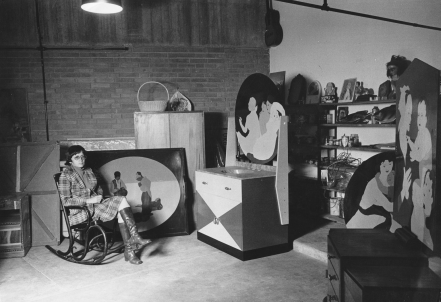
Beatriz González in her studio, Bogotá, ca. 1974. Photo: Rafael Moure. © and courtesy Beatriz González
Nick Moss reviews Beatriz González, at the Barbican till Sunday 10 May 2026
Capitalism ultimately exists as a system underpinned by force, but it presents itself as justified by a common-sense that manifests as a blur of words and images. An effective response will therefore seek to present other words, other images that seek to denature Capital’s assertion that it functions as a set of social relations that exist outside history, and without requiring either justification or reinforcement. Because the words and images change as the threats to the social order change, so must the counter-narratives we attempt also have to change in response. Beatriz González, in her artistic practice, met this challenge head-on.
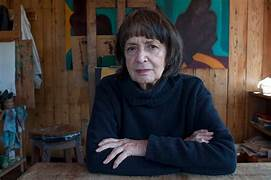
Beatriz González was born in 1932, in Bucaramanga, Colombia – and died in 2026, in Bogotá, just prior to the opening of her Barbican exhibition. Her practice revolved around the phrase ‘Art says things that history cannot’ and she used her art to refuse any collusion with and strip away the Columbian ruling class’s attempt to whitewash its involvement in the violence which was the reality of daily life for the Colombian poor.
González was focused on how images saturate our everyday life – what they reveal, what they suppress, and how art might function as a means of resistance. She collected images as a resource, from reproductions of paintings from Western art history to newspaper clippings showing violence and death. González constantly reworked and transformed her sources in a distinctive graphic style and using a bold colour palette. Her paintings used satire and fury to expose the relentless violence in Colombia, and showed how Western art was used to construct ideas of taste and value which served to disparage and diminish the creativity of indigenous and poor communities.
When González commenced her studies in 1962, at the Universidad de los Andes in Bogotá, Abstract Expressionism was seen as a sign of cosmopolitan modernity. González recognised immediately the need to reject all this and the idea that modernity was always elsewhere, of and owned by the West.
Instead, she painted a series of reproductions of Diego Velázquez and Johannes Vermeer. A poster of Velázquez’s Surrender of Breda (1635), hanging in the university studios, inspired a series of paintings in 1963 in which she worked to reproduce fragments of the painting. She stated that The Surrender of Breda wasn’t an homage to Velázquez, it was a way of painting that involved the issue of “how to copy a great work of art, how to make my own version.’’
González transformed and reworked Vermeer’s paintings of women engaged in domestic labour until they became detached from their original image, and made them into a series of studies of form and colour. In Walter Benjamin’s oft-cited text The Work of Art in the Age of Mechanical Reproduction, Benjamin states at the outset that he intends his theses to ‘brush aside a number of outmoded concepts, such as creativity and genius, eternal value and mystery.’
This is what González was also committed to, and what her focus on reproductions of works from the Western canon and her repurposing of them as decorations on furnishings is intended to achieve. She differs from Benjamin though in a key aspect of what she intends, and it is this difference that makes her works so significant. Benjamin argues that:
Even the most perfect reproduction of a work of art is lacking in one element: its presence in time and space, its unique existence at the place where it happens to be. This unique existence of the work of art determined the history to which it was subject throughout the time of its existence. This includes the changes which it may have suffered in physical condition over the years as well as the various changes in its ownership. The traces of the first can be revealed only by chemical or physical analyses which it is impossible to perform on a reproduction; changes of ownership are subject to a tradition which must be traced from the situation of the original. The presence of the original is the prerequisite to the concept of authenticity.
González, though, refuses the concept of authenticity entirely. When she reworks a painting from a European Old Master, she does not simply copy it. Each time she reproduces it, she amends it, alters it, simply by painting it afresh, and with another hand than that which painted the original. Thus, for Benjamin:
The authenticity of a thing is the essence of all that is transmissible from its beginning, ranging from its substantive duration to its testimony to the history which it has experienced. Since the historical testimony rests on the authenticity, the former, too, is jeopardized by reproduction when substantive duration ceases to matter. And what is really jeopardized when the historical testimony is affected is the authority of the object.
One might subsume the eliminated element in the term ‘aura’ and go on to say: that which withers in the age of mechanical reproduction is the aura of the work of art.
We might conceive of González’s ‘reproductions’ as in dialogue/debate with Benjamin, and the concept of the ‘auratic’ – or, more bluntly, a rebuttal of the notion of the aura of the work of art. At least insofar as the Western Old Masters carry with them the ‘authority’ of a colonising culture, and the notion of that culture having an inherent superiority.
González’s ‘reproductions’ are proof that a ‘provincial painter’, as she satirically described herself, can recreate a work of art that is lauded as an instance of Art as historical Event, can place her own mark on it, and, show that the techniques employed in the creation of the ‘original’ can be deployed as easily by the ‘colonised’. That from all of this something new can be produced, and that, in reproducing the images on items of furniture, the work of art can be reclaimed from what Benjamin calls the ‘cult value of the painting’ which is essential for its marketing as a unique commodity, and recover its utility .
González is not the only artist to have engaged with these issues, but the works on display here show that she did so with a particular lightness and wit, and with a clear understanding of the significance of her standpoint as a politically engaged female artist from a formerly colonised nation.
A great example of this is her Lacemaker Pielroja Almanac, which reproduces Vermeer’s Lacemaker against the colour bloc used by the ‘Pielroja’ cigarette brand which used a single ‘flat’ block colour as the backdrop for an image, typically of a woman smoking. González reworks Vermeer’s image against the Pielroja colour bloc.
González used photographs from magazines and newspapers to try to paint an approximation of the images that captured and manufactured the public imagination. She painted studio portraits of children, tabloid photographs of Colombia’s elite, images of saints and public heroes, victims of femicide and street shootings.
In the late 1960s, she created a series of prints from all of these to reflect the ‘temperature’ of Colombia, its ‘national reality’ – ranging from adverts to crime scenes. Of the crime scenes she stated:
What caught my attention was the presence of death, the position of the heads, or the disarray of a bedroom where a homicide had taken place.
In a sense, this was true of her attempt to construct a panorama of Columbian life in all its aspects – the presence of death, whether from poverty, from male violence, from the state, suffuses all of it. In a key painting here, she paints 3 images. They based on a photograph: Antonio Martínez Bonza, a gardener, and his girlfriend Tulia Vargas, a domestic worker, died by murder-suicide by jumping into the reservoir of the Sisga Dam, north of Bogotá.
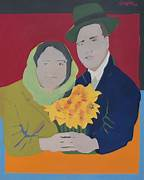
The Sisga Suicides
González became drawn to the ways in which ‘bad’ reproductions of the photograph abstracted the couple’s faces and erased any textural subtlety, and in her paintings then emphasised the compositional flatness, blocky forms and the way in which, in the reprints, the couple’s hands fused together in the foreground. Her work here, and from this point on, is reminiscent of similar explorations by Gerhard Richter and Marlene Dumas, and underpinned by her reflection that:
It amazes me how fast people forget the images from the news. The way that I fight against or try to prevent the memories from disappearing as fast is to use those images in my work. This process culminates in a work with a popular character, a monument but an ephemeral one.
Throughout her work, González flirts deliberately with notions of bad taste, inspired to do so by watching the Colombian ruling class try to co-opt the manners and fineries of the European bourgeoisie, while presiding over a state surviving on extrajudicial violence. González appointed herself the “court painter” to this class – and mocked them bitterly and relentlessly.
Satires of the Colombian ruling class
As Colombia became a zone for death squads, kidnappings and disappearances, drug mafias and cocaine terrorism, González’s paintings come to take on a particular sadness, with the belligerent satire that motivated her work, matched by a kind of awed horror.
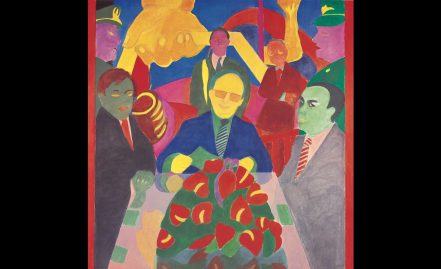
Photograph: © Beatriz González. Courtesy the artist
The painting Mr President What an Honour to Be with You at This Historic Moment (above) perhaps best illustrates the visceral angry power of her work. This painting was made in response to the Colombian military burning down the Palace of Justice after it was besieged by the guerilla group M-19. The composition draws on the imagery of colonial religious paintings that González had seen on a trip to Cuzco, Peru, in which a central biblical figure is flanked by a chorus of angels.
In González’s work, President Belisario Betancur sits at the head of the table, surrounded by members of his cabinet and the military. Laid across the table is a bouquet of anthuriums. In an earlier pastel drawing of the scene, González had depicted a charred body in place of the flowers; the body, González stated, represented the burning down of the very idea of justice. By replacing it in the painting, González intends to highlight the hypocrisy and deception of the government’s attempts to conceal its brutal role in the tragedy.
There is more, much more, that could be said about this extraordinary exhibition. González sees Colombian history as trapped between tragedy and farce, and paints it as such. She draws on an iconography constructed from the banality and violence of the newspapers and TV channels which are the flux of the war of images of daily life – a hanging boy, a murdered elderly man, a photograph of a demolished home showing the aftermath of a violent clash between military and paramilitary groups in which 20,000 bullets were fired in Saiza, a small village of only 115 homes.
González knowingly embraced what she termed the ‘joy of underdevelopment’, a reference to the deliberate repurposing of the imagery of colonialism in what she defiantly referred to as the ‘third world’ She set out to paint that joy – the joy of rebellion (“We Latin Americans have taken refuge in humour. We wouldn’t be able to survive without it”) but also to paint the pomp, the hypocrisy of the Colombian elite, and its commitment to violence as a reinforcement of the ‘grandeur of the fatherland’.
The final paintings here focus on Indigenous resistance and on mourning for all those who fall victim to extractive capitalism, as it ravages and slaughters in its glutinous celebration of environmental and social barbarism. She noted that: “upon entering death, colour changes… my palette turned towards the shadows”. If capitalism survives in part by fighting a war of images, the art of Beatriz González, in all its scabrous, mocking, beautiful fury, shows us how images can sustain resistance. “My art” she said, “recounts things that historians don’t see or cannot uncover.” It sets a challenge to all of us involved in creative practices to match her ambition, her range, and her rage.
We should note also that this excellent exhibition has been mounted by the Barbican team at a time when the Barbican has undergone real disruption, with Devyani Saltzman, the director of arts and participation at the Barbican Centre leaving her post after only 18 months in the role. To stage an exhibition of this quality and with curation that manages to set historical, international and aesthetic context with so light but yet also so informative and passionately engaged a touch, deserves real praise.