‘Come build in the empty house of the stare.’ – W. B. Yeats
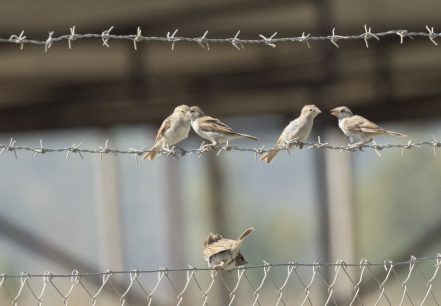
ISparrows are nesting
under the eaves again,
where the wood is rotting
and the insulation’s gone.
The nearby bank is busy with spring –
bluebells, red campion,
forget-me-nots, ferns uncurling
from hidden niches
their share of the world’s riches,
like the minerals that still might just save Ukraine –
for four years now
our villages have flown
the yellow and blue, unsure
what else to do, or how.
Years in which Hamas tore
the fragile net restraining vengeance
behind the net restraining independence.
Do sparrows nest in Gaza now?
The world seems all right or drifting so.
Though Assad’s gone and Bolsonaro,
there’s still Obiang, Afwerki, Erdogan,
Hun Sen, Lukashenko, Kim Jong-un…
little Xis, lesser Putins, the list goes on and on.
Trump’s bullying a democracy whose only sin
is being the American twin
that doesn’t admire its rage-red sibling
or its narcissistic sire. The age of the unquestioned, unquestioning egophile.
It’s simplicity again, thirties-style:
the whisper out; in the shout – all that’s made
this last one another dishonourable decade.
II
I grew up in the lucky English part
of the more peaceful second half of a war-torn century,
though the troubles in Ireland
spawned bombs on the mainland,
echoing our ancient responsibility,
while small or distant wars
in Vietnam, Latin America, Afghanistan and Africa
knocked faintly at the peeling imperialism of our Victorian doors.
During that drawn-out, cooling conflict with the USSR,
the shadows’ lengthening gentility seemed almost to admire
what little I unquestioningly inherited of the British Empire:
a relic heft, a gravitas, some sceptred grace
that was so innate it could allow its face
to be mocked by stand-ups and whatever
was left to the left of Labour.
The sun was finally setting, though, on a farce
we no longer took seriously:
hand in hand, the Raj and the British upper class
were walking into history.
Even that grammar school Tory Mrs T was a seed
fallen some distance from the Old Etonian tree.
And, by the end of her reign, there didn’t seem any need
for her Falklands brand of gunboat diplomacy.
When the Berlin Wall came down,
it felt like the ghosts of my youth had grown
as rusty as the iron curtain,
their place now taken by a certain
benign faith that the future would be
a tolerant, equal and modern Allons enfants de la Patrie…
with capitalism’s ever-promising bubble
ready and waiting beyond the rubble
to bless the newly free.
Beginnings and endings, though… always tricky.
What Empire leaves is a mask of memory,
and, underneath, all the expressions that it hid,
those mores we wore for centuries –
nationalism, racism, phobias, misogyny –
and when they go, they leave what history wants us to know.
And they don’t go straight and they don’t go so slow;
there are twists and bends, kinks in the flow,
backwaters where the shouting starts –
where Farage and BoJo wooed Britannia’s Brexit heart,
where woman-hating Tate crows
and the flashing blue light shows
that only he and white and strong can really be free
to indulge their passionate intensity.
III
We’re beginning to pay for our lack of all conviction,
though not as much as our children and their children will,
when we’re long gone who have done what we’ve done to our only home.
And did it, unlike our parents’ defence,
knowing that our eco-crime
was much nearer murder than negligence.
Who knew we’d never stop ourselves from such success,
from the plastic nature of our indulgence
and the choking ease of our well-oiled fantasies? Who’d ever guess
we’d weigh tomorrow against today
and find it so much less?
What on earth will they reflect when they
look at the mess our shameful glance
has dared to call their inheritance?
IV
I watch
the sparrows scratch
about beneath the window.
All along the hedgerow,
leaves are still opening;
insects thicken the evenings.
A little late this year,
the swallows have arrived; soon swifts will be here
on sickle wings to scream another summer from the blue.
On bad days they seem to me as I did, at twenty-two,
though I know no instinct can really be
accused of naivety.
They have only one defence who
can do no more. Nor do they need to.
It’s not up – or down – to them to care
that ‘more’ is the crown that paragons wear.
What we do – with our lands, our seas,
with those other migrants, with minorities
and those who don’t share our tastes or views
or do share our disputed borders, or who lose
the have and have-not race
or show a different faith or colour face –
what we do with those, is what we are
who could be so much more.
V
At twenty, I’d have said love was the panacea:
more emotion, more success, I thought.
But passion, like minerals, can be bought
and extremes so easily mutate
their precious loves to hate.
Beyond fifty, I beg instead for kindness to be here.
The past will always wait for us and our future must,
like sparrows’ eggs, contain some trust.
Which leaves us mired
in present complexities –
the difficulty and diligence required
by hard-pressed activities
whose once-shining dreams
are mantled by disabusing years
till nothing except nothing is what it seems:
a breeding ground for fears.
But what crooks the heart
isn’t evil or impure,
just a damage that imparts
scared or insecure
behaviour, like DNA, to any birth.
From there, un- or wrongly tended growth
breeds an unfiltered sense of worth
whose non-collective demands harm both
the self and others…
these polluted lands, their warring brothers.
But what little we know
can be added to
by the mind besieged behind its invested brow.
There’s only so much anyone can do
but, being more than a bird or flower,
that much can bring its generous relevance to bear
where thought can influence power
and mediation increase every share.
And such a gentle intelligence would show
those who trusted well enough to sow
this troubled season
with more than bitter unreason
that even an uncertain spring
will yield sweet harvesting
while some creative instinct still leaves
its shell of promise beneath the eaves.