By Geoff Bottoms
If you thought that the Social Teaching of the Catholic Church was its best kept secret, then the international movement We are Church International must surely come second. It began when delegates from ten countries, Austria, Brazil, France, Germany, Italy, South Tyrol (Italy), Portugal, Spain, The Netherlands, the United Kingdom and the United States of America, gathered in Rome from 22-25 November 1996 to further the work of reform in the Roman Catholic Church. At the tomb of St Peter, they recalled the words: “You are a chosen race, a royal priesthood, a consecrated nation, a people set apart to sing the praises of One who has called you out of darkness into wonderful light.” (1 Peter 2:9-10)
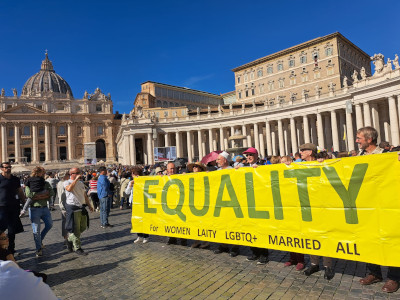
The movement is committed to the renewal of the Catholic Church on the basis of the Second Vatican Council (1962-1965) and its attempt to make the Church more democratic, accessible, welcoming and responsive to the contemporary world. It is represented in more than twenty countries on all continents and is networking worldwide with similar-minded reform groups under an International Co-ordinating Team. Campaigning on equality for all the baptised out of love and concern for the Church, it represents the “voice of the people in the pews” and has demonstrated this in several Shadow Synods in Rome.
We are Church is a response to the suffering of many in the Church who lack freedom, justice and compassion. In the spirit of Vatican II, it demands dialogue to bring about authentic renewal and substantial reform, and is taking steps to achieve these objectives immediately, in solidarity with Christians and organisations in the emerging economies and developing countries who are fighting for a Church engaged in the liberation of both women and men.
Equality, diversity and inclusion
The movement has set itself five goals: shared decision making, full equality for all genders, free choice between a celibate and non-celibate lifestyle, positive evaluation of sexuality as an important part of human beings created and affirmed by God, and Good News instead of a threatening message.
The first goal starts from the premise that all believers are of equal value and equal worth. Only in this way can the diversity of talents and charisms be fully realised again. As a result, the focus is more on gifts than roles, and therefore it rejects any form of clericalism. All the baptised must be equally represented at all levels and on all church bodies, and have a say in decision-making through appropriate democratic structures. This requires a church constitution with written rights, a separation of powers, decentralised decision making, and just procedures. Consequently the church leadership must justify its decisions with transparency and accountability, and the local churches must have a say in the appointment of bishops and be able to make joint decisions on important issues concerning them.
The second goal urgently demands access for all genders to all ecclesiastical ministries, including the ordained ministry. The exclusion of women and LGBTQ+ people from church offices cannot be justified biblically. Furthermore, the church can no longer do without the wealth of skills and life experiences of women and non-binary people.
The third goal argues that the link between the ordained ministry and the celibate way of life is not biblically and dogmatically binding, but has grown historically, and can therefore be changed. The right of congregations to celebrate the Eucharist and provide leadership is more important than any canonical regulation. The theology of the current ordination of priests is not comprehensible and creates clericalism and an exaggerated, sacral view of the functions and the persons exercising them. A different form of ordination must be developed with an emphasis on the priesthood of all believers together with the priesthood of each believer.
The fourth goal demands that a responsible decision of conscience in questions of sexual morality, such as the use of conception, sexual identity and orientation, must be recognised. Blanket condemnations in relation to premarital relationships or questions of queer identities must have no place in a community that is committed to love of neighbour. The “natural law” of binary sexuality in Catholic sexual morality must be consigned to history and adapted to modern scientific findings. The Vatican must fully support the Universal Declaration of Human Rights promoting gender equality and gender justice, and must not insist on the ideology of difference and complementarity between men and women.
The final goal emphasises that our Christian message should prioritise helping and encouraging support and solidarity over fear-inducing and restrictive norms. What is largely happening at church community level should also be demanded of church pronouncements when dealing with people in difficult situations as in the case of remarried divorcees, married priests without ministry, and LGBTQ+ people. Instead of condemnation and marginalisation, there needs to be more understanding and willingness to reconcile and encourage.
The slow march towards synodality
Things are beginning to change in the Roman Catholic Church with the synodal process launched by the late Pope Francis which aims to bring bishops, clergy and laity together to listen to one another and discern the way forward for the Church. It is a process that began in October 2021, culminating in two major assemblies of bishops in October 2023 and 2024, and is currently in a three-year phase focusing on the evaluation and implementation of the Synod’s final document, leading to a major Vatican Assembly in 2028.
While a synodal way of working is now seen as the way forward for the whole Church, there are disagreements on how that might be organised. The recent differences of opinion between the more progressive German bishops and the more conservative Vatican power structure indicate that it won’t all be smooth sailing. It will be interesting to see how this plays out now that the Bishops and Laity have agreed to set up a Synodal Conference, where clergy and laity will have equal representation, when dealing with and adopting decisions on important issues of the Catholic Church.
There are similar tensions concerning the issue of women’s ordination to the diaconate which was a subject of recent synodal deliberations. We Are Church International is very disappointed with the Final Report for Study Group 5 on Women that will be submitted to the major Vatican Assembly in 2028, which concludes that the time is “not yet ripe.” The long report makes no reference to the many women who have been serving parish communities without priests as ‘Pastoral Assistants’, or those women with vocations to ordination who have been seeking equality for more than 50 years.
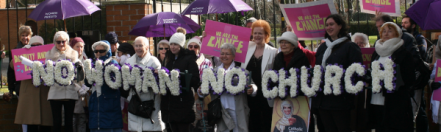
In response the movement is calling on Pope Leo XlV to promote the ordination of women, to ensure that all ministries and offices are based on the common dignity of baptism, personal competence and charisms, and has pledged to continue working and praying for the full equality of women at grass-roots levels where real reforms are taking place.
Similarly, opinions were divided when Pope Francis issued a narrowly-defined declaration in December 2023, titled Fiducia Supplicans, which formally permits priests to offer informal, non-liturgical blessings to same-sex couples, although with several caveats. Blessings must be spontaneous and cannot follow a prescribed church ritual or official handbook. They should never be performed in conjunction with a civil wedding or civil union ceremony. Priests cannot use clothing, gestures, or words that are characteristic of a wedding. Furthermore, Pope Francis specified that the blessing is for the individuals seeking help and closeness to God, rather than for the “union” itself. While attempting to be sensitive to the pastoral needs of gay couples, and gay people in general, this hardly goes far enough, and shows there is still a long way to go in addressing the reforms demanded by We Are Church International.
Grassroots cultural democracy
In conclusion it would appear that the vision of the Second Vatican Council has yet to be fully realised, although a Third Council may be needed that is truly ecumenical and embraces all the Christian Churches. Certainly that was the vision of the manifesto drawn up in Rome by We Are Church International on12th October 1997, when it proclaimed that:
We have a dream that the third millennium will begin with a truly ecumenical Council of all Christian Churches, which will regard each other as equals in their search for peace and friendship among themselves. This will be a Council marked by dialogue and respect for all religions – at the service of the world. We support the call of the World Council of Churches to launch, in the year 2000, a process leading to a truly universal Council.
That did not happen, yet the challenge posed by We Are Church International remains and its work continues. While cultural democracy has yet to hit the Catholic Church at the highest levels there is movement at the grassroots level, which is always the catalyst for change. John Churchman sums up the hopes and aspirations of the movement when he writes that:
…a truly Catholic parish is a joyful Christian community which celebrates the loving word of God in worship and in action, transcends traditional boundaries and welcomes those who seek spiritual growth and social justice, welcomes diverse ideas and encourages reflection on the message of the Gospel, is committed to the equality of all and strives to ensure full participation through liturgy, education and service, and seeks to empower all to grow in wisdom and bring to reality the promise of Christ.
Over to us!