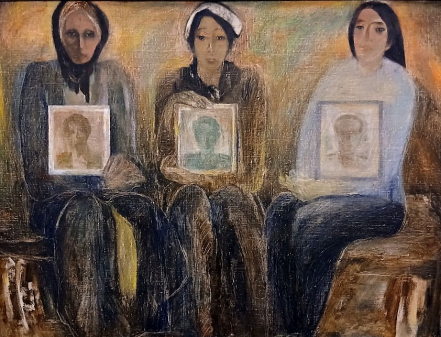
Dang Duc Sinh, oil on canvas, “In each hamlet”
Article and all photos by Caoimhghin Ó Croidheáin
The Vietnam National Museum of Fine Arts is housed in a beautiful building in Hanoi and contains many treasures of Vietnamese cultural history. Some of the art on show in particular reflects the Vietnamese national struggle of the last century against colonialism and imperialism. This art is notable for its depiction of the life of Vietnamese workers and peasants during these difficult times. Despite the controversies that inevitably surround a political movement or the state’s emphasis on a particular ideological approach to culture, whether it be Modernism, Social Realism or Socialist Realism, the art itself reflects and reveals much of the broader political, economic, and educational aims and policies of its leadership:
This artistic choice wasn’t merely aesthetic. It reflected a broader philosophical framework that dominated Vietnamese art during the war years: socialist realism, an artistic doctrine imported from the Soviet Union that would shape Vietnam’s cultural landscape for decades to come.[…] This artistic movement found fertile ground in Vietnam through the efforts of Trường Chinh, the Secretary General of the Communist Party of Vietnam from 1940 to 1956. His 1948 speech, “Marxism and Vietnamese Culture,” definitively declared that “in our era, the revolutionary culture is the socialist realist culture.” This pronouncement would shape Vietnamese artistic expression for generations to come.
Early developments
Earlier in the 20th century art had a mainly decorative function as paintings and carvings were designed and made for local temples and pagodas. In 1925 the Ecole des Beaux-Arts de l’Indochine [EBAI] was set up by Victor Tardieu, a French academic and naturalist painter. The idea was to train artists in art history and technical courses like oil painting and perspective. Oil painting was a new medium and French styles of form and content were taught. Traditional lacquer painting and silk painting forms were turned into fine art mediums to very successful effect.
By 1945 Hồ Chí Minh, Vietnamese communist revolutionary leader of the Việt Minh Front, declared independence on 2 September 1945, proclaiming the Democratic Republic of Vietnam. France then consolidated power by asserting its colonial dominance over Vietnam leading to the First Indochina War in 1946.
National Art
The EBAI was closed down at this time an artists joined the resistance against the French and moved from romantic realism to modern realism…..
focusing solely on the inspiration and needs of the revolution and being appealing and educational to a majority of people. Hence artists like Nguyen Hiem, Nguyễn Sáng, Phan Văn Đôn and Trần Văn Cẩn created works that depicted the countrysides, portraits of peasants, soldiers battles scenes, they uphold the belief that artist should show the reality of society instead of idealised imageries.
The three media, Lacquer, silk and oil medium, were taken up and transformed into “national” art so that in form and content they became important tools in the struggle against colonialism and imperialism.
These radical paintings depicted Vietnamese people in difficult situations defending themselves and their families against dominant and powerful enemies with superior weapons and military hardware.
Not only was the resistance depicted in various operations and situations, but the important role of women was emphasised in many paintings.
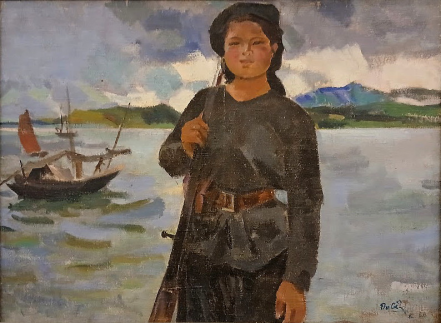
Trần Văn Cẩn, painting, “Militia women of a coastal region”
For example, in Trần Văn Cẩn’s painting, “Militia women of a coastal region”, a female guerilla is depicted as a strong figure with an unafraid gaze ready to get involved in direct action. The sea and the land is depicted with a typical local sail boat. These are the characteristics of the new national art emphasising the moral and legal ownership of the land and its coasts by the Vietnamese people.
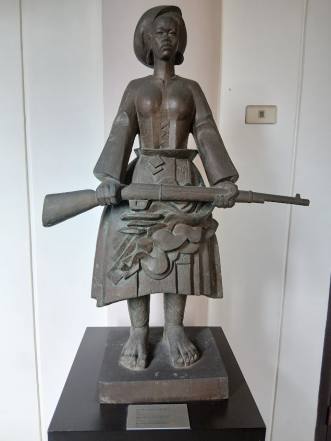
Vi Thi Hoa, Bronze, “Militia woman of the highlands”
Similarly, in “Militia woman of the highlands” by Vi Thi Hoa, a peasant woman without shoes is presented in a strong, unyielding stance holding her rifle with both hands in front of her. Its form is a mixture of the stylisation of early forms of Vietnamese sculpture combined with the socialist realist aesthetic of people confronting oppression, (as opposed to the unfortunate aspect of social realism that tends to depict people in their most downtrodden and dispirited of situations).
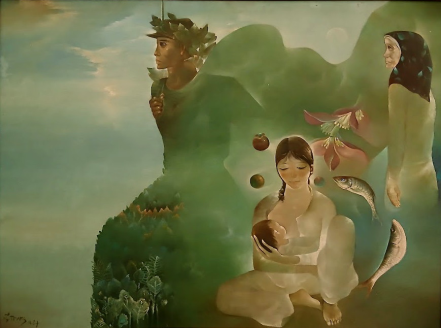
Nguyen Trung, oil on canvas, “Portrait of soldier”
In “Portrait of Soldier” three women are depicted in a manner similar to the pagan concept of the goddess as the maiden, the mother, and the crone. However here the maiden is no innocent wallflower. She is youthful, strong and protects the mother (with her child) and the older generation. As in pagan ideology, nature is represented as being protected, while at the same time, part of the three women. Trees, plants, fruit, flowers, and fish, the essence and sustenance of life, i.e. Nature itself, is being protected in this circle of life painting.
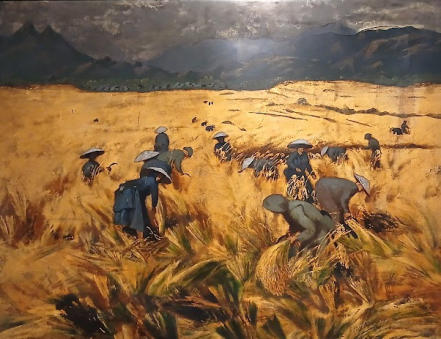
Phan Ke An, Lacquer, “Harvest in Viet Bac”
In the Lacquer painting, “Harvest in Viet Bac”, the richness of the Lacquer medium itself becomes evident. The golden harvest lacquer almost looks like gold-leaf, reminiscent of the medieval European paintings with the shine of gold leaf in the background. The emphasis on the hard work and necessity of bringing in the harvest for the sustenance and continuation of the struggle is evident here. This painting stands in stark contrast to Jean-François Millet’s painting, The Gleaners (Des glaneuses) from 1857, where the women compete with the crows and pigeons for the last remaining grains left by the harvesters who invariably at the time would have been working for the local big landlord.
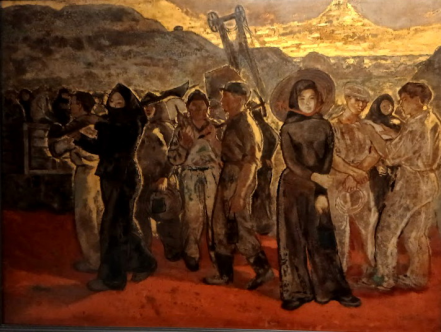
Nguyen Sy Nuoc, Lacquer, “A work shift ended”
Here in “A work shift ended” the light contrasts that are almost glowing in the Lacquer medium emphasises the sunset, as the workers, male and female, are preparing to go home from a long day’s work shift. The emphasis on tools and machinery stresses that the workers are involved in some kind of industrial production like mining. The atmosphere is one of collective work with no obvious boss or bosses depicted.
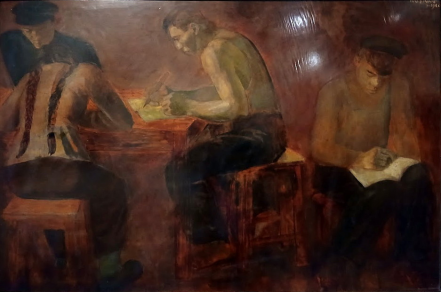
Nguyen Sang, Lacquer, “Study time”
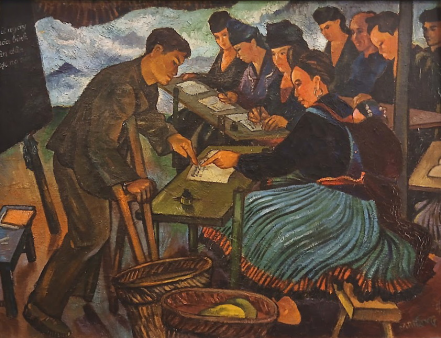
Mai Long, oil on canvas, “Class of H’Mong ethnic children”
Another important aspect of the national art ideology is education. Many paintings depict workers and peasants reading and writing together in classes and makeshift buildings showing that education was considered an important part of the national struggle. All kinds of people are shown from mothers with their children, young men, and members of a different ethnic group.
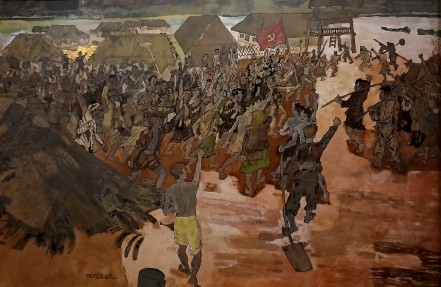
Nguyen Tu Nghiem, Lacquer, “Farmers struggle against taxation”
Collective struggle is also shown in strikes and demonstrations for causes, giving people agency and the desire to fight back politically as well as militarily. Solidarity and unity is a strong tool against the endless forms of divide and rule used against people to deny any form of resistance to oppressive rule.
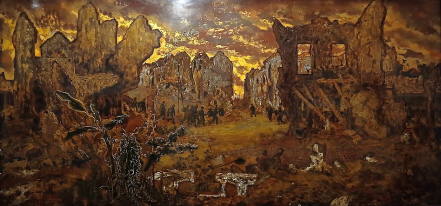
Le Quoc Loc, Lacquer, “Resistance War”
However, the necessity for constant struggle which has wreaked destruction on the people in the resistance forces is a constant reminder in the paintings. Scenes of destroyed villages and towns, such as “Resistance War”, make us aware of the heavy toll the war is having on the people.
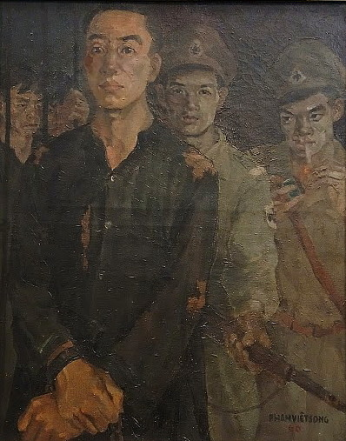
Pham Viet Song, oil on canvas, “Hoang Le Kha on the way to the execution ground”
Scenes of death, execution, and the memory of lost family members are some of the most evocative paintings of this style. In “Hoang Le Kha on the way to the execution ground” a captured prisoner is directed by men with rifles to his execution. His face and hands have colour and he has a look of resigned determination, while his captors are in grey tones.
The losses are felt deeply as “In each hamlet” as three women hold up pictures of those killed. The extent of the war is shown in the title of the painting as every small hamlet and town is affected by the conflict. The colours are muted reflecting more sadness than anger. The repetition of the theme implies multiple and extensive loss of life.
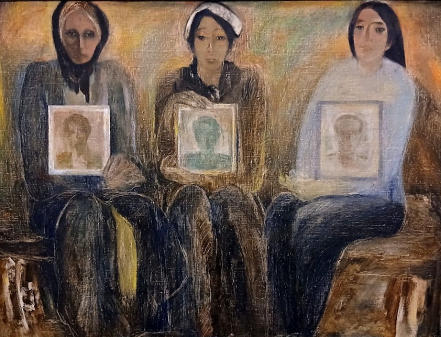
Dang Duc Sinh, oil on canvas, “In each hamlet”
The movements that produced such art in Vietnam have their own complex political background but the universal impact of such depictions of struggle and resistance war against colonialism and imperialism rises above local politics:
The legacy of socialist realism in Vietnam is complex. While officially abandoned after the country’s 1986 economic reforms (Đổi Mới), its influence on Vietnamese artistic expression persists. The movement’s emphasis on collective struggle and historical progress helped forge a national identity during times of war, even as it sometimes silenced individual voices.
These paintings serve as a reminder of the way art can filter and concentrate the many different aspects of struggle against the destruction by far superior forces that even today are seemingly unstoppable. They depict sadness and horrors but at the same time show tenacity and strength, as well as unity and determination that in the end is almost impossible to destroy.