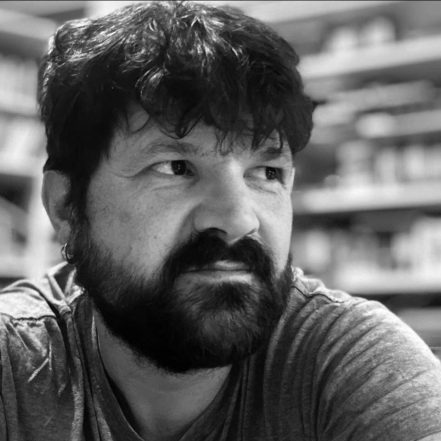
There is a long tradition of working-class poetry in Italy. Worker-poets like Sandro Sardella, Luigi di Ruscio and Tommaso di Ciaula described the reality of factory work in the post war period through powerful free verse poetry. Matteo Rusconi is a leading working-class voice in Italy’s contemporary poetry scene. His 2021 collection Swarf (Truccioli) describes the reality of factory work in the 21st century with intensity and humour. These four poems are the first ever translation of Matteo’s work in English.
Translation from Italian into English by Francesco Sani
#44
I carry home the noise of the factory
like a veteran carries inside
memories of war.
Under the shower again I find
screeching metal
smashing hammers
and my hair covered in the swarf of an iron Christ.
The cycle time matters more than my soul;
speed is everything
progression is everything
and me aging is nothing;
I am but replaceable gearing.
I carry home the smell of the factory
like a dog coming back after a swim in the sewers
and by the gate I often think
of the time wasted in there
of Prévert’s poem in my locker
of the sun burning on my shoulders
now that solvents have taken care of my skin.
—
Mi porto a casa il rumore della fabbrica
come un reduce porta dentro di sé
il ricordo della guerra.
Nella doccia ritrovo
lo stridere del metallo
il battere del martello
e tra i capelli ho sparsi i trucioli di un cristo di ferro.
Il tempo ciclo è importante più dell’anima,
la velocità è tutto
gli avanzamenti sono tutto
e il mio invecchiare è il niente,
io sono solo un meccanismo sostituibile.
Mi porto a casa l’odore della fabbrica
come un cane che ritorna da un tuffo nella fogna
e sul limitare penso spesso
al tempo perso là dentro
alla poesia di Prévert nel mio armadietto
e al sole che brucia le spalle
mentre alla mia pelle ci ha già pensato il solvente.
Paper Flower/Fiori di Carta
Ai lavoratori della ditta Lamina
morti per un incidente sul lavoro/
For the workers of the Lamina factory
who died in a workplace incident
Ten hours locked
inside the walls of a factory
force me to forget
what air is made of.
What now fills me from head to toe
is not oxygen, for the most part
it’s rotten water spilling
from the sink on a steel container
the hair in my nose
threads of rust and swarf.
My callus talks
of a calm cold-minded boss, a plate
of tempered steel.
Ten hours of work
locked in a can of waste oil
they help forging and
quenching this steel sheet
while I run after the last bit of fresh air
by the large windows of concrete and glass.
Tomorrow under the shade of a paper flower
I will be a petal of burnt wood pulp;
tomorrow under the shade of a wheat field
I will take my rest to stop
the dampness of metal from corrupting me.
—
Dieci ore al chiuso
tra le mura di una fabbrica
mi costringono a dimenticare
di cosa sia fatta l’aria.
Quello che mi riempie fino ai polsi oramai
in gran parte non è più ossigeno,
è acqua che cola marcia
dal rubinetto del cassone del ferro.
I peli del mio naso
sono fili di ruggine e truciolo
e i calli mi parlano
di un padrone lucido e freddo, una lamina
di acciaio temprato.
Dieci ore di lavoro
chiuso in una latta di olio esausto
mi aiutano a forgiare
la tempra di questo foglio
mentre lungo i finestroni di cemento e vetro
cerco l’ultimo respiro buono.
Domani, sotto l’ombra di un fiore di carta
sarò un petalo di cellulosa esplosa;
domani, all’ombra di un campo di frumento
riposerò per non essere più corrotto
dall’umidità del metallo.
Pimples/Brufoli
We are blue collars in boiler suits,
a red shirt in the summer
a red hoodie in the winter.
Everything is curtesy
of the firm.
If you look closely
all dyed in the same colour
we look like blood cells,
blood running through fingers.
We look like fingers crushed
by heavy mallets,
hands torn open by burning-hot swarf.
Our contracts like branding iron
like cows we roam pastures
and we are red like pimples,
like the cranberry juice
I drink every morning.
—
Indossiamo una tuta blu,
una maglia rossa in estate
e una felpa rossa in inverno,
tutto cortesemente sponsorizzato
dall’azienda.
A guardarci bene
con questa tinta di ordinanza
sembriamo globuli del sangue,
il sangue della ditta.
Sembriamo dita schiacciate
dalla mazza pesante,
palmi lacerati da trucioli incandescenti.
Indossiamo il marchio del contratto
come vacche al pascolo
e siamo rossi come brufoli,
come il succo di mirtillo
che a colazione mi bevo.
I don’t know what will remain of this phoenix day
that started with a dream crumpled on the bedside table
and with mosquitos smashed against the plaster on the walls.
For sure, sweat will remain on the bedsheets
the heat that roams free in the warmer hours
and the oily stains on the coverall left to rest
in the bathroom – where it won’t offend the nose.
Maybe some iron filings will remain on the shoes
a few cuts at the edge of the nails
a mark on the planner to note overtime hours
the last piece the CNC released
and scraping paste for the grinding wheel mixed with fine dusts:
leftovers will remain to be scraped off
with a hand-sharpened blade – like ye olde knife grinder.
I do not know what I’ll leave behind after my shift
perhaps the silence of oil pipes
perhaps the inflatable noise of the broken steamroller
or maybe a jungle of vines made of metal.
Maybe a dirty tissue will remain, left on the floor
to prove that I was there.
—
Io non so cosa resterà di questa giornata fenice
cominciata con un sogno accartocciato sul comodino
e con zanzare spiaccicate sull’intonaco delle pareti.
Di certo rimarrà il sudore sulle lenzuola
l’afa che nelle ore più calde si sprigiona
e le macchie oleose della tuta blu lasciata riposare
in bagno, dove non intacca la sensibilità dell’olfatto.
Resterà forse un po’ di limatura sulle scarpe
qualche taglietto ai lati delle unghie
ore di straordinario sul calendario segnate.
Probabilmente avanzerà sul tavolo
l’ultimo pezzo dal CNC uscito
e l’abrasivo della mola mescolato a pulviscolo vario,
rimarrà un residuo da raschiare via
con una lama affilata a mano – in arrotino’s style.
Io non so cosa lascerò a fine turno
forse il silenzio delle tubature dell’olio
forse il respiro pneumatico del compressore malandato
oppure una giungla di liane composte da materiale ferroso.
Può darsi che rimanga un fazzoletto sporco, caduto a terra
a testimoniare il mio passaggio.
Author’s notes:
#44
The poem #44 is titled after the code I digit on the shift register at the start and end of every shift. The poem by Jacques Prévert I refer to in the text is Lost Time./ La poesia #44 prende nome dal codice che digito sul marcatempo a ogni inizio/fine del turno di lavoro. La poesia di Jacques Prévert citata nel testo è Il Tempo Perso.
Paper Flower/Fiori di Carta
Paper Flower was written to honour the memory of four workers who lost their lives on January 16, 2018 at a plant belonging to metal-processing firm Lamina, Milan, due to a leak of argon gas from a furnace tub. The title references the poetry collection Fiori di Carta (Paper Flowers) by Sandro Sardella./ Fiore Di Carta è stata scritta in ricordo di quattro operai che il 16 Gennaio 2018, presso l’azienda metallurgica Lamina di Milano, morirono per una fuoriuscita di gas argon nella vasca di un forno. Il titolo si rifà alla raccolta Fiori Di Carta di Sandro Sardella.