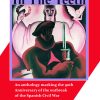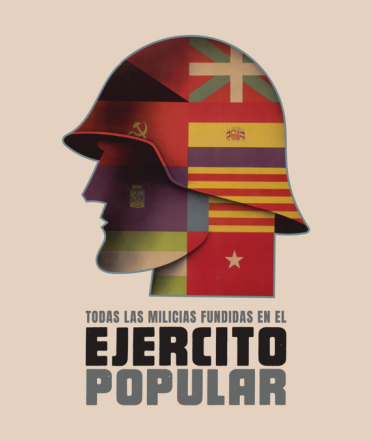
Poster: ‘All militias are merged into the People’s Army’
Mark Perryman celebrates the fusion of progressive politics with visual art
90 years ago, on the 17th July 1936, the mutinous General Franco launched his coup, backed by substantial numbers of the Spanish army he commanded, to overthrow the elected Spanish government. He was almost immediately back by his fascist co-thinkers, Hitler and Mussolini, with decisive military support to follow.
1936 was the height of a politics known as the ‘Popular Front’, uniting whoever was against fascism, with all those involved willingly putting their own politics aside for the single cause of stopping the march to power of fascists right across Europe.
The recruitment poster for the Ejercito Popular was emblematic of this. Ejercito Popular, a ‘people’s army.’ Todas las milicias fundidas en el Ejército Popular, ‘all militias merged into the people’s army.’ The soldier’s helmet vividly illustrates this. The symbols of the anarchist CNT-FAI alongside their deadly rivals’ hammer and sickle of the Spanish Communist Party and wider international communist movement.
Those rivalries still erupted on occasion but for the most part were subsumed into the greater cause, that of defeating Franco. And across the helmet the various flags of the Spanish regions including Basque, Catalan, Andalusian. Regions, the Basque and Catalan in particular, fiercely independent yet united for the Republic’s survival.
The Popular Front as a cultural front
This wasn’t simply a political unity, the Popular Front was deeply rooted in popular culture too. 1936 was also the year of the Berlin Olympics, the Nazi Olympics, presided over by Hitler, on the eve of the Holocaust, with the international Olympic movement in full collaborative mode.
Meanwhile in Barcelona the ‘ People’s Olympics’ was taking place. The Spanish Republican government had refused to send a team to Berlin Olympics, which they correctly surmised would be used to sanitise and propagandise the Nazi regime. Instead, they organised a ‘People’s Olympics’ in Barcelona, joined by 6,000 athletes from across the world.
The day before the opening ceremony Franco launched his murderous attack on the Republic, and started the Spanish Civil War. The Barcelona Games were cancelled; the athletes were forced to leave but some chose not to return home but to join the International Brigades in their battle for Spain’s land and freedom. Sport was popular culture, and was recognised and mobilised by the Popular Front as resistance.
Within months, and without the aid of television news let alone the internet and social media, Spain became the global epicentre of the Popular Front. The Ejercito Popular joined by the International Brigades – volunteers making their way from across Europe, America, Canada, Australasia.
They were invaluable reinforcements, yet like the Spanish volunteers mostly with little or no military experience. It is hard to imagine now the extraordinary act of courage involved in taking up arms to fight the trained army Franco had at his disposal. An act of bravery framed by political commitment or desperation – or both.
Add to this the significant and sophisticated support for Franco provided by Hitler and Mussolini. The bombing of Guernica in 1937 was a bloodied dress rehearsal for the blitz the Luftwaffe would inflict on London and other English cities just three years later, in 1940-41.
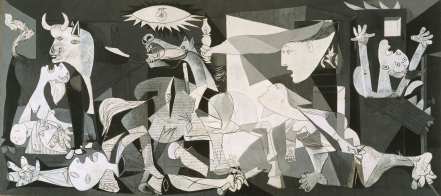
Picasso’s painting of what Guernica suffered is the most powerful painting imaginable of the devastating consequences the inhabitants of this city suffered. But for Picasso this wasn’t simply about ‘great art’ but framed by his own politics:
Painting is not done to decorate apartments. It is an instrument of war.
Art at war, with war. The Popular Front was a Cultural Front too, not as an added extra but theorised and practiced as a central part of ‘doing’ politics.
In this regard it is entirely fitting to mark the anniversary of the Spanish Civil War via an artful recruitment poster for the Ejercito Popular, designed by Emetrio Melenderas, a Spanish graphic artist who produced posters for the Republican cause during the Civil War.
Menderas like many artists, poets, musicians, writers and more, put his art at the disposal of the Popular Front, not in an instrumental way but to add another dimension to the resistance. Ejercito Popular, his most famous work, comprises the breadth of the Popular Front, from communists and anarchists via Basque and Catalan separatists to Spanish republican nationalists. For once, together as one, on a helmet, worn to save lives whatever their differing beliefs.
In later work during the Civil War Melenderas used his artistry to celebrate the Popular Front unity of nationalism and internationalism, when in October 1936 the International Brigades were formed to join Spain’s battle to defeat Franco’s insurgency. And again, the breadth of this resistance reflected in his ¡Movilizacion! poster beautifully captured the desperate need to recruit women for a vital part of the resistance, as farmers to grow and harvest the crops that could feed the Republic. A vital effort repeated just a few years in war-torn Britain, with the Women’s Land Army.
Didactic, instrumentalist, purpose-driven? Yes, this art was all of those things. But at one and the same time of the highest imaginable aesthetic quality, beautiful on its own terms, drawn, painted and produced for the cause in its own unique way not to serve as a necessary add-on.
Such a combination of progressive politics and art was rare in the political culture of those days, as it is, sadly, nowadays. In a word – or three to be precise – it shouldn’t be. ¡Viva Emetrio Melenderas! ¡Viva Ejercito Popular!
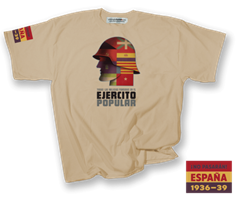
Exclusive to Culture Matters Ejercito Popular T-shirt is available at £10 off — quote coupon code EPCM from here.