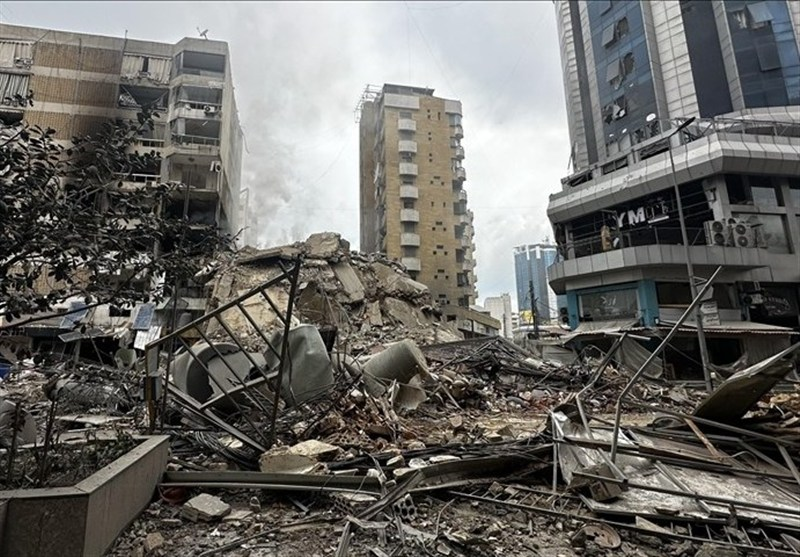
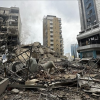
A mosque destroyed in the Jabalia area of the Gaza Strip. Commons image by Jaber Jehad Badwan
By Richard Penderyn
Last year a letter I co-authored on the destruction of cultural heritage in Gaza was shared on LinkedIn. The text that follows here is written by me alone, inspired but that letter, but also making additional arguments around the class nature of the destruction.
In the past two years the world has witnessed the shocking loss of human life in Gaza and the ongoing genocide. As cultural workers we can talk about the protection of heritage, the material aspects of stone, ceramic, wood and parchment, and it all sounds trivial in comparison to the tragedy of genocide. But the destruction of heritage should not be seen in comparison to genocide, it should be seen as part of it.
Both Palestinian governing bodies and the State of Israel have a share of the blame for the loss human life and for the loss of cultural heritage. That share however is not equal. The State of Israel is the dominant power by orders of magnitude and therefore carries the largest degree of responsibility. This is at a time when journalists have either been excluded from Gaza or killed if already there and Israeli citizens continuously protesting against the genocide.
The destruction of heritage in Palestine did not start in 2023
The book Forgotten: Searching for Palestine’s Hidden Places and Lost Memorials by Raja Shehadeh and Penny Johnson (reviewed by the Morning Star in May 2025) was written during a visit of the authors to Palestine before the conflict of 2023 started. It describes the systematic destruction of heritage sites and monuments since the mid-20th century. The recent destruction of sites and monuments in Gaza was not triggered by the recent conflict, it is part of a process that has carried on for many decades.
The Palestinian authorities have a share of the blame in terms of not making enough provisions for protecting heritage sites, but the main reason for this destruction is a concerted plan by the State of Israel. In 2022, the group Forensic Architecture undertook an investigation on Israeli military targetting archaeological sites in Gaza. They reported evidence of repeated bombings from 2012 that have caused progressive damage to the sites. An update by the same team about a year later refers to complete destruction of the same sites.
Eastern Mediterranean cultural heritage sites
The area of Palestine has been a place of human activity for a very long time. It includes Prehistoric, Ancient Egyptian, Hellenistic, Roman, Byzantine, Arabic, Ottoman as well as early Jewish sites. It is host to sites from a range of cultures – not only Arab/Muslim – including the Greco-Roman harbour of Anthedon, the Monastery of Saint-Hilarion (3rd century AD), the Greek Orthodox Church of Saint Porphyrios which dates from the 5th century AD, and many more. Arab/Muslim cultural heritage sites are mainly targetted and destroyed in Palestine but the destruction is not limited to sites from a specific culture.
A recent report by the United Nations Human Rights Council lists the sites that have been confirmed as damaged or completely destroyed. Emek Shaveh, an Israeli NGO working to protect cultural heritage sites reported on the destruction of the Omari Mosque and more recently on the attack of the Holy Family Church. The Arab group of the International Council on Monuments and Sites, an international NGO working for the protection of cultural heritage sites, provided another list of sites that have been deliberately targetted. Other reports include:
- Total obliteration: A report on the destruction of heritage monuments, sites, and artifacts in Gaza (vol 4)
- A requiem for Gaza’s iconic sites, destroyed in the war
- Gaza City archives among heritage sites destroyed in Israel-Hamas war
- Widescale destruction of cultural heritage in Gaza
- Israeli Damage to Archives, Libraries, and Museums in Gaza, October 2023–January 2024
- Palestina heritage reports – Heritage for Peace
- A ‘cultural genocide’: Which of Gaza’s heritage sites have been destroyed?
Land and class
The identity of people is shared with the identity of place. People who migrate often experience trauma and people who return after a long time to the place they grew up experience intense emotions. The land offers the necessary resources allowing people to prosper and develop, such as good soil and water for olive groves. Children growing up in a place experiencing their parents and communities care for the land, develop strong affection to it, continuing the tradition of generations and thus becoming members of these communities. Cultural heritage sites dating centuries or millennia are completely connected to the natural environment – local trees, plants and animals – and form part of the identity of a place. The identity of people is destroyed when the place is destroyed as younger generations no longer have reference points to their traditions.
Powerful states and colonialism
Colonialism is a brutal act of occupation, enslavement and extraction of resources through the use of force. Colonialism is led by states or proxy states with military capacity and intention to colonise. That intention stems from the objectives of the ruling class of the colonising state. Typically the objectives are to control more land alongside the land’s resources, such as fresh water for profit-making and better return for investment.
Controlling people is possible through financial pressure but it often ends up being done through force and war, as is the case in Palestine. War means brutality, and under normal circumstances the citizens of any state, including Israel, do not wish to see people being enslaved and/or treated with brutality.
Therefore, the ruling class embarking on colonisation has a problem: How does its state hide colonialism?
Two strategies have been employed:
a) Secrecy: the state as a tool of the ruling class keeps the general population in ignorance of its brutal acts. This is also the reason why journalists have been banned from or murdered in Gaza.
b) Devaluation: the state develops a narrative that reduces the colonised people into beings without the same rights as its own citizens.
These two strategies are used in combination until the ideas of colonialism become normalised among citizens of the colonising state. By reducing the value of the colonised people, the value of their culture is also reduced and vice-versa. The material evidence of that culture, the archaeological sites, temples, churches, historic buildings, etc., becomes less important and eventually its destruction becomes insignificant. But the reverse is also effective: by destroying historic sites of a people, the value of the creativity and humanity of this people reduces, the identity of their place is lost, thus their exile from their land seems less important.
The systematic destruction of cultural heritage sites in Palestine is an attempt by the Israeli ruling class to diminish the creative achievements of Palestinians, reducing them to sub-humans and to modify the land to such an extent that the identity of Palestinians in that land is destroyed.
Other Mediterranean countries
If the Israeli ruling class is colonising the land of Palestine and exiling and killing Palestinians, what is the purpose of indiscriminately destroying Roman, Hellenistic, Byzantine or Ottoman sites in addition to Mosques? Many of these monuments are culturally linked to Mediterranean countries that are actually supporting Israel in the acts of genocide (see for example the extensive development of relationships of the Greek state with Israel during the recent conflict). Why would Israel destroy those sites? There are a few points to make here:
a) There are no meaningful lines to draw between cultures. Labelling something as Roman or Byzantine or Arab is somewhat meaningless. Palestinians are primarily Arab Muslims but they are the custodians of all sites of their land regardless of faith. Destroying non-Muslim sites is part of erasing Palestinian identity.
b) The non-Muslim communities in Gaza are affected in the same way by the cultural genocide regardless of the position of the Mediterranean states that they may be culturally associated with. For example, prior to being attacked by the Israeli army, both the Greek Orthodox Church of Saint Porphyrios and the Greek Orthodox church cultural centre were used as shelters for Palestinians, an action to which the Greek state, in the best case scenario, would remain neutral. An attack to Gaza’s only Catholic church after it was used as a Palestinian refugee centre was obviously condemned by the Vatican but only triggered a minor complaint by the far-right Italian government (which arguably shares the position of the Israeli government in many areas). In short the Israeli state sees any grassroots support for Palestinians as a barrier to the genocide and while it does not prioritise attacks to active sites linked to other cultural traditions, it clearly considers those as trivial collateral damage.
c) The ruling classes of the countries that are associated with non-Muslim sites in Gaza have nothing to gain from the sites under attack. For example the ruling class of Greece has to balance the potential profit from an energy deal with the state of Israel against the damage of sites in Gaza for which there is no scope for any economic benefit. Why would the ruling class care about sites and monuments when they are aiming for large profits doing business with Israel? The Israeli ruling class know very well that destroying sites linked, for example, to Greek culture is not a significant concern as there is no meaningful opposition from the Greek ruling class.
d) Perhaps the most important point is that the ruling class of Israel at this stage only has one objective: to ensure that there are no claims made to the land in Gaza and Palestine more broadly, so that any future investment on the land by them is safe. Wiping cultural heritage sites is equivalent to “clearing the map”, or rather clearing all the material evidence of any historical claim to that land: “There is nothing here to indicate historical presence of Arabs”. Without any material evidence preserved, the next step, as described in Shehadeh’s and Johnson’s book, is simply to be quiet about any history that may have existed. For example, important Palestinian sites are no longer shown on Israeli maps. Within a generation, all will be forgotten.
Therefore in addition to systematic racism, the destruction of cultural heritage sites in Palestine also has a solid cause on class conflicts, with the ruling class of Israel ensuring that their ownership of Palestinian land is secure from any claims of historic occupation by the Palestinian working class or in fact the Palestinian ruling class.
The role of cultural workers
The Hague Convention for the Protection of Cultural Property in the Event of Armed Conflict in combination with the subsequent Rome Statute of the International Criminal Court, state that the destruction of cultural heritage is a crime against humanity. Israel has not ratified the Rome Statute and they are not bound by it. This fact alone shows the intention for cultural genocide.
While the global community of heritage professionals works through conventions and preservation charters, the reality is that the only effective resistance is to ensure that the ruling class of Israel cannot benefit from the land of Palestine. This can be done in two ways:
a) by maintaining records of sites that have been destroyed with references to the land that they existed, so that the history of these sites is preserved through documents. As the references in this text show, scholars already engage in this work.
b) by applying pressure to the UK ruling class and the state (both the Westminster Government and the devolved Governments of Wales and Scotland) to interrupt any profit-making activity with the state of Israel or Israeli companies that make profits from Palestinian land.
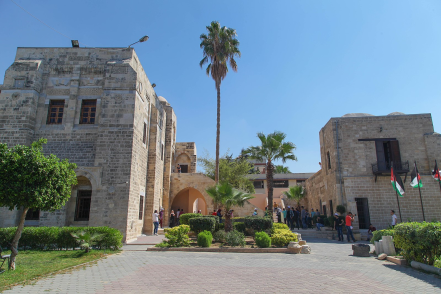
The Pasha Palace Museum, Gaza, before destruction. Commons image by Ramez Haboub