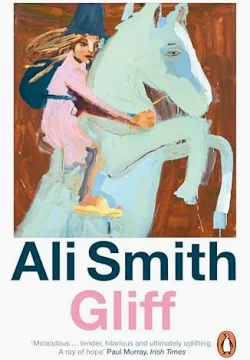
Gliff, by Ali Smith, Hamish Hamilton, 288pp, £18.99, is available here
By Jenny Farrell
The dystopian fiction of imperialism, which began with Jack London’s Iron Heel, has returned with a vengeance in the 2020s, and has been increasingly recognised in international literary awards. From Paul Lynch’s Prophet Song (2023 Booker Prize) to Ali Smith’s Gliff (2026 Dublin Literary Award), novelists imagine futures uncomfortably close to the present. Do the people who inhabit these writings fight back?
In Lynch’s novel, resistance is clandestine and itself sinister. Smith builds refusal as a measure of humanity into the very structure of Gliff. Through a mother figure, two embedded parables, the horse named Gliff, the act of naming, and a final shift to second-person narration, Smith argues that defiance is a persistent, improvised salving: tending wounds, remembering the erased, and walking north toward the unverifiable.
The novel’s central political category is the “unverifiable”: those stripped of digital identity for speaking truth to power. And the horse Gliff transports the memory of what is deeply humane in a world where the system, and its enforcers, have become inhuman. Significantly, the grassroots Dublin Literary Award, representing readers’ choice, signals resonance – and Gliff earns this recognition because it refuses to let readers remain spectators.
The state in Gliff renders people “unverifiable”, subjecting them to detention, torture, and “re-education” in ARCs (Adult Retraining Centres) and CRCs (Child Retraining Centres). The catalogue of who is deemed unverifiable and why, rings frighteningly familiar:
They were largely unverifiable because of words. One person here had been unverified for saying out loud that a war was a war when it wasn’t permitted to call it a war. Another had found herself declared unverifiable for writing online that the killing of many people by another people was a genocide. Another had been unverified for defaming the oil conglomerates by saying they were directly responsible for climate catastrophe. Another had been unverified for speaking at a protest about people’s right to protest. The ferals had been marked unverifiable simply because nobody knew what had happened to their adults, and it couldn’t be proved who they were.
To be declared unverifiable as a punishment for truth-telling makes Smith’s dystopia terrifying, precisely because it mirrors our time’s hostility towards undesirable truths.
The novel follows the fate of two young girls, Briar and Rose. Their mother is the novel’s hidden point of origin, a whistleblower whose story the children carry like a wound. She worked for Kindweed, a corporation whose benign name masks toxic reality; she exposed the truth, was sacked, taken to court, and confined to a red line painted around the family home.
When Briar asks what a whistleblower is, her mother answers simply: “Someone who tells the truth about something when other people don’t want anybody to tell the truth about it.” This definition reveals moral clarity. The mother’s philosophy – “We can’t solve it, but we can salve it” – becomes the novel’s governing ethos. She leaves Briar a wildflower book, drives the children north to see a prehistoric horse bone carved over twelve thousand years ago, and then disappears. Her absence structures the novel; her values (naming, remembering, caring for the non-human) become the children’s moral compass. She embodies both characters from the embedded parables in the novel: the mother who never forgets, and the opponent who persists beyond erasure.
These parables, both individually and jointly, provide a mythic framework that reinforces the justification for and long history of resistance. The Saccobanda story tells of a horse-headed child who hears the unsaid, is declared unverifiable and taken. Her mother remembers. All abused things rise as a grey mountain of clamour. This is the myth of collective rebellion, giving the novel’s community of outcasts living in St Saccobanda’s school a deeply rooted identity. The grey mountain is the promise that the erased will return – as noise, as matter, as memory.
The second parable, concerns a tyrant who kills his opponent, burns the body, and tries to get rid of the ash. But the ash becomes the air, the water, the universe. The tyrant breathes his opponent. This is the parable of the oppressor’s undoing: the opponent simply persists. The state cannot annihilate truth. Together, the parables offer moral legitimisation: resistance is not futile; it is the only possible response to a world that tries to erase.
The horse Gliff operates on multiple levels: prehistoric, living, and literary. A Stone Age horse carving from Derbyshire’s Robin Hood Cave, shown to the children by their mother on a trip north, bears marks of a possible attempt at erasure; yet the image survives. This encounter foreshadows the living horse, bound for the abattoir, whom Rose names “Gliff” – a Scottish and northern English vernacular term meaning a sudden fright, a glance, or simply a substitute for any word. The horse steps over the red line without hesitation and accompanies the children north.
On a literary level, Smith evokes the Houyhnhnms of Gulliver’s Travels, whose superiority to the human Yahoos rests on reason, truthfulness, and innate dignity. Gliff belongs to this tradition, inspiring gentleness, attentiveness, and care. At the novel’s climax, as Rose walks north, the horse as companion, reciprocating the care it has received and embodying the enduring relationship between humans and animals celebrated by both prehistoric art and Smith’s novel.
Briar’s arc traces a difficult path from resistance to enforced complicity to redemption across two timelines: the near-present of childhood and five years later, when Briar, following her capture and “re-education” has become “Mr Allendale,” a Packing Belt Superior forced into a male identity. The turning point comes when a badly injured Packing Belt worker, Ayesha Falcon, recognises Briar and tells her the story of the cave where Rose had lived and helped “ferals”. Confronted with Ayesha’s fate and story, Briar recognises her betrayal.
Although mainly narrated from Briar’s perspective, the final pages belong to Rose, the sister who escaped capture and continued to practice human kindness. Rose is the novel’s radical antagonist, the younger, wilder sister who refuses the terms of power from the beginning. She mispronounces words as a refusal of power’s language. Her key actions form a chain of persistent rebellion, making her unverifiable to the end. Where Briar’s trajectory is about returning to oneself, Rose’s arc is about never leaving. She is the anchor of the novel’s moral vision precisely because she never becomes complicit.
Colon represents the repentant child collaborator. A Designated Data Collector wearing an “educator” watch, he is part of the surveillance system that drives the dystopia. His development moves from complicity to refusal: he removes his surveillance watch; he warns Rose and Briar; he is trapped inside a red circle until Oona McCool (named for Finn McCool’s clever wife) shouts, “it’s just a line of paint, you can step out of it.” Defeated at the end, he decides to follow Rose and Gliff north. When he asks, “How do we make it not wrong?” Rose answers: “We solve it by salving it.” Rose leads, the boy follows her and the horse. It is a hard-won image of possible community across lines of prior complicity.
North carries profound significance in Gliff. The green north of the mother’s trip with them; the cave art representing twelve thousand years of human-animal relations; the unverifiable; the direction of escape from the southern surveillance state. The mother’s north was a temporary escape in a campervan. But the children’s north is different: Rose and Briar (separately) walk north as refugees. No campervan, no passport, no adult. The north not as destination but a direction. The aptly named Robin Hood Cave, home of the palaeolithic horse etching, is located in Derbyshire, en route north.
Derbyshire’s tradition of rebellion is defined by a commitment to the common weal against oppressive landlords, forged through a legacy of industrial and religious dissent that spans the armed Pentrich Revolution of 1817 to the Peak District’s enduring role as a physical refuge from Westminster. For a Scottish writer like Smith, going north expands into further rebel territory. North is where the supera bounders that paint the red lines have less reach, where the state’s surveillance thins out, where a girl on a horse might find refuge.
After Briar’s first-person narration for most of the novel, the final pages switch to second-person, and relate Rose’s defiance following Briar’s capture: “You are a girl on a horse.” The reader becomes Rose. Fightback is no longer observed; it is enacted. “You” implicates us directly. The ending remains open: Rose, Colin, and Gliff walk north. Briar follows later. The final line – “We’ll be making it up as we go” – refuses closure. There is no fixed path, no guaranteed victory. The future is defined by what it is not: not authoritarianism, not surveillance, not the abattoir, not the red line. It is improvisational, collective, and open. Smith does not pretend to know what comes next, only the direction matters.
In Gliff, Ali Smith exposes what is wrong with contemporary society: surveillance, data extraction, the hostile environment for refugees and truth-tellers alike, corporate and establishment impunity. And she offers a hopeful image of resistance: a girl with a horse, a stone in her pocket from her demolished home, going north. Gliff stands as one of the most significant dystopian novels of the 2020s – not because it predicts a future, but because it shows us how to live in the one that is already here.