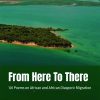
Edited by Nandi Jola and Omobola Osamor (CivicLeicester, 2025)

By Alan Morrison
At this time of anti-immigrant rhetoric and measures of the Western Right, from Trump’s thuggish trigger-happy ICE raids in the US to the rise of Reform, “asylum hotel” protests, and the divisive Raise the Colours campaigns and rallies in the UK, the Africa Migration Report Poetry Anthology Series could not have come at a more important time.
From Here To There – 101 Poems on African and African Diasporic Migration brings together 63 poets from across Africa—Cameroon, Eritrea, Kenya, Morocco, Nigeria, Sierra Leone, Somalia, South Africa, Uganda, Zimbabwe—as well as poets in the UK, US and Europe of African descent. The title has an echo of Ian Sanjay Patel’s We’re Here Because You Were There (2022) quoted by Zara Sultana at the close of her rousing speech at the first Your Party conference.
The poems are as diverse in style as the diasporic experiences they express, with themes ranging from departure, transit, destination, to attempts at integration, and discrimination.
Thulani Mahlangu’s ‘Where I Am From’ expresses ancestral dislocation: ‘My grandparents are shadows in photographs,/ Their names stitched in whispers./ I carry their absence like inheritance./ Migration is the ghost story of my blood’. Samuel Julius Habakkuk Kargbo’s ‘Victim of Tribalism’ shines a light on the aspirations of refugees fleeing persecution: ‘My ambitions soar high like the Rüppell’s griffon vulture/ Towards lands where education is free of hate’.
Patrick Kapuya Tshiuma’s ‘The Long Way Home’ looks to God for deliverance from a terrible fate in his native country: ‘He kept me from warlords/ From right-wing hatred, hardcore/ From Jungle beasts and narcos// I did not die a John Doe’. Abiola Agbaje’s ‘jewels lost at sea’ is an effective loop poem, its anadiplosis mimicking the back and forth tug of migration’s oceanic tides. Jim Aitken’s ‘Ncuti Looks Back’ has Rwanda-born Dundee-raised Ncuti Gatwa, most famous for playing the fourteenth incarnation of The Doctor, celebrating his success: ‘Not at all bad for a lad from Nyarugenge, Kigali’.
Rina M. Alluri’s ‘Blessing’ is rich with sense-impression: ‘greeting vendors balancing bread baskets on their heads/ as the stench of gasoline stains the Ibadan air// clutching thin white napkins,/ frying plantains’. Remind Mugwambani writes in ‘Footsteps of Our Ancestors’: ‘We roam, seeking greener pastures,/ Like the tortoise, we carry our shells,/ Our cultures, identities, and stories to tell’. Ijeoma Victory Ejme writes in ‘The Prisoner’ of being ‘in pursuit of the green/ that my eyes haven’t seen’. Green is the colour of refugee salvation.
Driss Amjich’s ‘Bloom’ might be the haunting portrait of a refugee in an asylum processing centre: ‘Sitting on a brown plastic stool.// Anxious,/ About an influence and a bloom’. Karuna Mistry’s ‘Perspectives (Home from Home)’ also depicts the isolation of an asylum seeker in a cold unwelcoming country: ‘A house is not a home – just brick as its bone/ No TV or computer; barely any furniture// Mould in the bathroom, dust in the bedroom/ Replace the wallpaper with last month’s newspaper// Pay as you go – paying top-up too slow…// Switch the central heating or pay for eating?/ – Decide/ Make ends meet in this filthy old street/ – Suicide?’
There’s an epigrammatic quality to Gordon Anjili’s ‘Emigrants’: ‘Like robins, we stayed. Like swallows, they left./ And some returned to their old summer nests./ We fete and applaud them as patriots true,/ And scoff at those who remain foreign guests’. Barrington Gordon’s ‘No Buts… (Universal Declaration of Human Rights?)’ and Zita Holbourne’s ‘Back To Where You Came From’ are poetic dialectics.
Nandi Jola’s ‘nostalgia’ lays down a gauntlet of cultural schism: ‘your nostalgia and mine are two different things/ if you remember the Beatles/ I remember Emmett Till’ (an African-American boy lynched in 1955 Mississippi). In ‘Black Women’ she recounts Black women pioneers languishing in a shadow-history: Mary Maynard Daly (first Black American woman to earn a Chemistry PhD), Augusta Savage (sculptor of the Harlem Renaissance) and Harriet Tubman (abolitionist). That I had to Google the first two attests to the poem’s point.
Octavia McBride-Ahebee’s ‘Preparations for the Voyage to Lampedusa’ is richly descriptive: ‘in our wedding henna and the indigo of our gods…/ using a hand-rolled cone of discarded plastic/ I labeled him in Arabic on his forehead/ with the translated love poems of Rumi// on the palms of his hands, I rendered in sloppy English/ the poetry of Lorde and Knight,/ between the nervous Dogon masks that dressed his breasts/ and the hairy lotus flowers’. Her ‘1822/2014’ depicts the attempt at a slave revolt by free Black man Denmark Vesey in 1822 Charleston, South Carolina. J.O. Neill’s ‘Complicity’ evokes the slave trade: ‘He embodies his craft, the language of wood,/ endowed like the grey of his seaglass eyes,/ the flax of his caulk-flecked hair’. As does Annette Pateman’s ‘First Time’: ‘The first time I felt/ dark iron/ on my wrists/ around my neck/ I thought/ I was dying’.
M. Chambers’ ‘African Exile’ transfigures an imported fertility statue as a Maquette of an African slave: ‘Dragged from her home./ Shipped like a commodity,/ put up for sale,/ auctioned off as property’. It blossoms into further foliations: ‘Flower-laughs of children,/ planted along the way’. There is the alliterative evocation of a mythical swamp creature of the Congo Basin: ‘The barking cry of Mokele Mbembe,/ mingling with the crackling fires’.
Mixed ancestry is celebrated in the figurative ‘To Lina’ by Leonora Masini: ‘She is Eritrea and Sudan and Italy’. In ‘Only Berberè?’ Masini uses olfactory sense impressions to evoke various cultures, particularly the Ethiopian/Eritrean spice of the title. Smell is after all the most mnemonic of senses.
Jenny Mitchell’s ‘Looking at the Benin Bronzes’ is a hauntingly elliptical poem expressing depersonalisation and powerlessness: ‘Your words are watching me./ I see you smiling distrust…// Grow your mouth./ Say what I want you to hear./ But above me a flag…// And behind you those flowers and leaves.// A church in the shape of your head.// Words are alive,/ Let them speak’.
Nasra Dahir Mohamed’s ‘I Am Somali’ sculpts the motto: ‘I am Somali, moving is in my blood –/ A nomad’. Mariam Mohammed’s ‘The B(lack)ody as a map to self’ proffers an almost Plathian aphorism: ‘I hold words/ on my tongue like an egg’. In her ‘From where do I come?’ the answer comes: ‘She told me: if I just keep walking,/ I might find my way’. Nasra Dahir Mohamed homes the motto: ‘I am Somali, moving is in my blood –/ A nomad’. Victor Ola-Matthew’s ‘Another Man’s Land’ emphasizes the refugee’s lot: ‘busy securing your future, chasing a permanent residency’.
In his long footnoted polemical poem ‘There Will Always Be One More Thing’, Ambrose Musyiwa uses strikethroughs across the racial descriptors to emphasise unspoken European prioritisation of white over Black and brown refugees: ‘can’t possibly do for Black African and Muslim Asian refugees/ what we did for white, Christian, blue-eyed, blond, middle-class, working/ class European men women and children Ukrainian refugees’.
Musyiwa’s ‘st georges walks into a pub’ riffs on racist tropes: ‘st georges,/ does lynch mobs/ strange fruit/ swinging off southern trees?/ strange fish/ off small boats?’. As does Dike Nwosu’s rap-like ‘A Journey Full Circle’: ‘Biafra, Nigeria./ History, hysteria// Lonely London./ No blacks, no Irish and no dogs./ Throw in the towel, Enoch Powell./ Rivers of blood, skud./ Racial tensions’. Ugwuja Emmanuel Ifeanyichukwu’s ‘Reaped Dreams’ plays with homophenic crossovers in meaning: ‘sending letters from Libya/ inked with our raped identities,/ reaped dreams’.
Two poems satirise anti-immigrant rhetoric: Jana van Niekerk’s ‘From God to Dust’: ‘I am a Parvenu/ I live on charity/ I renounce my individuality’. It closes on a sublime note: ‘light// The fallen angel/ his perfect shattering/ so that we should see/ what colour we were made’; and Joseph C Ogbonna’s post-colonial polemic ‘Don’t Surprise Me Europe’ is a post-colonial: ‘I am Africa,/ colonial Europe’s partitioned cake// I am the ancestral habitat of the/ itinerant welfare seeker,// I brave the blistering heat of the deserts/ and the belligerent Maghreb/ to have my needs sated in lands west of Bosporus’.
Jana van Niekerk’s ‘From God to Dust’: ‘I am a Parvenu/ I live on charity/ I renounce my individuality’; and Joseph C Ogbonna’s ‘Don’t Surprise Me Europe’: ‘I am Africa,/ colonial Europe’s partitioned cake/ ancestral habitat of the/ itinerant welfare seeker,/ to have my needs sated in lands west of Bosporus’. Frank Olunga satirises racial profiling: ‘When I go shopping. They give me free security./ Someone to watch what I buy. My skin, the issue’. Then comes a pointed comment on pharmaceutical numbing of capitalism-induced psychiatric distress: ‘Mama, did you know you can buy guns like sweets here?/ People are depressed and they need pills to sleep./ The land of milk and honey must have been a lie’.
Deborah Saki’s ‘A New City’ also laments the pharmaceutical dystopia of the West, where medications and often unhelpful therapies placate psychical distress caused by a racist hostile environment: ‘We did not leave for the flat white pills in their transparent orange tubes/ that the doctors say may make you drowsy’. In ‘Swamp Song’ James Sentiba writes ‘I’ll therapize myself’, and does so by daydreaming about his far distant home: ‘Nothing can harm me here/ in the weeping wetland where/ music and wind are the only languages./ I float on the wind, humming in unison/ with the swaying palm leaves’.
Skin, not simply in terms of pigment, is a common motif. In Philisiwe Twijnstra’s ‘Zulu Girl In Rotterdam’: ‘In the sea of whiteness, the body floats. Drifts in foreign land./ The city whispers she’s black/ The body tumbles down./ The black forgotten body is bruised/ like a drug dealer, you take pills./ Vaseline Blue Seal, where are you Vaseline Blue Seal?/ you thought you knew the sun./ the sun is not the same./ it snows after the sun./ this sun does not have clan names./ this sun has no morning’. In Fauziyatu ‘Fauzi’ Moro’s ‘Echoes of A Migrant’s Ritual’: ‘She immortalized her identity, bound to her skin like a tightrope// Blisters,/ Birthed from the stinging union of skin and cashew bark/ Blisters/ Healing into rugged body art…// The skin map on her aged arm will be the identity charm’.
In Furaha Youngblood’s ‘Adrift’: ‘The dressing table holds round powder boxes filled/ with shades that complement only cream and ivory skin tones./ Ebony, Chocolate, Cinnamon, and Caramel are foreign’. These images and cultural motifs express her sense of the unfamiliar: ‘I am adrift in a sea of unfamiliar and frightful things./ Adrift./ Yet, to save myself, I must use the floating planks/ of cultural imperialism, a sinking ship’s debris./ I am powerless to choose otherwise’. It closes on the defiant trope: ‘I am a survivor, and once ashore,/ I will burn those planks to warm my spirit’.
Omobola Osamor’s ‘Tomorrow on today’s plate’ is an alliterative, image-rich short poem: ‘Black chugs behind the keke napep,/ erupting volcanoes burn our throats, eyes and nostrils;/ joining ranks with emissions from industrial cigarettes,/ a murder of crows,/ countering libations,/ writing our obituaries’.
The Nigerian Yoruba slang term ‘Japa’, meaning to leave the country to find better opportunities, crops up in many poems, and in the title of Ogbonna’s ‘Japa Quagmire’: ‘he hears about lucrative mining activities/ in the terror belts of his beleaguered country’. Dike Okoro’s ‘Remembering’ recounts the Nigerian Civil War: ‘bombs ripped/ apart thatched houses. Bible clutched…’; and in Patrick Kapuya Tshiuma’s ‘Until Again Goma is Free!’: ‘Bombs dropped while flowers blossomed’.
The anthology includes a comprehensive Contributors section providing biographical details and publications of the poets, all of which helps to further contextualise their poems.
From Here To There is a vital verse intervention amid the toxic discourse surrounding immigration to the West from past European colonies, powerfully emphasizing the humanitarian and karmic momentum that propels it, essential reading not simply for such messages but for the ripe poetries that carry them on rafts of afflatus.
An edited version of this review was published in the Morning Star on 16 January 2026 under the title ‘The songlines of migration‘.