The book is available here
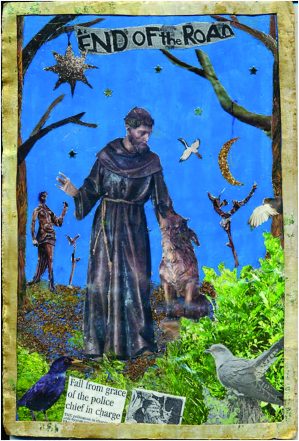
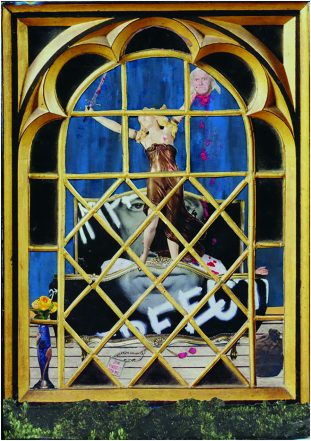
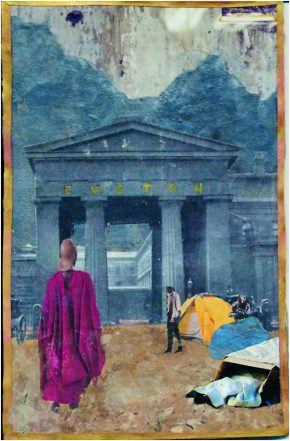
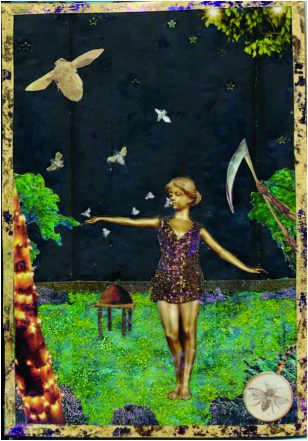
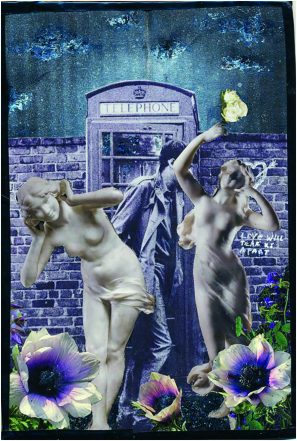
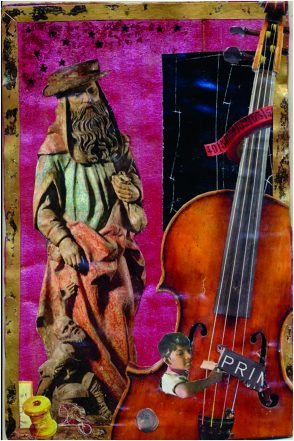
Valentine’s Day is coming up and to mark it Geoff Bottoms reviews this book, which includes a poem to St Valentine. All the illustrations below are taken from the book, and are collages made by Steev Burgess
We are “In need of saints.” That is the bold claim made from the outset in this collection of poems by Fran Lock. Inspired by liberation theology, she invokes and evokes a kaleidoscope of saints that embody her idea of “Christian-Communism.” In this she shares the vision of the late Archbishop Oscar Romero of San Salvador, who was assassinated in 1980 for speaking out against human rights violations in El Salvador. He wrote that far from being “the opium of the people”, the Church’s true purpose is “not to sedate but to rouse men and women to the true meaning of being a people.” And by people he meant “a community of persons where all co-operate for the common good.”
This is Fran’s starting point, with her radical notion, based on scriptural and hagiographical witness, that God “rides on the side of the marginalised and the oppressed.” For her saints aren’t plaster statues or even beautifully created icons, but authentic human beings with all their faults and failings, whose exemplary courage and compassion create a bond with those who look to them for both help and inspiration. More than that they link us to “a long historical continuum of solidarity,” reminding us that we are all connected through space and time, so that their stories have subversive potential in uniting us in the common struggle to make another world possible.
True to form, Fran’s writing is inclusive and diverse, enabling this collection of poems to appeal to our common humanity, regardless of faith, so that what Christians refer to as the “communion of saints” could equally be applied to the “communism of people.” While the Church has its heroes of faith, the working class also has its exemplars of historic struggle in the battle for socialism, so that both contribute to a sense of solidarity reaching back into the past for inspiration, and looking to the present for mutual responsibility and encouragement.
As Fran points out, Christians look to the lives of the saints and identify with their particular struggles and sufferings, while invoking their intercession in the belief that they can share their victories over adversity and contribute to a better world. Similarly, those of all faiths and none, who are engaged in the political struggle for peace and socialism, can look to the writings of the giants of the working-class movement for inspiration and enlightenment, as they invoke their memory and draw strength from their example.
St Francis
It is in this spirit that Fran approaches seventeen saints from a variety of angles. She reimagines some of them as eco-warriors, as in the case of St Francis…..
St. Judith
…..or as radical socialist feminists reflecting Judith in the Old Testament, or as the abused, exploited and oppressed reminding us of St Margaret, swallowed up by cruelty and iniquity.
St. Martin
Here is the poem about St Martin of Torres, who gave half his cloak to a beggar. It’s one of the finest in the collection:
Saint Martin in Euston (Saint Martin of Torres)
miserere. monday is a man reduced to his bare
incident, a stain the pavement eats. a sharded
light is stalled between the concrete benches,
busses, cranes. drills compete, declare a complex
discord. everywhere the air is rutted, hurts.
and yet the earth turns still. the concourse fills
with factions, mobs, gym memberships, majorities
and miniskirts. miskiltered mouths. here are
the men who bury their piqued slang in mobile
phones, little kids who kick at pigeons; prêt
a manger sandwiches, the salaries and symptoms.
miserere. where kinship skitters, alleys end
in piss. this circus of averted eyes and shifted
weight. we wait in line for black americano.
cargo of feeble guilts. appropriate frown, a face
made plasticine with pity. melt. and it is terrible.
drink up, get out, and go, cocking deaf in
headphones, march like regiments or inmates.
off to work. high-ho!
but then –
monday is a man, and when he speaks
the old home hails me; love becomes a wet
umbrella, sprung indoors. i felt – i saw –
i thought about saint martin, cutting his cloak
in two. miserere. it’s all too much, sometimes.
the grim unfolded fact of it. the shit. how lips
are franked by sanction, shrinking into slur
and stoop and scuff. undifferent dirt. these
grounded birds. these ragged nails and filthy
cuffs. i saw – i heard – and in my head saint
martin stands, as naked as a maypole. his halo
weak and radiant-hard. the struggling fluorescence
of a lightbulb in a bedsit. backstreet, bus stop,
tarmac yard, this his kingdom. tears his shirt, his
hair, his skin to remnant whispers. but still,
there’s not enough of him. can’t cover
such a vast and shuffling need. miserere.
how love is this machine for stretching,
reaching, wretched, incomplete. here we
are in incomes, indecision, rolling our
eyes like pellets of bread in order not
to see.
but see!
saint martin through a megaphone, ranting
and antagonised: what’s wrong with you?
what’s wrong with you? and then you see.
and you cut your coat in two.
Other poems take the form of asking the saints for their prayers, as when St Lucy, who was blinded for her faith, is invoked by her petitioner to be delivered from the shallowness of material things: “i need your second sight. tight new buds, their wakeful flourish. see my way clear to the light.”
St Rita
Or consider St Rita, who is invoked by women with lost childhoods for whom escape is not possible, as they negotiate their way in a violent world of men: “Patroness of Impossible Causes, pray for us, that we might flip a decade’s deadweight like a mattress; gather our godspeed, walk away from ourselves.”
St Valentine
In the case of St Valentine, whose legend is complex and messy and owes a great deal to Chaucer connecting him with love and lovers, Fran merges his hagiography with Joy Division’s singer and lyricist Ian Curtis, whose apocryphal legend of conflicted love is equally muddled. This forges a connection between the petitioner and the hybrid Saint that cuts through the twisted narrative of their lives and brings renewal and wholeness: “to be myself. delete. make new.”
Then there are direct invocations of God from St Uncumber, who was punished for resisting predatory male lust, protesting against patriarchal power, and from St Sebastian, who was riddled with arrows and clubbed to death during a time of persecution. He pleads on behalf of a teenage rent-boy in Soho dying of Aids: “you are adulterated by arrows, dulled and torn, thread-bare, firstborn, still standing – just. bearing up the bed you’re bound to, eyes rolled skyward, stoic ghost.”
Drawing on Fran’s own life in working-class and Traveller communities, the poem Bury the Wren is the most personal of all the collection as the petitioner prays for deliverance from the sectarian hatreds that have riven Ireland over the centuries, and which continue to afflict the most vulnerable: “we pray for strength in times of persecution. but did you cast forth sparks? make perfect love a lightbulb moment. no. all blood. no lust. we pray to forgive.” Steev Burgess, who accompanies the text seamlessly with his poignant, colourful, and evocative collages, reinforcing the message of the poems, writes in his notes at the end of the book about Fran “finding love among the ruins.” That could be said of the entire collection.

St Rollox
Meanwhile St Rollox offers a prayer of thanksgiving for his faithful canine friend who saved his life, bringing to mind the countless homeless in the doorways of our towns and cities with only a dog for a companion.
St Homobonus
St Homobonus the merchant, who used his wealth to help the poor, supplies a different angle altogether as he is transported from his native Cremona to Primark on the Tottenham Court Road, where out of both sorrow and anger at the exploitation of the sweatshop labour involved, he tears the fabric into strips with his bare hands.
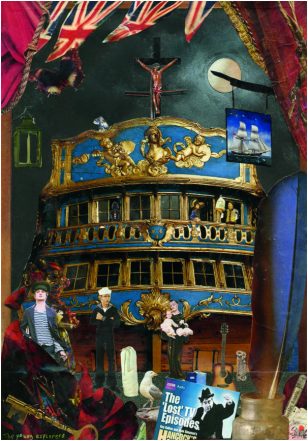
St Anthony
St Anthony shares a similar empathy as he extends comfort to lost souls in a poem attempting to capture the doleful yet whimsical idiom of the comedian Tony Hancock who committed suicide in 1968: “nothing is lost. luck merely leaves on a broomstick shrieking. such is life…don’t lose heart. button up against the world.”
Fran has done us a great service in expressing in poetic terms Marx’s analysis of religion as “the sigh of the oppressed creature,” while arguing that prayer is a scream of protest against exploitation, oppression and injustice. It is also a call to action that involves struggling together as “a mutually responsible socialist community.” We are the stuff of which saints are made!