Commons image
By Dennis Broe
One strand of the American character, popularized by America’s first novelist James Fenimore Cooper, is that of the rugged but honest pioneer, hewing to a homespun truth that in its simplicity permits no obfuscation.
That’s one side. The other side, also prevalent in American literature, is a duplicitous, lying, cheating, conning American who will go to any ends to deceive his fellows. This side is particularly well represented in the work of Herman Melville, Mark Twain and the crime novels of Jim Thompson.
The art of scamming is also highlighted in my new Harry Palmer/Crystal Eckart novel Pornocopia about how the gigantic scams of porn and gambling have penetrated the American psyche.
This side of the American character is rabidly on display in the conduct of our leaders, with Trump turning the American casino economy into his own personal cash cow, and New York’s former mayor Eric Adams following suit, as he exits a corrupt regime by fostering a crypto-Ponzi Scheme on the public.
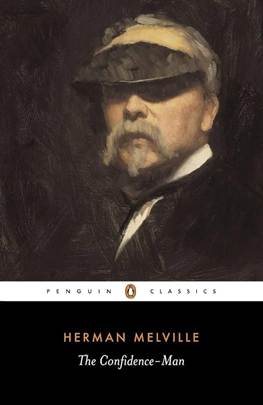
Melville’s last novel, aptly named The Confidence Man, features a boatload of characters heading from Saint Louis to New Orleans with the boat, with its pilgrims constituting a kind of American Canterbury Tales. They are split between con artist and gullible types, though often the latter are stalwart and sometimes straight-talking victims: “…men of business and men of pleasure; parlor men and backwoodsmen; farm-hunters and fame-hunters; heiress-hunters, gold-hunters, buffalo-hunters…”
A stranger boards the boat who in several guises solicits money for charitable causes though we know the charitable cause is himself. It’s possible all the conmen are one conman or that the boat is made up of several conmen, but the point is the same – by the mid-19th century when Melville is writing, these characters now dominate the American landscape.
The scammer, aboard the aptly named Fidele or faithful, continually asks his mark to have confidence in him which he describes as “the indispensable basis of all sorts of business transactions.” And of course, “confidence” is the sine qua non of the stock market, which now propels a hollowed-out American economy. When a passenger objects that two dollars a box is too much for an herbal remedy, the confidence man suggests instead his victim “take a dozen boxes at twenty dollars; and that will be getting four boxes for nothing.”
However, he meets his match in the ship’s barber, who when the scammer suggests the barber trust him to pay later for a shave, declines this offer first with “Sir, you must excuse me, I have a family” and later with the simpler and more elegant “Ah sir, I must live.” Melville is here invoking Shakespeare’s ordinary characters who spoke simple truth to loquacious power. The barber’s bare eloquence also echoes Bartleby’s refusal of degrading work in Melville’s “Bartleby the Shrivener”: “I prefer not to.”
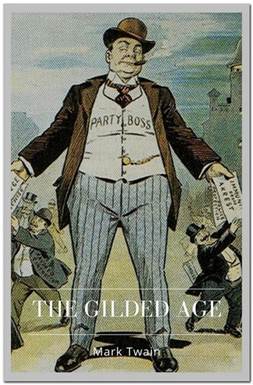
Later in the century, Twain’s The Gilded Age, which gave that name to the era of the robber barons in the latter part of the century, mocked the hypocrisy of the U.S. Senate, where lobbyists use sexual intrigue to pass bills supposedly aimed at “helping the Negro” but actually aimed at enriching themselves.
Behind this seduction by a female lobbyist, is a Southern gentleman calling himself a colonel who manufactured “gigantic schemes, …speculations of all sorts…in an atmosphere…full of little and big rumors and of vast, undefined expectations.” The Colonel’s “air of indefinite expectation,” translates to him employing forms of blackmail and bribery to get what he wants.
When the plotters are exposed as Senator Dilworthy, who is pushing their bill, is revealed to have unsuccessfully attempted to bribe another legislator, appropriately named Noble, to secure the vote, the Senate, instead of investigating Dilworthy, investigates Noble the truthteller for impugning “the reputation of a United States Senator.”
Noble responds to these charges by asserting that the people of the country hold “three-fifths of the United States Senate in contempt – Three fifths of you are Dilworthys!” An assertion truer in our own time than in Twain’s as in the last Gallup poll only 10 percent of U.S. citizens trust or “have confidence in” Congress.
Twain and Melville are describing individual conning and scamming, but in the century they lived the U.S. government, as Lewis Lapham notes, began with Andrew Jackson’s introduction of the corrupt and corrupting spoils system, and equally featured the country constantly reneging on its debts in cancelling parts of the money borrowed to finance its first three wars, with in each case the U.S. courts throwing out attempts by creditors to collect.
After the War for Independence, several states defaulted on British loans to the tune of $121 million ($4.4 billion today) and after the Civil War, the Northern states repudiated the debts incurred by the Southern states during the war. So, the scamming which Twain and Melville are describing took place at an institutional as well as an individual level, and characterized the country as a whole.
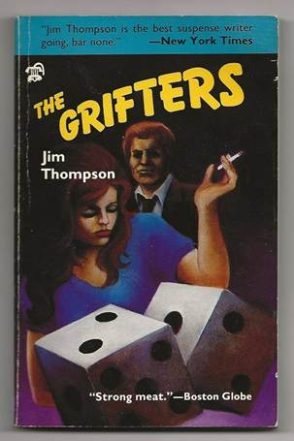
In the tradition of Twain and Melville, the crime fiction writer Jim Thompson chronicled American scamming and conning both high and low. Indeed, in Thompson’s terms, what the U.S. government was doing in the prior century was “welshing” on its bets.
Thompson was excellent on the lower form of conning and The Grifters is a detailing of the con artist’s ethos, from their self-proclaimed code “…it’s a grifter’s job to take the fools,” to the mother of the swindler Roy, who was trained by The Farmer who “always worked to make himself likable” and whose grift, though it involved lifting their money, “Always left the people with hope.”
Roy, the son and budding con man, finds himself in the financial capital New York, “…the logical objective of a young man whose only assets were good looks and an inherent yen for the fast dollar.”
But Thompson does not stop there. He is aware that the low-level con is only a reflection of what goes on at the top, as described by the young Texas oil pipelayer in South of Heaven: The callousness was more subtle on the upper levels; you knifed a man by cutting off his credit or pulling a slick double-cross. Down in the dirt where we were, you simply knifed him.
In his second novel Heed the Thunder, his perverted version of Steinbeck’s East of Eden, the scion of the town’s wealthiest family gets away with but is obsessed by his likely murder of a woman he impregnates but refuses to marry. The death haunts him to the point where “he could not stand himself sober these days.”
In The Nothing Man Thompson describes “the American way of life” as “supply and demand”; “the landlords supply what they care to in the way of housing and demand what they feel like.”
The protagonist of The Transgressors, Lord, is scammed by the oil company man McBride who has absorbed the values of the company owners. McBride hews to the letter of the law to cheat Lord out of the oil on his land, by buying up the land surrounding it and using it to drill into the oil on Lord’s property. Lord accuses him of drawing up a contract in bad faith “with intent to defraud.” To which McBride answers in the “flat, dull tones” of the righteous, “The contact was entirely legal,” abiding by the principle – proclaimed in Donald Trump’s Art of the Deal – that in every transaction “there was a loser and a winner” and it was his job “to see that the employers were not the losers.”
Lord’s answer to this slavish devotion to institutional cheating is Thompson’s ultimate indictment of a class whose scamming knows no bounds:“Been a lot of people like you around,” “right from the beginning of history. Burnin’ and torturin’ and killing – slappin’ other people into the gas ovens. And it’s always done legal.”

In our own century, my novel Pornocopia, the sixth Harry Palmer Mystery, set in the early 1950s, traces the emergence of the now much more organized and institutionalized “vices” and scams of porn and gambling both in LA and in the newly emerging “den of iniquity” Las Vegas. The case begins with Harry discovering that a Beverly Hills couple had like 19th-century nobility, “little income to speak of,” and were like the mink they hire Harry to recover “lavish on the outside and tattered on the inside.”
Harry is hired by a sex-reel star Purrfect to get her out of the clutches of two low-level mafiosi brothers. The brother who handles distribution, which sometimes means copying other company’s reels and repackaging them, tells Harry the secret of the business: Ya gotta make it look seedy and dirty. If people ever found out there’s nothing wrong with sex, we’d never survive.
The “business” involves luring young women who come to California to be actresses or models into a life of porn, an industry run by racist men who abuse Purrfect’s co-sex-reel star, the African American performer Chancey. These women find that once they are in the business they cannot get out and can never work in the legit movie industry, though Harry is amazed at the similarities between the underground sex-reel trade and the above ground Hollywood studios.
The novel also tracks the emerging entry into the business of larger scale financial interests whose “rationalization” of the industry may involve murder.
In Vegas, where Harry is escorting Chancey he realizes the secret behind the conning phrase “What happens in Vegas stays in Vegas”: The more you lost, either at the tables or with the girls who surrounded the tables, the less you talked about what really went on, giving the impression that it was all fun and games because no one wanted to admit that while they may have come there hoping to win, they left not wanting anyone else to know that what went on instead was relentless losing.”
He also is told by Chancey’s mother that the result of the scam the casinos are running where they skim off the top and pay little taxes, is “Overcrowded schools, polluted water, traffic congestion and new casinos going up every day with no organization, just chaos.” On a bender in a bar, an out of work reporter tells him that he was fired from the local newspaper for investigating “mob expansion into all the casino-related businesses in the town” and beyond that the mob “infiltrating Main Street and Wall Street. They’re going legitimate and they’re becoming mainstream…taking the short step from racketeer to capitalist.”
The final con Harry discovers involves a U.S. government effort to steal Iran’s oil and overthrow its democratically elected leader, an effort which blows back on Harry’s case in the U.S.
The legitimization of crime and scamming and its blending with government reaches its apogee in our own time with Donald Trump, the scammer-in-chief and his systematized looting of the U.S. treasury in his “big, beautiful” bill which continues the givebacks to the rich in his first administration but also in his using the office to accumulate personal wealth. This blatant grabbing of loot is usually done, more tastefully, by politicians after they leave office. Think of the Obama’s Netflix deal or Tony Blair’s and the Clinton’s acquiring vast sums as “consultants” or on the speaking circuit.
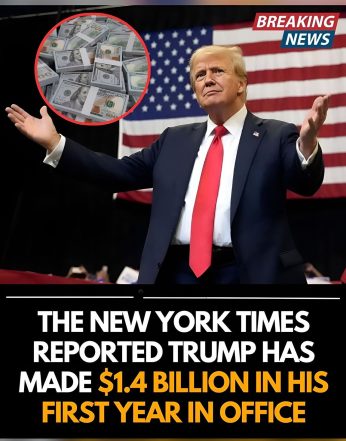
According to a New York Times, somewhat modest, estimate Trump has so far used the office to acquire $1.4 billion, including profits from twenty overseas real estate projects involving foreign governments, money from Amazon for the Melania “documentary,” – not a film but a sham exercise in branding – and from major tech and media companies, as well as from cryptocurrencies he and Melania have founded for, or foisted on, the public.
Trump is also not above scamming his own followers. The rapper Nicky Minaj, from Trinidad and Tobago, was presented at the White House with a gold embroidered document that she thought was a visa but was actually a “memento” of the occasion, and not a visa at all.

Lastly, there is New York’s Eric Adams, whose former administration has been compared to the city’s most corrupt period in history, Tammany Hall. Under Adams, hundreds of contracts were handed out with no competitive bidding. Upon leaving office he began fronting for a digital crypto product named NYC Token, all part of, as New York magazine called it, “a multimillion-dollar meme coin hustle, known as a ‘rug pull.’”
Adams and his cronies, who quickly deserted the currency, may have netted a million dollars from investors who were then left with only a magical token, a digital imprint with no value behind it.
Trump and Adams are real-life scammers stepping out of the pages of Melville, Twain, Thompson and my own novels as a hollowed-out country – whose single dominant industry consists of the manufacture of military weapons – instead of producing, instead embraces the ultimate con of fictitious capital as scamming becomes the currency of the day.
Pornocopia is available on Amazon, Apple, Kobo, Barnes and Noble and wherever fine books are sold.