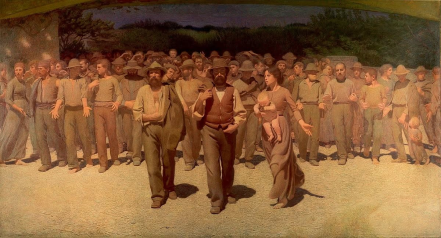
Il Quarto Stato / The Fourth Estate by Giuseppe Pellizza da Volpedo (1868-1907)
By Adam Page
There is a silence, almost physically heavy, which settles over a town after the men have gone back in, beaten with their demands unmet, their leaders blacklisted and their children hungry for a winter that didn’t need to happen. I’ve heard that silence, standing in it working in healthcare. It isn’t the silence of peace. It’s the silence of a wound closing over an infection, the body deciding to live with the poison simply because the alternative was worse.
Every strike novel worth its ink is written in that silence. Or the roar that precedes it, and if you want to understand how a civilisation treats the people who built it, you don’t read its economic textbooks. You read its strike novels. The economists lie for a living. Novelists, when they’re good, can’t help but tell you the truth even when they’re trying to sell you something else.
I have lost count of the number of years now watching the same con get run in a hundred different costumes; the boss weeping about market forces while he’s getting a new paint job on his yacht. The politician calling the picket line “thuggery” from behind a desk his grandfather’s union dues helped build. Or the newspaper editorial discovering, with flawless timing, a sudden passion for “the rule of law” just when the law is being used to break a man’s spine. It’s the oldest con there is, and literature has been documenting it, dressing it up and sometimes getting it catastrophically wrong for a hundred and fifty years.
The strike novel is the genre where the machine shows its teeth, and where writers, decent or cowardly, brilliant or sentimental, have had to decide what to do when they see those teeth. Do you make the crowd noble or a monster? Do you give it a face? Ten faces, or does it remain a fog of shouting men, as a fog is easier to control on a page than a hundred individual human souls each with their own reasons for freezing half to death instead of going back to work for a wage that will kill you slower than starvation?
That’s the real point of this essay. Not “here’s a list of books about strikes” which is the sort of dead-eyed literary supplement that could be thought up by a committee of accountants. The actual subject is the set of choices a writer makes the moment collective action comes into the frame; because the strike, more than nearly any other event in modern life, breaks the machinery of conventional narrative.
As a form, the novel was built around the private consciousness of an individual protagonist, someone working out a personal fate against a backdrop of society. The strike says: “To hell with your individual consciousness.” It’s a mass phenomenon, thousands of people’s wills fusing, even if it’s brief and unstable, into a single body that acts and suffers, and sometimes wins. It’s writing that requires either wrecking the traditional furniture of the novel, or performing some clever carpentry to make room for the crowd without losing the reader’s grip on any one face. Every writer in this tradition has had to solve that problem. Most solved it by cheating in one way or the other. The great ones cheated beautifully.
The strike as organism
We start where we have to start; in 1885 with an obsessive, pseudoscientific Frenchman named Émile Zola descending, literally as he went down the pits himself interviewing miners, into the coalfields of northern France to write Germinal. His whole deranged project, the Rougon-Macquart cycle, was built on the conceit that behaviour could be traced like disease being transmitted through blood and environment. It was bad science that made for incredible fiction, because when he turned that pseudo-clinical eye on a mining community starved into revolt, it was more than a strike novel he produced, it was a strike organism.
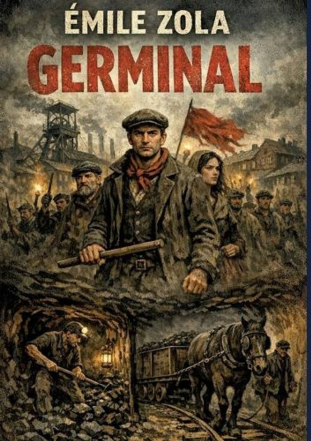
The mine itself breathes in that book, a beast that eats men. And when the strike finally erupts, it’s written with the same feverish, nearly erotic intensity Zola brought to his descriptions of the pit. The crowd surges and swells, becoming an animal with ten thousand legs tearing through the countryside, and Zola can’t decide, and doesn’t seem to want us to decide, whether this is monstrous or glorious. It’s both, of course, and that ambivalence isn’t a failure of nerve, it’s the most honest thing in the book.
Germinal created the template everybody since has been arguing with, consciously or not. The strike as an elemental force, the workers as a collective body bigger and older than any individual character, with the management a distant, almost theological evil operating through absentee shareholders who never appear on the page, as the whole rotten point is that those extracting the wealth are never where the violence is. That hasn’t changed in a hundred and fifty years. Those men who decide to shut a plant, break a union or cut a pension are never standing in the room where the consequences land.
Zola understood that cowardice before anyone had a name for it and built it into the novel’s architecture, with the mine owners remaining abstractions, ideas of money, and the misery is rendered in such gnawing, hungry detail that you can feel the coal in your throat. And the famous ending, with new growth pushing up through the earth as the beaten miners walk away, has been read for more than a century as a note of optimism and hope. I read it as something colder; a promissory note with no due date, the kind of comfort you offer a dying man because the truth is much too heavy to say out loud in the room.
How the system extracts value from labour
A jaunt across the Channel and a leap forward of a few decades, and we get a very different animal: The Ragged Trousered Philanthropists by Robert Tressell, a dying house-painter in Hastings who wouldn’t live to see it published, and who poured every ounce of rage he had left in his lungs into it. It isn’t, technically, a strike novel; it’s about a gang of painters and decorators grinding their way through poverty while their employers lie and skim, but it belongs here as it represents the genre’s other great pole: didacticism so clear it pretty much has a placard nailed to it.
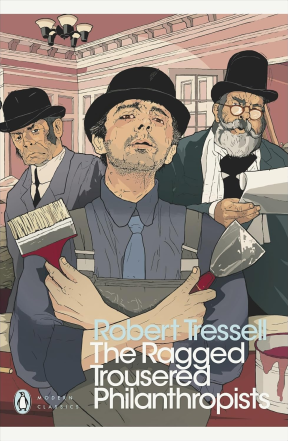
Tressell doesn’t trust Zola’s beautiful and terrible fog, he wants you to understand, in very clear terms delivered by Frank Owen, his mouthpiece, exactly how the system extracts value from labour, just why charity is a con, and philanthropy a euphemism for theft with a better public relations office. The novel is agitprop, it knows it, and it works because Tressell’s fury isn’t performative; it’s the rage of a man actually dying of the poverty he’s describing, and you can feel the clock running out in every chapter.
The problem (and every writer in this tradition inherits it) is that the sermon and the strike don’t always sit comfortably together in the same book. A sermon needs a listener who can be persuaded, and a strike needs a crowd that can act before persuasion is even finished, moving on fury and hunger and half-formed instinct as much as doctrine. Tressell gets around this by avoiding the mass action itself and remaining inside the slow attrition of underpaid labour. This is the strike novel’s quieter and more insidious cousin: the novel of exploitation before the breaking point.
It’s a long and grinding setup to an eruption that never quite comes, as the man ran out of pages and lung capacity before his characters ran out of patience. But even that is a kind of honesty. Most people, most of the time, don’t rise up. They just endure, and the novel which tells you that, instead of the fantasy where the workers always find their nerve, is doing something a lot braver than the sermon it appears to be.
Strikes need martyrs
America does this differently, of course, as America has always told itself a different lie about class: the lie that there isn’t one, and the man on the picket line today could be boss tomorrow if he just wants it badly enough. This is a story so useful to money, that money has spent more than a century paying to keep it alive. And into that landscape walked John Steinbeck with In Dubious Battle published in 1936. It’s a novel about a fruit pickers’ strike in California and is, structurally, one of the coldest and most clear-eyed books ever written about industrial action, and earns its coldness the hard way.
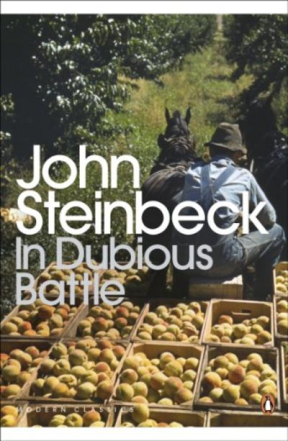
For that time, Steinbeck does something truly radical: he doesn’t let either side off the hook. His organisers, Mac and the young idealist Jim, aren’t saints. Mac is a solid tactician who understands, with cold professional clarity, that a strike needs a martyr more than a victory, and that dead men are better propaganda than living wages. The novel watches him manipulate outrage and grief with the same chilling competence a general uses to spend soldiers’ lives for territory.
Here is not the noble, singing proletariat of agitprop. Here we have human beings as tactical material viewed, and Steinbeck’s background in marine biology bleeds straight into his fiction, with something like the detachment of a man studying a colony of animals under pressure. It caused anger among the doctrinaire left of the time, who wanted strike novels to be recruitment posters, and it should still unsettle anyone reading it today. Righteous causes can be run by people who are not always righteous, and the crowd can be as cynically deployed by its leaders as by the bosses it’s fighting, with none of that making the wages any less starvation wages or the growers any less monstrous.
Steinbeck holds both these truths at once without letting either cancel the other, which is a harder trick than it sounds. Three years later, with The Grapes of Wrath, he’d more or less abandoned the experiment and let the Joads have the full weight of feeling he had denied Mac and Jim, as though he had decided that all that clinical distance made for beautiful architecture but lousy politics.
Somewhere in the usual telling of this tradition, an entire strand gets quietly amputated, and it’s worth taking a moment to say so clearly: it’s regularly taught that the strike novel is a story men tell about men, with picket lines, fistfights, and martyred organisers. It leaves out the fact that women weren’t bystanders to industrial conflict, rather they were its emotional and logistical infrastructure.
So for example there is Mary Heaton Vorse, writing about the 1912 Lawrence textile strike in work that fused reporting and novel in ways that hadn’t quite been done before. And Meridel Le Sueur, writing the Depression from inside the bodies of women who fed, hid, and buried strikers but got none of the biographies.
Their work knows something the Zola-to-Steinbeck axis mostly doesn’t: that a strike is also a household deciding whether there will be dinner that night, with a woman doing the arithmetic of survival while the men do the arithmetic of principle, and the women’s arithmetic is every bit as much industrial conflict as the picket line is.
If we only read the canonical strike novels you would think revolt happened completely among men, in public and in daylight. It didn’t; half of it happened at kitchen tables in the dark, and those writers who knew that wrote a truer and harder book, and mostly got left off the syllabus for it, as the syllabus, like everything else, was built by people with an interest in which half of the story gets remembered.
The grey exhaustion after losing the fight
And this brings us, finally, to Pat Barker, and I have to be honest before I go further: her early novels; Union Street, Blow Your House Down, The Century’s Daughter, aren’t strike novels in the Zola/Steinbeck sense, there is no huge set-piece of ten thousand men pushing against police lines. Barker instead gives us, in the working-class communities of the industrial North East rendered in unglamorous precision, something arguably more honest and devastating: the aftermath – their world after the mill has half-closed and the men have been made redundant in slow motion, and after the union that used to mean something has been hollowed out into mere formality.
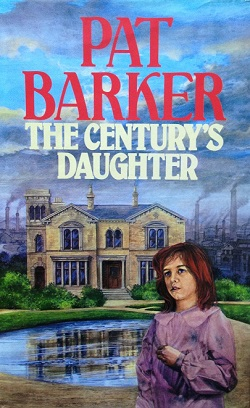
Barker writes the world the strike novel usually ends before reaching; not the eruption but the grey exhaustion of a community whose collective power has been destroyed so completely that collective anything starts to feel like a luxury nobody can afford. Her women aren’t marching, they’re doing the much less cinematic work of surviving deindustrialisation one grim shift and one grim funeral at a time. And if you want to know what it really costs a community to lose the fight, not a dramatic loss with the picket line overrun by police on horses, but the slower loss where the factory just doesn’t reopen, Barker is the writer who tells you. It’s the ghost the strike novel leaves behind once the cameras have been packed away and those men who made the decision are already thinking about their next acquisition.
The strike as historical trauma
GB84 from David Peace arrived two decades later and it closed the loop by going straight at what Barker was circling: the 1984-85 Miners’ Strike itself, here rendered in a paranoid, fractured and incantatory prose which reads like the nervous system of the country short-circuiting in real time. There is surveillance, sabotage, hidden funding channels, a government treating an industrial dispute as though it were a live counterinsurgency operation, something which the archives later confirmed is pretty much exactly what it was doing.
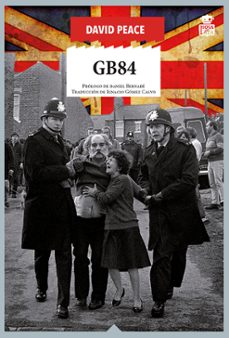
Peace gives us no comfortable distance here, there is no omniscient calm or Zola-style zoom-out to make sense of it all. We are inside the panic and betrayal, inside the exhaustion of men who didn’t lose because they were wrong; they lost because the state had more money and patience, and no scruples at all about breaking the law it was invoking against them. Reading David Peace after Barker is like watching a wound get inflicted then watching it fail to heal. Together, they form the other half of the tradition Zola started: not the strike as an elemental eruption but as historical trauma, still working its poison through the community’s bloodstream a generation later. I’ve walked through streets like the one Peace describes, towns where the pit closed forty years ago and the town never found anything else to be, and the silence there isn’t metaphorical. It’s a real and physical absence where a whole way of understanding your own worth used to stand.
Something to notice, if you haven’t already, is that almost none of these books end in triumph. That isn’t an accident of the books I’ve selected, it’s close to a law of the genre and deserves to be looked at hard, because a literature only imagining defeat is doing quiet ideological work whether the author intends it or not.
Zola defers his hope to some unspecified future, Tressell’s characters never quite get to the strike, Steinbeck’s pickers lose bloodily on the page, and Peace’s miners lose historically in the record. Ask yourself why. Part of it is just honest history: plenty of strikes did lose badly, and a literature that pretended otherwise would be lying about the odds the way bosses lie about the market.
However, I think part of it is a failure of nerve which has nothing to do with honesty and everything to do with conventional narrative. Victory doesn’t build tension in the way defeat does, it doesn’t hand an author the free rising action a doomed strike hands you for nothing, and so writers, even rage-filled ones, keep reaching for the tragic shape as that’s the shape the form rewards. A hundred and fifty years of strike fiction quietly teaching its readers that collective action ends in martyrdom isn’t a neutral aesthetic choice. It is, whether the novelist intended it or not, a story that suits the people who would rather you didn’t try.
So here is what more than a century of this literature really teaches us, once we strip away the university jargon: every writer who takes on collective action has to decide whether the crowd gets a face or stays a weather system; if defeat is written as tragedy, indictment, or the still disturbing popular cowards’ option, as inevitability, as though exploitation were a law of nature instead of a series of decisions specific men could have, at any point, chosen not to make.
Whether the organisations are saints, cynics, or something more dangerous and true, which is ordinary people doing an incredibly hard thing imperfectly, and whether the State and Capital remain comfortable abstractions off-page, as Zola left them, or whether they get dragged into the light and named, how Tressell insisted, and how Peace drags the British state itself into the dock and makes it answer.
None of this is academic to me, and it shouldn’t be academic to you, either, as the machine which broke the miners in 1984 is the same one, wearing a slightly better suit, that’s deciding right now which hospital doesn’t get funded, what warehouse worker doesn’t get a bathroom break, or which gig economy driver gets classified as an “independent contractor” to make sure nobody has to pay for his insulin.
The strike novel urgently matters now, not as a museum piece about the Victorian coalfields but as a working manual for recognising the con when it’s being run on you. Greed doesn’t update its methods much, it only updates its vocabulary, and this month’s vocabulary is “flexibility”, “efficiency” and “market realities” – and that’s exactly the vocabulary Zola’s mine owners would have used if they had access to a communications department.
Those men who don’t appear on the page in Germinal still aren’t appearing on the page. They’re in offshore boardrooms, insulated by six layers of subsidiary companies from ever having to look at the face of the person whose pension they just voted to gut. It drags them into the frame whether they like it or not, and makes us sit for a few hundred pages in the silence after the men have gone back in. So that you remember, the next time somebody in a nice suit tells you collective action is unreasonable, exactly whose reasonableness got you into that ditch in the first place.