This is the first of a new series of articles from Geoff Bottoms, showing how the principles of cultural democracy can be applied in detail to religious texts. In this article, he outlines a Christian socialist interpretation of the story of Jesus and the Canaanite Woman.
Stuart was homeless after losing his job as a gardener. He used to sit outside Holy Trinity Church in Stratford-upon-Avon, where Shakespeare is buried, in the hope that someone would stop by and maybe throw a few bob in his dishevelled cap. Most people passed by as if he didn’t exist, yet he continued to smile at them – half out of expectation and half out of embarrassment, because he was ashamed.
As I came across him on leaving the church recently, at the end of a service all about discerning the image and likeness of God in others, I remembered something an ex-homeless man said on Channel 4 News some time ago. When asked what the ordinary person could do when confronted with the homeless on the street he replied “Just stop and talk to them and try to understand their situation”.
So I spent about ten minutes with Stuart who told me his life story, together with his hopes and dreams for another job and a place of his own where he didn’t have to rely on his mates’ sofas for a night’s sleep. Apparently there are no support services for the homeless in leafy Stratford, yet Stuart was just one of half a dozen sleeping rough that I came across during my stay.
In St Matthew’s Gospel (Chapter 15: 21-28) Jesus comes across an outsider who was not only a Gentile but a Canaanite, and therefore bitterly hostile to the Jews. Venturing outside Jewish territory for the first time in order to be free to prepare himself and his disciples for what lay ahead, the woman’s persistent demands on behalf of her sick daughter were something of a distraction. Certainly the disciples thought so as they tried to get rid of her, by telling Jesus to give her what she wanted in the hope that she would then go away. Of course the priority of Jesus was towards the House of Israel as time was of the essence – yet he responded out of love and compassion in answer to her determined faith and healed her daughter. Not for the first time had a Gentile put so much child-like trust in Jesus that it shamed those of his own people, who had first claim on his ministry and mission.
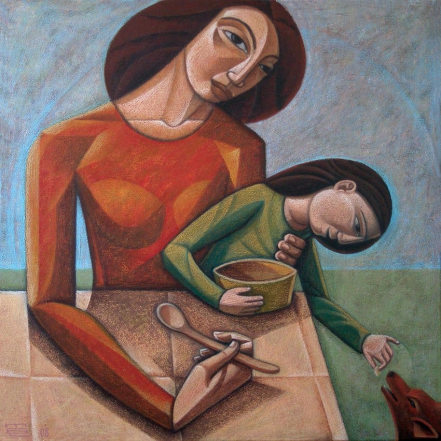
We might find it shocking at first to hear Jesus say, “It is not meet to take the children’s bread and to cast it to dogs” especially as it was considered an insult to call someone a dog. After all, dogs were the unclean scavengers of the street often savage and diseased. Yet the Greek word for dogs used in the text referred to household pets rather than the mangy mutts to be found on the local rubbish tip. Sensing that Jesus was engaging in a bit of banter, the Gentile woman with the sick daughter was quick-witted enough to reply, “Yes Lord; yet even the dogs eat of the crumbs that fall from their master’s table”. Now how could Jesus refuse when faced with such faith, love and unswerving persistence? In fact his response foreshadowed the going out of the Gospel to the whole world, so that in a sense we are truly heirs of that woman’s simple faith, as the love of God embraces the whole of creation.
She may have been an outsider, yet she was a mother in need whose audacious love and unflinching faith forced her to her knees in adoration of the One she called Lord, so that together with a tenacious and unwavering hope she opened her heart to God’s healing touch. Yet the truth is that the heart of Jesus is always open to us in our various needs and especially to the needs of the poor, the marginalised, the sick and the suffering. And he calls us as his followers to share in his love and compassion to the outsider, for that is where he is to be found today, huddled in a doorway on street near us, in the home of a lonely person who never sees anyone from one week to another, on the wards of our overstretched hospitals and in the soporific lounges of our elderly care homes, in the squalor of our failed prisons and detention centres, and with the victims of sexual, physical, mental and spiritual abuse.
Geoffrey Studdert Kennedy, the Anglican priest and poet, known as “Woodbine Willie” for handing out cigarettes to the troops in the trenches, wrote a poem called Indifference while he was a chaplain during the First World War. In his poem, Kennedy compares the behaviour of Christ’s contemporaries with the indifferent behaviour of some towards the stranger and the outcast today, and challenges us in Lent to consider whether we are following Christ to Golgotha:
When Jesus came to Golgotha, they hanged Him on a tree,
They drove great nails through hands and feet, and made a Calvary;
They crowned Him with a crown of thorns, red were His wounds and deep,
For those were crude and cruel days, and human flesh was cheap.
When Jesus came to Birmingham, they simply passed Him by.
They would not hurt a hair of Him, they only let Him die;
For men had grown more tender, and they would not give Him pain,
They only just passed down the street, and left Him in the rain.
Still Jesus cried, ‘Forgive them, for they know not what they do, ‘
And still it rained the winter rain that drenched Him through and through;
The crowds went home and left the streets without a soul to see,
And Jesus crouched against a wall, and cried for Calvary.