
Can You Keep a Secret?
By Dennis Broe
In a television landscape where working class-centred series are few and far between, here are two which present the trials and tribulations of that class as well as their antagonism to the class above as exemplified in the U.S. hegemon.
The better and clearer of the two is the BBC’s sit-com Can You Keep a Secret, which begins with its major secret, kept by an elderly West Britain village couple and revealed to their law-abiding son. The secret is that the son’s father, who he presumed was dead, has faked his death and the couple, led by Absolute Fabulous’s Dawn French as Debbie Fendon, is now pocketing the insurance and state money from his demise.
Their working-class logic, outlined by Debbie, for what the law would term fraud, is impeccable. Her husband has Parkinson’s Disease, which the insurance company told them it would not cover. So, she says, after a lifetime of paying their taxes, following the rules and never getting arrested, “what have we got to show for it? A dingy house in the middle of nowhere with a dodgy boiler and a garden full of fox s–t.”
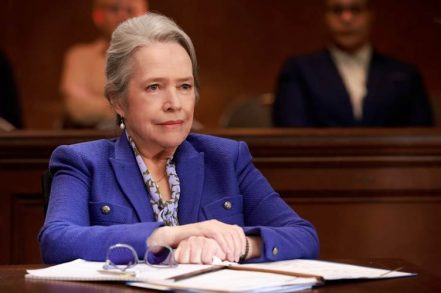
All this hints at the desperateness of the tail-end of life for a class that is on its last legs, for which fraud is as good a recourse as any to survive. Dawn French’s exuberant elder in this series is the equivalent in this television season of Kathy Bates’ lawyer avenging her daughter’s death facilitated by a corporate law firm in last season’s Matlock. Both series deal in a highly dignified way with the aged, the detritus of capitalism, and with the problems and the triumphs of that age group, attempting not to be forgotten and in the parents’ example, full also of sexual energy.
What does Debbie do with, in her mind, her not ill-gotten gains? One thing she does is give it back to the community, in the form of a donation to a cultural centre for her town, which like many others in Keir Starmer’s austerity Britain, is starved for funds to support communal activities.

Unfortunately, the series, as the episodes move along, loses the focus on ageing and centres on a blackmail plot. It is hoped in season two that the original focus will return.
More complicated and in a way more damning is Hulu’s and Australian streamer Stan’s series, with two Americans in the lead, Sunny Nights. Will Forte (The Last Man on Earth) stars as one half of a brother and sister duo, Marvin and Vicki Martin, who in their attempt to launch a sunscreen company inadvertently get involved with a group of low-level Australian mobsters and con artists.
The trick here, which the series only partially acknowledges, is that the American upper-middle class entrepreneurs are more ruthless than the gangsters, who despite their crimes are solidly rooted in a working-class Australian milieu. Martin is conned and then blackmailed but it is Vicki who deals the murderous blow to the gangster who is threatening them.
Vicki is at first the more ruthless of the two, wanting to blow up a rival company’s stock but eventually Marvin—with Forte initially doing a laid-back Jason Bateman from Ozark, then transforming after a talking-to by a business coach and channeling energy he derives from the murder—knifing the rival company’s stock in a murderous rage, which the series validates as him taking control.
When they acquire some money from the business, Vicki wants to spend it on herself rather than put it back in the company – just as at a higher level, American CEOs don’t invest in innovation but instead splurge on their own extravagant lifestyles.
The better part of the series though, and truly a wonder to behold, is the range of working-class low-lifes who populate not only the washed-up amusement park they use as a loan-shark and blackmail cover but also other walks of life.
There is Suze who lures men into the honey trap, but who really wants to break free of this life and buy a motel she can share with her disabled father. And Mony, whose violent rage owes to loyalty to her brother and who explains the battered amusement park was where the two used to play as kids. There’s ex-rugby player turned enforcer Terry, who desperately needs money for an operation to save his life after a game injury; the rotund pest control female officer, who aspires to be journalist-detective, and many more. The series is a veritable instruction manual on how to create a range of varied characters by tying them to their working-class backgrounds.
Inadvertently, it also functions as a critique of the ruthlessness of the American entrepreneurial impulse, which in one instance sees the businesswoman Vicki steal the money that the rugby player Terry needs for the operation that may save his life.
This savagery is disguised under well-worn corporate cliches like “help us help you,” and “if we succeed you succeed,” an ethos even adopted by the gangsters as one of them, trying to get out of their life of crime says, “I’m looking for an exit from my current employment situation.”
This review is a preview of “Short Term Gain for Long Term Pain,” Episode 4 of Lies, More Lies and Damn Media Lies https://liesmoreliemedialies.substack.com/