By Nick Moss
The absence of working-class voices from cultural life is something I have raised here and elsewhere repeatedly. There are, though, other questions which necessarily follow on from this – how might we organise to make things otherwise, and just as importantly, what should we anticipate from working-class writers when they have access to platforms which allow them a voice?
In periods of reaction, it is important not to expect working-class writers to be untainted by the times in which we live – revolutionary purity is not an option for us. A point I have tried to sketch out previously is that young drill rappers for instance will, as well as detailing police oppression and the impact of poverty and racism, also at times evidence misogyny, homophobia and crass materialism in their lyrics.
That should not mean either that we refuse to recognise the importance of the best of their works, or that we disengage from them, and hold our noses. The gap between the left and the lived experience of the working class has become such that we cannot recover this ground by holier-than-thou judgement.
A recent case in point is Free Ireland, a song and video by rapper Jordan McCann and Dublin singer Conor McLoughlin. Jordan belongs to a well-known criminal family in Salford, and has been convicted for crimes including violence, armed robbery, gang affiliations and drug dealing. He started a rap career behind bars and has produced lyrics that combine acute social observation about the circumstances of his early life with an unflinching account of his own violence. This, for instance, is from his 2021 Daily Duppy performance:
Ever had nowhere to sleep and had to roam the street
Ever had nothing to eat and had to starve and freeze
Ever been evicted and seen your ma on her knees
Single mum 7 kids in her car no heat
Bro this shit’s too deep some things I can’t speak
I’d die on my feet before I live on my knees
9 grand upfront 6 months on the keys
Next day 9 grand went and fixed up my teeth
Bro I blew 20 quid and wasn’t home all week
Who the fuck comes home like me? It’s either prison cells or the baddest AP’s
All or nothing there ain’t no in-between
I used to have an old john now my thing’s got a beam
Had a lot of friends now they’re nowhere to be seen
Operation Gulf took them all of the scene
Bro my dad was a fiend I got crack in my genes
[/vc_column_text]
In the same performance, Jordan states:
I know these racist pricks don’t like me, cos I’m lively, big fat white pikey
I’m in Salford everyday come find me
I know these racist pricks don’t like me, cos I’m lively, big fat white pikey
By 2025, then, it comes as bit of a surprise to find Jordan and McLoughlin singing “Free, free, free Ireland from all the trouble and the violence. Free, free, free Ireland from all the Guards and the migrants.”
Also, this is in a video that features a clip from the November 2024 race riots in Dublin, in the wake of a young child and others being stabbed in Parnell Square. How is it that someone willing to call out “racist pricks” and indict the nexus of poverty and state violence that trapped his family, and who once rapped “I don’t judge nobody ’cause I know I got no right” is, four years on, giving voice to lyrics that became an anthem for anti-migrant protestors in Ireland?
I think that one cause is precisely that awareness of state violence and the direct impact it had on his own family. As Jordan sets out in his first “Fire in the Booth” appearance:
Left my mum a widow, seven kids, she’s a real G-She’s a real G, the system killed my daddy, I won’t ever let it kill me.
If you’ve spent most of your life at war with the cops, with the screws, with the Parole Board, then your first instinct is to show solidarity with anyone else who comes into conflict with the force of the state. To the extent that there has always been an anti-police element to the riots that spread across the UK and Ireland in 2024 and 2025, it’s not surprising that Jordan would be drawn to sympathise with those involved:
We’re McCanns and we’re hated, no man, seven kids
Mum you’ve done amazing
Come a long way from Chedworth Crescent, sharing trainers
Armed police would raid us
Guns and tasers, that’s why I fucking hate ’em
The issue is that he fails to see refugees as equally victimised by a state that criminalises and pauperises them, and uses them as scapegoats for the polarisation of capitalist societies between extremes of wealth and increasing poverty. Which begs the question of why it is that Jordan is closed off to the wider context of the targeting of refugees by the far right, and why he has chosen the side of the racists.
One reason relates to the specific historical circumstances of the 32-county state. At the start of the ‘Free Ireland’ video, a man in Dublin is shown shouting at a line of gardai in riot gear: “The batterings will continue until the plantation is complete.” This has been seen as a reference to the ‘Great Replacement’ theory, now common currency on the right. No doubt; but there is also a specific Irish context which needs to be taken into account. The reference to “plantation” is analogical to specific events in the colonial assault on Irish identity.Plantations in 16th- and 17th-century Ireland involved the confiscation of Irish-owned land by the Crown and the forced redistribution of this land to settlers from Great Britain. The main plantations occurred from the 1550s to the 1620s, the most significant of which was the plantation of Ulster, the biggest of the plantations of Ireland. It led to the founding of many of Ulster’s towns and created a lasting Ulster Protestant community in the province which identified as British and saw its interests as aligned with the British state.
Prior to plantation, Ulster had been the most Gaelic province of Ireland, and the most independent of English control. When Irish working-class youth see in migration a form of plantation, they are wrong on the facts but in the absence of counterarguments from the left, the ‘plantation’ analogy has unsurprisingly cut through.
Yet far from gaining, migrants and ethnic minorities living in Ireland face a disproportionate risk of homelessness. They are most at risk of discrimination by potential landlords and have an evidenced over-reliance on the precarious private rental market. Migrant groups are significantly more likely to live in rented accommodation, with 48% renting compared to 9% of those born in Ireland. Specific groups within the migrant population are represented more than others, 80% of nationals of eastern-EU member states are residing in rented accommodation, this being linked to the concentration of this cohort within lower-paid employment with higher job precarity.
Since January 2024, nearly 3,000 people in Ireland seeking international protection have not been offered temporary accommodation, despite the legal obligation to do so. Many of them have been forced to sleep rough, a situation made even more unsafe with the rise of various protests and social tensions throughout the year. Parts of Dublin are now tent cities for large groups of homeless and vulnerable refugees.
The key issue, though, is the absence of the left from the most disadvantaged working-class communities. The response of the Irish left to ‘Free Ireland’ has been symptomatic of the faultline between the left and the working class. In response to the McCann/ McLoughlin video, Damien Farrell, of Dublin Communities Against Racism, stated in the Sunday World that “Rap artists like this have a media platform and inherit a space where the person who is loudest is heard the most.” Aside from the tautological aspect of this last statement, I’d argue that it’s actually in drill rap videos that those normally least heard are for once given space to speak. Farrell goes on to admit that he hasn’t seen the video or heard the song – but this doesn’t prevent him from feeling qualified to comment. After all, it’s just some pikey from Manchester – who needs to bother to put in the basics or do a bit of research? The power imbalance between the ‘respectable’ left commentator and the white-trash Salford Irish crim, means any shit will stick.
Farrell goes on to add that “It is the hidden voices that Dublin Communities Against Racism represent that we are trying to encourage.” Now DCAR seems an admirable organization, and its analysis of the situation as regards homelessness and racism is acute. They rightly identify:
….the abject failure of the present and previous governments to provide adequate housing for the people of Ireland is due to an ideological affinity with private property that only serves developers and landlords, including foreign vulture funds. The fact alone of 166,000 vacant homes fully demonstrates this … We call on people to reject the propaganda of the far right that there is no housing crisis in Ireland, no health crisis and no cost-of-living crisis but simply an immigration crisis. This lie only serves to whitewash the failures of the establishment and is designed to do so.
All well and good. The problem though is with the idea that the “hidden voices” of Dublin do not include kids on estates in North Inner City, Ballymun, Tallaght, Finglas, and Clondalkin. The reality is that these kids have no voice at all. No one cares about what they have to say or is willing to give them any kind of platform. There is also little point in having an analysis of racism, fascism, housing etc. that does not get argued out and put into practice primarily in those areas where poverty, poor housing and crime are most entrenched.
Nor is an anti-fascism focused only on building a coalition of the victims of fascism likely to succeed. What is required is an anti-fascism that sees those targeted by the far right as potential recruits and seeks to win them to the left. The poorest, most disadvantaged estates should be the natural constituency of the left, and the fact that the left has ceded this terrain has given the far-right free reign. So, when Jordan McCann, whose life experiences incline him to an anti-police, anti-systemic ideology, looks at who is fighting the police in Manchester or Dublin at the anti-migrant protests, he sees kids who look like him. Meanwhile, the left retreats further to its campus / third sector comfort zone and shuts itself off from the “hidden voices” of the inner cities.
The left has to engage with the working class as it is, and that we are failing substantially in our battle to democratise culture and give voice to working-class creativity, if someone like Jordan McCann should become lost to the far-right. Because McCann knows all about state violence and the need for solidarity, and is able to give voice to it in a way that connects to a young working-class audience, who should be driving scum like anti-immigrant activist Gavin Pepper out of Ballymun-Finglas rather than helping them get elected there. Last word on this debate to Jordan McCann:
You should blame them screws for the way that I was treated
Nine years of my life fighting for freedom
Down the block freezing, I’ve seen real guys turn weakling
Segregation beating, at his door screaming
Cut his wrist, bleeding
Screws told him “Shut up before we send a team in”
Heart sinks, the next morning found his body leaking
When I say “Fuck the system”, understand the meaning
That was my friend, imagine how I was feeling.
Work as degradation
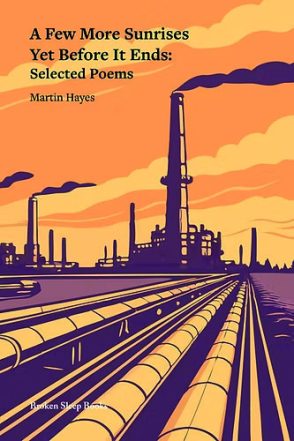
Broken Sleep Books have just brought out A Few More Sunrises Before It Ends — Selected Poems by Martin Hayes. Alan Morrison has already reviewed this at length in Culture Matters – it is an extraordinary collection and establishes Hayes as the equal of those poets of work and working-class life whose inspiration he has always, properly, acknowledged. The influence of Charles Bukowski and Fred Voss is most apparent, less in terms of style than in the way he refuses to have his imagination shackled by the subject of working for a living, and allows his writing to spiral off on wild discursive flights.
Fred Voss used to sometimes come off like Jim Morrison on a Harley, swigging tequila and refusing to let his beatnik soul be chained to the lathe. There’s some of that here, but it manifests also as what Andy Croft in his introduction describes when he says that “this book doesn’t have a beginning or an end; there is no narrative arc. Each poem represents an obsessive returning to the scene of the crime.”
In Problem Solving, which opens the book, Hayes writes of his employment as a dispatch room supervisor in the courier industry: –
we sit at control points
having to repeat things over again and again and again
until the blood starts pounding inside our heads and necks
hoping that the courier down the other end of the line
is getting enough fragments of it enough
for it to make some sense.
In the book’s last poem, The Definition of What’s Not a Machine, this definition is set out as:
when you can measure
evil or good
by the instinct inside your guts
rather than by a calculation
when there is an urgency
in the things that you do
because you know that one day you will die.
On the terrain between these two poems, from the book’s first words to its last, a struggle is waged between an absolute alienation, and a stoic Romantic sensibility which in The Ground-In Dirt refuses to submit to the fact that:
…there is some dirt
that is so ground in that
you will never get it clean.
Resistance in this modern, casualised, hyper-managed workspace, often comes as meltdown, because “this job has us in its mouth and is shaking us about in its teeth / as debt runs through us like streams of poison.” (p 104). Hayes can sketch the essence of work as degradation, as a constant process of undermining, in a few simple lines in Calling in Sick:
cynicism and disbelief were rife in a supervisor’s mind
at the best of times
but when it came to illnesses
and reasons for days off sick
that’s when they really could show
how much humanity
they had been able to lose
That’s Hayes’s Romantic sensibility, right there – the recognition that somewhere along the line, the bastards who revel in crushing us have had to somehow also crush themselves. We become, as a result of work, “the participants/ who try to drink the memories from their minds/ the fear from their eyes/ and the trembling from their guts.”
What Hayes is really great at is recognising that solidarity can sometimes simply be about getting someone through the day, or sharing a drink and a moan. One of the failings of art produced so as not to offend is that it misses the point of a part of working-class speech, which is about a kind of coded recognition, a way of talking sometimes complete shite just to say to someone else “I get you. I live that life too.”
James Kelman does it brilliantly. Irvine Welsh does it. So do Janice Galloway, Roddy Doyle, and Alan Warner. Middle-class fiction and poetry assumes that what’s said always reflects a similar interior dialogue, so that things are either surface or depth, when in fact it’s normal for someone to exist and communicate at several different levels at once – bantering about the footie while thinking about a pay offer, the need to put money aside for Christmas, mum’s health, and the latest bullshit from Trump. Martin Hayes’s work is so great because it recognises this and can incorporate all these facets into a poem, all at once.
What also makes Hayes a great poet, and what means he’ll never be taken under the wing of the poetry establishment, is his hatred of most of what passes for poetry, as in ROAR!: –
poets are always trying
to write about something
the trouble is
It often doesn’t mean anything
because none of their lives
are ever falling apart
quite enough to make their poems
ROAR! ROAR! ROAR!