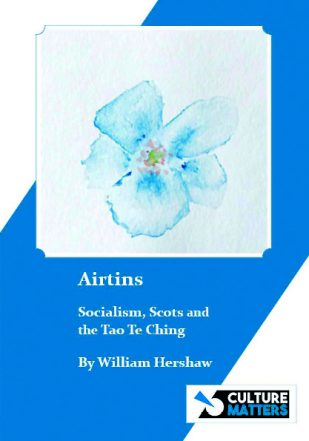
Airtins is available here
By Geoff Bottoms
For those of us who are “sassenachs” this collection of poems in the Scots language can be a challenge for many, even with the helpful glossary at the foot of each piece. Yet persistence pays dividends, as eventually the poetry works its strange and beautiful magic and the meaning gradually becomes clearer. In any event, the sheer flow of the gentle yet powerful language has the effect of washing over the reader in a way that is both healing and motivating.
And that is the point, as the collection seeks to translate and express the wisdom of the Chinese philosopher Lao Tzu or Laozi, to be found in his classic work, “Tao Te Ching,” dating back twenty-six centuries. For William Hershaw the Scots language is a suitable medium for Lao Tzu’s teaching, as it lends itself to the “idea of duelling polarities within one entity,” implying a balance between light and dark, life and death, and right and wrong; similarly, Marxism speaks of “contradictory unities,” where internal and external struggles between opposing forces drive them to change.
Lao Tzu called his direction in life “The Way,” which explains the title of this collection of poems, “Airtins,” meaning guidance in the Scots language, and refers to being in harmony with the world rather than trying to control it. In his Epigrams he writes, “Them that flaw as life flaws need nae ither airtin haund” (Those who flow as life flows do not need another guiding hand).
Yet this does not mean complacency in the face of present-day horrors as he advocates pragmatism in the form of a practical, green, cultural and spiritual socialism by which we are called to co-operate by saying “aye” before “naw.” In his poem “The Puir Fowk” Lao Tzu calls out injustice with the words, “The puir fowk’ll thole until they rise up. The rich mak leivin deir, by pricing the puir lives cheip” (The poor folk will suffer until they rise up. The rich make living dear, by pricing the poor lives cheap).
The collection is in four parts, illustrated with beautiful watercolour drawings of a snowdrop, Scottish primrose, dandelion and rosehip by Mary Hershaw, suitably complementing the cadences of the Scots language as it engages with Lao Tzu’s moral and philosophical guidance. While certain liberties have been taken by Hershaw, the first part translates eleven of Laozi’s poems, and sets the tone by introducing us to “The Way.” One of the poems reads, “The Wey gaes on, is greater than aa. The Wey raxes faur, The Wey gaes aawhaur, And ayont syne retours” (The Way goes on, is greater than all. The Way extends far. The Way goes everywhere. And beyond then returns).
Here again the idea of water as a metaphor for “The Way” is employed and used throughout the collection. In Hershaw’s words, “The distribution and function of water is symbolic of equality, justice, and the preservation of resources.” Water sustains everything as a life-giving force that is both gentle yet powerful, reinforcing the sense of balance and equilibrium that is central to Lao Tzu’s thought. To quote one of his Epigrams again from the third part of the collection, “Water is the saftest thing yet it maun pree the haurdest mountains and stane” (Water is the safest thing yet it may penetrate the hardest mountains and stone).
The anti-establishment voice of the Scots language
In the second part of the collection Hershaw writes poems inspired by Lao Tzu reflecting his own personal experience. Taking his cue from the idea of discovering by searching he is humble enough to admit in his poem “Equilibrium” that “Tae ken the unkennable’s nae kennin avaa – the closest ye’ll come is the fauthest awaa” (To know the unknowable’s not knowing at all – the closest you’ll come is the furthest away). Yet his confidence in “The Way” is borne out by another Epigram that affirms “Takkin tent o the Wey I micht walk faur and never be feart I’m forewandert” (Paying attention to the Way I might walk far and never fear being lost).
The final part of the collection comprises a Taoist perspective on Scotland itself with poems celebrating both the beauty of the Scottish landscape with its rivers and their headwaters and the anti-establishment voice of the Scots language. A coda of rivers at the end of the final poem has a refrain, “Tae be life, tae gie life, sing we our nemmes” (To be life, to give life, we sing our names).
This is juxtaposed with Hershaw’s outspoken and forthright rejection of the lived experience of colonialism promoted by the far right in his poem “Flag o a Deean Empire” (Flag of a Dying Empire). “Britannia’s braggart clout, imperial stramp o conquest, vauntit by the faur Right, xenophobes, slavers, racists, supremacists, immigrant haters Hingan ower public life, turning yella slawly in the barrack’s museum supporting leears (liars) at lecterns scraighan (screaming), We rule here.”
A socialist antidote to the crises of capitalism
For those seeking a better world where all can live harmoniously and peacefully with each other and with the planet, which the late Pope Francis described as “our common home,” this beautifully crafted collection of poems, embracing the thought of Lao Tzu, is a socialist antidote to the crises of capitalism with its existential threat to humanity. In the present climate the poem “War” is especially prescient. “Their wappinschaws bring wae and hertskaith. Furred merchants grouw fat sellin murderous graith” (Their military parades bring woe and heartbreak. Furred merchants grow fat selling murderous weapons).
On the whole the Taoist message of the poems may not be revolutionary, yet its call to work together in the belief that small steps can lead to eventual and substantial change provides us with a balanced, sane and humane perspective in a polarised world that can be described legitimately as “airtit”.
Airtins: Socialism, Scots and the Tao Te Ching, ISBN: 978-1-912710-93-5, 95 pps, 4 colour illustrations, £12 inc. p. and p. is available here. The translations of the poems quoted in this review are the responsibility of the sassenach reviewer, who apologises for any unintended discrepancies. (I share responsibility – sassenach Ed.)