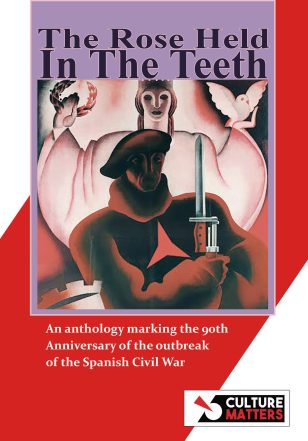
Book cover
The Spanish Civil War erupted in late July, 1936. To mark the anniversary, Culture Matters has just published this book, an anthology of poems selected by Alan McGuire and Alan Morrison. It is available here as a printed book and here as an ebook. Below we reprint the Foreword, by Alan McGuire
Living in Madrid, football is hard to get away from. Down Gran Vía, the capital’s main shopping avenue, there are Atlético and Real Madrid stores, and even a Barcelona one. Then there is Madrid’s biggest attraction: the Bernabéu Stadium. Honestly, even if you aren’t a Real Madrid fan, you’ll probably like it. Interactive screens, trophies galore and a tour around the stadium all at the same time. But what interests me isn’t football. It’s where the stadium is and the legendary rivalry between Real Madrid and Barcelona.
Around the Bernabéu are some of Madrid’s wealthiest neighbourhoods. The Paseo de la Castellana, the avenue the stadium stands on, is the backbone of the city. Start at Recoletos, the street from which the Castellana later grew, and you can almost walk through the development of modern Madrid. Firstly we have what were once aristocratic palaces, many of which later became foreign embassies. Today, the embassies have moved, but the old grand palaces now house the cultural foundations of multinational banks, sponsoring art exhibitions and networking events, while others are occupied by international organisations and EU agencies that seem to exist simply to keep the global order going.
Keep heading north and the story continues. First comes Plaza Colón, celebrating Spain’s “discovery” of the Americas. Then there is Nuevos Ministerios, a series of government buildings begun under the Republican government and completed under Franco. The modern classicalism/rationalism architecture reflects the ideals of the Second Spanish Republic, such as a belief in the modern state being able to plan rationally and efficiently, but it also holds elements that would come from the Francoist state, such as centralised power.
Next comes AZCA, Madrid’s first financial district, started during the final years of the dictatorship and completed in the early decades of democracy. This represents a Spain looking forwards towards global capital and becoming a modern European nation fully incorporated into the European bloc, and NATO, both of which would happen by 1986, just 11 years after the death of Franco.
Further up are the Puerta de Europa towers, and a skyline decorated with Madrid’s Four Towers, or four and a half now. They were built in the 2000s on land sold by Real Madrid president Florentino Pérez. The land had originally been gifted to the club by Franco on the condition that it could only be used for sport. For years the club tried to sell it without success, until the well-connected former city councilor Pérez came along and made it happen. Coincidentally, he also owned Spain’s biggest construction company, which went on to build the Four Towers on the land he had helped to sell.
How the Civil War is remembered in Spain
The story of modern Spain is written throughout its landscape and by the people who have lived, travelled, fought, procreated and died here. Once you start following the narrative, one story leads into another.
Yet learning the official narrative often leaves you with more questions than answers, as everyone seems to have an alternative version. The fact that the late dictator’s family continued to own major car parks in the capital until little more than a decade ago tells a rather different story from the mainstream narrative of Spain’s transition, one that, until recently, was accepted by many on both the left and the right.
The official narrative, which was arguably written by Spain’s largest left-of-centre newspaper El País, the monarchy, the country’s growing urban middle class, and the Spanish Socialist Workers Party (PSOE), says that Spain had a peaceful and bloodless transition from authoritarian dictatorship to modern-day European democracy.
The Spanish Civil War is often treated as a singular historical rupture, while its aftermath is filed away as something separate, a forgotten echo of a dictatorship in modern Europe created by the violence and neglect of Great Britain, France, Italy and Germany. However, in Spain, the war continues to leak. It shapes the language of politics, the memory of the streets, and the uneven visibility of state violence.
Unlike the global framing of the First and Second World Wars as clashes of empires or moral binaries, Spain’s war cannot be simply framed in terms of good versus evil. It was not just a conflict between distinct ideologies, but a war over the structure of society itself: the ownership of land and labour, who should hold authority, the role of faith, and the legitimacy of democracy. It was a coup d’état by the army against a popular front government that had legitimately won a general election just weeks before.
The rebels from within the army framed the war as a spiritual crusade by good Catholics to root out godless communist and Freemason influence. The anarchists claimed it was the revolution that was lost. The Communists argued it was a fight for democracy and against fascism. With all these narratives flying around, it’s often forgotten that where you lived could determine who you ended up fighting for, whether you agreed with their ideals or not.
A well-known example is that of the Machado brothers. The poet Antonio Machado supported the Republic and died in exile in France in 1939, while his brother, Manuel Machado, found himself in Nationalist-held Burgos when the war began and remained in Francoist Spain. Manuel later wrote in support of the regime, however various historians have claimed his position as more complex than a simple political ideal. Their story is a popular example of how the Civil War divided families and friends by circumstance. It wasn’t about choosing a side, as many Hollywood war films would have us believe; it was a matter of life or death.
One narrative that stays true is that the Spanish upper classes have never felt that the working classes have a right to administer the state and the future of the country. That was true then and it remains true now. One common feature that today’s political discourse shares with the discourse of the war and dictatorship is the framing of ideological and class opponents as the other, a dehumanising effort. It was this discourse that gave legitimacy to the dictatorship and the Civil War.
The Pact of Forgetting
The Civil War did not simply end with the rebels’ victory in 1939. It was followed by decades of repression. The Franco regime imprisoned and executed hundreds of thousands of Republicans and those suspected of opposing the dictatorship. Political censorship and persecution continued well into the 1970s, limiting public discussion of the war and, with that, society’s ability to process the violence it had witnessed. Even after Franco’s death, those fighting for a fairer settlement and justice for the past faced resistance from the remaining Francoist state, as the Transition prioritised political stability over confronting the crimes of the dictatorship.
The postwar dictatorship, and later the democratic transition, can be read as re-articulations of the same struggle for the direction of the country and its meaning, with each stage fighting over how an acceptable narrative of the Civil War can be told and taught. The Pact of Forgetting, a name often given to the unwritten political consensus of the transition years, offered political stability but it brought silence for those who wanted to speak and freedom for those who had committed crimes. The clearest legal manifestation of this consensus was the amnesty law of 1977: it freed all political prisoners from Francoist prisons, yet it also meant no one could be prosecuted for any crimes committed by the state during the dictatorship.
Many people have criticised this move; however, at the time there was a real fear that the very powerful Spanish Army would overthrow Spain’s delicate fledgling democracy. There was an element of truth in this, with the attempted coup in 1981 being the proof. However, the critique is often flattened, and it is more about how the official narrative has not been challenged enough by the more liberal parts of the state apparatus and society.
The Historical Memory Law
Since the passing of the first historical memory law in 2007, the silence of the victims of Francoism has started to speak again. Historical memory returned as a site of struggle. This is not an abstract argument. It is embedded in place. Spain has more than 2,000 known mass graves from the Spanish Civil War and the Franco dictatorship, containing the remains of tens of thousands of people who were executed and buried without identification. Clive Branson easily predicted this in his poem ‘December 1936, Spain’, written in June 1939:
They who lie so still
with no Cross,
only this, their courage, their faith
manures the barren earth
for new trees
to spring up the hill-side to the very sky.
The first historical memory law aimed to give victims’ families the right to exhume their relatives. It was later defunded by the right-wing People’s Party, and it was not until the updated Democratic Memory Law of 2022 that responsibility for exhuming these bodies was placed on the state itself. The cities themselves become a site of dispute.
Buildings associated with repression continue to function as administrative centres of the state without any acknowledgement. The main office of Madrid’s regional presidency, in the very centre of the city at Puerta del Sol, where New Year is celebrated on TV every year, was once a police station where political opponents were tortured and even murdered.
Even literature has to deal with the disputes of history. Writers like Miguel Hernández wrote poetry as a form of political expression but also as a means of survival during his imprisonment in a Francoist prison and his subsequent death. In 2026, newly examined Francoist military documents added evidence to the historical context surrounding the poet’s death. A report written in June 1940 acknowledged that the poet had been sentenced to death for acts of “little significance,” reinforcing the view held by many historians that he was punished primarily for his political ideology and his work as a writer rather than any major crime.
The documents also show international efforts to save Hernández’s life. At the request of Pablo Neruda, the Chilean diplomat Germán Vergara Donoso appealed directly to the Falangist minister, while also sending food and financial support during his time in prison. These interventions helped reduce his death sentence to a sentence of thirty years in prison. And while formally his execution was prevented, Hernández died of tuberculosis in prison in 1942. It’s often argued that this was neglect, and intentional.
Poetry as therapy
New archival research such as this continues to shape Spain’s understanding of the conflict and its aftermath, yet that also means the history of these events continues to be a site of political struggle between the left and right, with “enlightened” liberals often taking an equidistant stance on history to avoid taking sides at all. But whether it be modern-day liberals or the fascists of the 1930s, poetry continues to highlight the injustices faced and the emotions that drove people from all over the world to defend popular democracy.
Poetry acted as a witness statement and a picture of a crucial moment in history. There were plenty of poets and writers who weren’t just there for material, but were there to defend what they believed, as Alan Morrison points out in his poem ‘Black on Coral Red’:
An unprecedented splash of poets & assorted men
Of letters put aside their pens for weapons in defence
Of Spanish democracy: Communist poets…
The years of Spain’s democratic Transition were marked by unanswered questions. Many families, both across Spain and those exiled outside it, still did not know what had happened to family and friends who had disappeared during the Civil War and the Franco dictatorship. The Transition brought democracy, but it did not help these personal histories; in fact, for some it made it harder. Here, Ian Gibson’s The Death of Federico García Lorca became more than a biography. Writing about the poet’s final days and investigating his murder, the book was a therapeutic source for Spaniards who had been working through their personal pain in private. As debates over historical memory have continued, his disappearance has become a symbol of the thousands of victims whose remains have never been recovered.
Gibson has argued that Lorca belongs to everyone still looking for answers about relatives who were never given a funeral. Lorca has a disputed place in public life: he is celebrated by people across the cultural spectrum, from the PSOE to Podemos, the LGBTQ+ community, and regional institutions and governments. It’s a wider reflection of the way his life and death became a symbol of Spain’s complex and disputed efforts to understand its own history.
Franco’s afterlife & the ghost of Falangism
Equally, the figure of Francisco Franco is also celebrated. An eccentric Chinese man famously owns a bar in a working-class neighbourhood in the south of Madrid. You can buy bottles of wine with Franco’s face on and Spanish-flag dog collars there. The owner has bragged that some members of the national police are regular customers. Franco also continues to be a hero of the North American far right as they look to him as an ideal for today.
Furthermore, the ideas of the dictatorship live on in some of the state’s repressive apparatus and in the country’s economy. The legacy of Francoism continues, with defenders of the regime often having some historical link to the dictatorship. Even though a law has been passed prohibiting the celebration of the regime, the fascist salute and the eagle-adorned Spanish flag remain a common sight and the Falange party continue to stand candidates in elections.
However, the biggest political party on the right, the People’s Party, was indeed set up by ex Francoist ministers. As the saying goes they went to bed supporters of Francoism and woke up democrats. As María Olivares shares in her poem ‘Route of the Water Battle’:
I wonder about the thin line that separates
here and now, our memory from our humiliation,
while the descendants of the genocidal ones
can publicly celebrate this battle.
Even today, Barcelona and Real Madrid continue to argue with each other over social media about who was closer to Franco and his regime. But this argument only shows that history isn’t simply black and white; much like the photographs that document it, there are various shades of grey that make up the whole picture. It’s here where poetry from the people who were there, and from those reflecting on the situation, helps us learn about all the bits in between that give us the full picture of the Civil War and Europe’s fascist dictatorships, which continued well past 1945.
Looking at the Spanish Civil War is not only learning about a war. It is learning about an ongoing struggle over memory and class power that brings us to the present day. John Cornford put it clearly himself in his poem ‘Full Moon at Tierz: Before the Storming of Huesca’:
Time present is a cataract whose force
Breaks down the banks even at its source
And history forming in our hands
Not plasticine but roaring sands,
Yet we must swing it to its final course.
The Rose Held In The Teeth: an anthology marking the 90th anniversary of the outbreak of the Spanish Civil War, selected and edited by Alan McGuire and Alan Morrison, ISBN 978-1-918132-10-6, 84 pps., printed book £10, ebook £5.