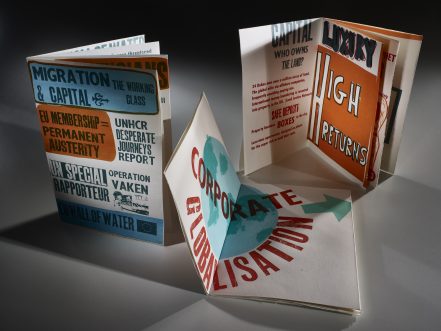
Migration and Capital: photo by Dave Lawson
By Theresa Easton
When the Coalition government of David Cameron and Nick Clegg introduced its austerity programme in 2010, the consequences were felt far beyond public services. Across the UK, council-run community spaces were closed or scaled back: libraries, youth centres, Sure Start centres, community arts venues and other civic institutions that had provided places for people to meet, learn, create and share.
The gradual erosion of civic space might have suggested the end of local cultural production. With fewer places to gather, fewer resources and increasing pressures on people’s time and finances, it would have been reasonable to expect community arts activity to decline.
In Newcastle, these contradictions were particularly stark. In 2008, Newcastle and Gateshead had mounted an ambitious joint bid to become European Capital of Culture. Although Liverpool ultimately won the title, the bid reflected a commitment to investing in culture as a driver of civic participation and regeneration. Yet only five years later, Newcastle City Council leader Nick Forbes announced the effective removal of the council’s arts budget in response to the financial pressures imposed by austerity. The contrast was striking: a city that had recently championed culture as central to its future was now withdrawing public support for it.
Yet cultural production did not disappear. In many cases it adapted, relocated and reimagined itself. Zine-making communities have ridden the waves of austerity and emerged stronger than ever.
What is a zine?
A zine is usually a small, self-published work, most often made from paper, although it does not have to be. Produced individually or collectively, zines are typically made in multiples to sell, swap or give away. Their DIY ethos places emphasis on accessibility, experimentation and autonomy rather than commercial success.
Historically, zines have provided a platform for voices excluded from mainstream publishing. They have been spaces for political discussion, personal reflection, artistic experimentation and community-building. Many zine makers embrace practices of re-use and recycling through collage, hand-printing and repurposed materials. In an era increasingly shaped by algorithmic content and generative AI, the handmade quality of zines has acquired renewed significance.
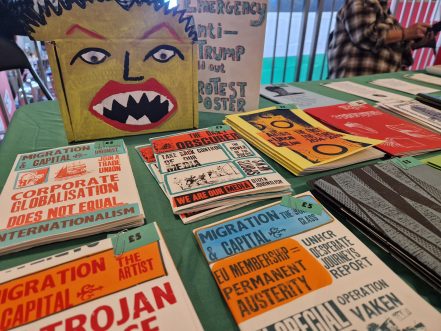
Table at zine fest
This was evident at a recent Tees Zine Fest, organised by Tees Zine Works, where participants were invited to create zines responding to concerns about creatives being displaced by AI technologies. The invitation was not simply about technology; it was about agency, authorship and who gets to participate in cultural production.
The zine community extends far beyond the act of making. It includes people who distribute zines, organise fairs, run distros, trade publications, facilitate workshops and create networks both online and offline. As scholar Alison Piepmeier argues, zine-making is an embodied practice. It is not only about the finished object but also about the social relationships and shared experiences formed through making and exchanging work.
The relevance of space
Cultural activity requires space—not only physical space but mental and emotional space as well. The loss of community venues, combined with increasing demands of work, caring responsibilities and everyday financial pressures, has made creative participation more difficult for many people.
Yet zine-making remains remarkably resilient because it requires relatively little. A kitchen table can become a studio. A photocopier can become a publishing house. A folded sheet of paper can become a platform for ideas, stories and resistance.
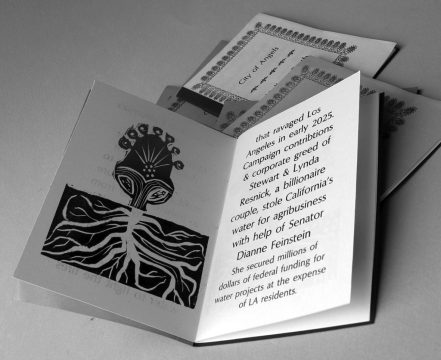
City of Angels by Theresa Easton
Making zines can provide temporary escape from the pressures of everyday life while also creating opportunities for expression. Feelings of frustration, anxiety or powerlessness can be transformed into something tangible. When zines are made collectively, these individual experiences often become expressions of solidarity. People discover that their concerns are shared and that private struggles frequently have social and political causes.
Zine-making as a research tool
In my own practice, I have been working with sanctuary seekers at Scotswood Garden in Newcastle. Through conversation, reflection and creative exercises, participants are invited to respond to questions and statements drawn from their lived experiences on “What is Sanctuary?”
Zine-making offers a unique method of research because it allows experiences that are often unspoken to become visible. It creates space for participants to reflect on marginalisation, belonging, identity and community in ways that conventional research methods may not capture.
The process can be verbal and non-verbal. Stories emerge through conversation, but they also emerge through drawing, collage, image-making and visual association. Thoughts and feelings become pages. Fragments become narratives.
In this sense, zines become sites of activism as well as documentation. Their portability makes them highly accessible. They can travel through communities, be exchanged at fairs, left in libraries or passed between friends. Ideas move with them.
Cultural democracy and citizen publishing
The principles of cultural democracy suggest that culture should not be something delivered to communities from above. For example, the 2018 The Great Exhibition of the North, Jake Berry’s vanity project could have been something created by communities themselves. Rather than concentrating cultural authority in institutions, cultural democracy emphasises participation, collective ownership and the recognition of diverse forms of creativity.
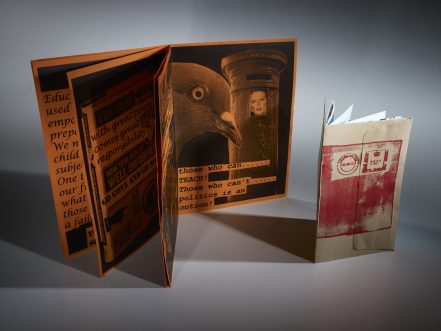
Gove zine: photo by Dave Lawson
This raises an interesting question: is zine-making a form of citizen publishing?
In many respects it is. Zine makers exercise direct control over content, design, production and distribution. They decide what stories are told, whose voices are heard and how their work circulates. There are no editorial gatekeepers, funding panels or market demands determining what can be expressed.
Sherry Arnstein’s influential “Ladder of Citizen Participation” offers a useful framework here. Arnstein argued that “participation without the redistribution of power is an empty and frustrating process for the powerless.” Zine-making does not necessarily redistribute political power in a formal sense. Producing a zine will not, by itself, change government policy or alter institutional structures.
However, zines do create spaces where people can exercise cultural power. They enable the circulation of ideas, experiences and critiques that might otherwise remain invisible. They can introduce anti-capitalist, feminist, anti-racist and community-centred perspectives to audiences who may not otherwise encounter them. In doing so, they contribute to the wider cultural conditions in which political change becomes possible.
Within Arnstein’s framework, zine-making comes closest to forms of citizen control. The creators maintain ownership over both process and content. Equally important, readers frequently become makers themselves. The distinction between producer and audience becomes blurred. Collectors, traders, organisers and participants all contribute to sustaining the wider zine ecology.
Making space for humanity
At their best, zines explore what it means to be human. They document everyday experiences, preserve overlooked histories and create opportunities for empathy in increasingly hostile environments.
Whether reflecting on experiences of migration, poverty, disability, gender identity, community organising or personal survival, zines make visible lives that are often excluded from dominant narratives. They remind us that cultural production is not the preserve of professionals or institutions. It belongs to everyone.
In an age of shrinking public infrastructure and growing economic insecurity, the persistence of zine culture offers an important lesson. Cultural democracy does not depend entirely on buildings, budgets or official recognition. It also emerges wherever people gather to tell stories, share experiences and make meaning together.
The survival of zine-making through austerity demonstrates that culture is not simply something consumed. It is something collectively produced. And in that sense, every folded page, photocopied image and stapled booklet becomes a small act of cultural democracy.
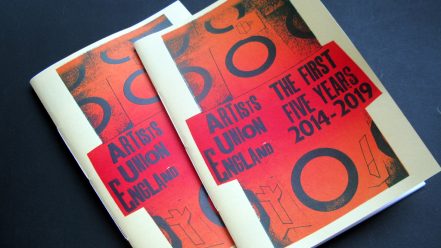
AUE zine by Theresa Easton