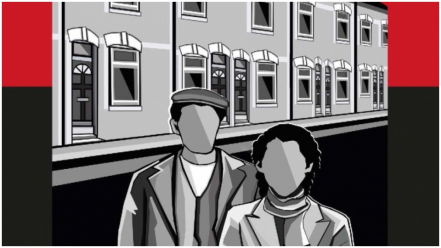
Image by Karen Dietrich
By Nick Moss
In the June/July 2026 issue of The London Magazine, the editors asked a broadly selected group of poets of some renown a series of questions. The first of these was Would poetry be more effective – that is, interest more people more deeply – if it were more directly concerned with the issues of our time?
The poets (Rachael Allen, Jorie Graham, Lavinia Greenlaw, Ishion Hutchinson, Luke Kennard, Nick Makoha, Ange Mlinko, Paul Muldoon, Don Paterson, Pascale Petit, Camille Ralphs, Sam Riviere, A. E. Stallings, Joelle Taylor and Hugo Williams) for the most part answered in the affirmative, albeit with qualifications as to, for instance, who “people” might be (and who decides this) and how the “issues of our time” might be determined. Jorie Graham’s response is perhaps the most powerful and substantial but also can stand as consistent with the response of the majority:
I’m not sure how any poems – real poems – can avoid being stained in some manner by the issues of their time. That concern can exhibit itself in the form every bit as much as in what we call the content. And what are the issues of our time anyway? We haven’t exactly transcended mortality. Our hearts are still being astounded by the surprises of love, as well as broken by them. So, Eros and Thanatos are still the main rivers running through the landscape of lyric poetry. Into that landscape now flow the crises of technologically induced loneliness, land devastation, late-stage capitalism – all of which exacerbate inequality. Woven into this is the unavoidable feeling that all other species are under assault alongside us. …Everyone in their own way is tackling the disaster from some particular, courageous point of view – tinged by the ‘everything everywhere all at once’ of this era. Yes, it’s profoundly difficult to bring ‘current events’ as such into one’s poem without trivialising the vastness of the networks afflicting all life – yet one feels one must try.
It would be difficult to take issue with any of this, and Jorie Graham is, in any event, one of the most extraordinarily wrenching and forceful poets working today – a poet whose work can be disorientating, distressing (because it captures so well the sense of a world being propelled towards its doom by a relentless, nihilistic, extractive capitalism) and yet also puissant and invigorating. However, two others among the respondents demonstrate still the kind of attitudes that made the development of Culture Matters as a space for working-class creativity so necessary.
Luke Kennard (currently longlisted for the 2026 Booker Prize) responded with this:
People really need to get over their learned helplessness and stop blaming poetry for their own shortcomings as readers or their stubborn, philistine refusal to engage with any kind of challenging or interesting writing. It’s pathetic. ‘Oh, I was put off poetry by the way it was taught at school.’ No, you weren’t. It’s 2026. Your English teacher was probably lovely, and you’re just repeating something journalists used to say in 1995. ‘Wah, poetry is elitist.’ Do you hear yourself? It’s embarrassing… If someone can’t find anything to engage with in the vast myriads of contemporary poetry or several thousand years of human culture and art it’s because they’re not even trying, and I’m tired of having to even think about people like that, let alone cater to them.
Kennard’s viewpoint is probably the easiest to deal with. Its bog-standard elitism wrapped in meritocratic bog-roll. The 2026 Independent Inquiry into White Working-Class Educational Outcomes found that:
White working-class families tend to live in areas with under-resourced schools or those with lower Ofsted ratings. This inequality means that even within the state sector, white working-class children often attend schools with fewer resources, lower teacher retention rates, and less access to advanced courses. School selection mechanisms may further these inequalities, as they favour families with more resources and social capital. Research from the Sutton Trust has shown that high performing state comprehensive schools tend to have a lower proportion of free school meal pupils than both the national and local averages, meaning that disadvantaged pupils are less likely to get into top schools than others, even if they have one in their local area.”
None of these matters, according to Kennard. It’s all your fault for failing to engage, child! Pay attention at the back of the class! All teachers are “lovely” and Kennard will waste no time on considering whether there are forms of culture which are potentially elitist, excluding or alienating, or why this might be the case. So far as he’s concerned, we exclude ourselves from culture-there are no issues around education, access or the class content of what is put forward as “several thousand years of human culture and art”. We just aren’t trying.
Kennard sounds like the head prefect having a tantrum – the literary insider who only sees his own success, without recognising the cultural capital that sustains it, and now engages in pulling up the ladder while telling you the rungs are there to run up if only, you’d jump a little higher, try a little harder. Kennard told the Guardian in 2008 that, growing up, “The house was full of books. I was encouraged to read Hardy, Dickens and Charles M. Schulz.” He seems not to realise that, for many working-class kids, this is not the case.
There is also this, from Camille Ralphs:
When I think about poems as reportage, I recall all the ‘urgent’ poems I’ve been sent and an immortal clipping from The Times in 1912: ‘Only poets should write verse’, it announces, then requests that everyone else should please stop sending in their delicate and heartfelt poems about the sinking of RMS Titanic. Well, quite.
Poetry, in other words, is for the poets. As to who decides who the poets are – well, other poets, usually those teaching creative writing MFAs or editing broadsheet review pages. Poetry thereby becomes the preserve of a self-selecting elite.
The problem with this is not only what it means in terms of who gets excluded from artistic practice, but also how it closes down what is allowed to be said, who gets to write about “the sinking of RMS Titanic” and what it is deemed seemly to say. A lot of poetry that refuses what Ralphs calls “urgency” offers up only a kind of oh-so tenderly observed Heideggerian quietism as an alternative. This gives us a poetry determined to “take the long view” – not to rush to judgement, and not to intervene.
This proscribes whatever might constitute the “political” in contemporary poetry – so that what becomes the “commonsense” of the universe of professional poetry is a trite reformist mush that is reflected both in its dismal prattle-as-poetic -practice and its political sentiments more generally.
Step forward Simon Armitage – the probation officer as laureate, and his ilk – policing the boundaries of what can be said, by who, and of how we might say it. Say the wrong thing and you’ll face the poetry world’s equivalent of recall to prison. All of this goes to show that the need for Culture Matters as a political vehicle, and the need to organise space for poetry that can take the measure of its times, is as necessary as ever.
I want then to highlight three new collections which work to demonstrate how poetry can articulate the justified rage of our class and do so without needing any special pleading as to aesthetic quality – to fuse form and content to make a poetry that can slip between the ribs of mainstream culture like a flick knife.
Manifesto Press has just issued Who We Are: 61 Poems from the Morning Star. In the introduction by Maxine Peake, she refers to “poetry’s power to express the inexpressible”. What’s particularly important about these poems is that the “inexpressible” here is the possibility of collective struggle against capitalism, and the maintenance of the possibility of a better world, the continued articulation through poetry of the hope for a socialist future.
Writing a poem may seem a small thing, but in this context, it is a keeping-open of a cultural space for resistance, a refusal to give the culture industry the last word. Poetry produced by the struggle of our class is always, whether produced at times of victory or defeat, a determination to define our history and our experience for ourselves.
Owen Gallagher’s poem Democracy Was a Fine Idea is a good example of the best of the poems here:
DEMOCRACY WAS A FINE IDEA
until the Government dragged it onto the floor
of the House of Commons, ripped
its thoughts out and held them high,
taunting the opposition.
They plucked the vision from its sockets,
tore the speech from its mouth,
severed its head
and stamped on its calloused hands.
To ensure its remains would not be venerated,
they doused it with hate, struck a match
and shovelled the ashes
down a sluice in the Thames.
Owen Gallagher ‘s poetry is always possessed of a furious clarity, and the best poems in this collection share that faculty. What Gallagher does is what the likes of Kennard and Ralphs would have us believe is either not worth doing or impossible anyway. You may well hear people say in the pub that politicians are “just a bunch of thieves”, but we should apparently abandon the idea that poetry might present itself as a medium within which that contention can be examined, and its implications explored and made clear.
In ‘Democracy’ and ‘Dictatorship‘ Lenin said this:
It is profitable and indispensable for the bourgeoisie to conceal from the people the bourgeois character of modern democracy, to picture it as democracy in general or ‘pure democracy’.
Owen Gallagher uses poetry to distil Lenin’s critique into its essential terms; he clarifies it so that it can be grasped by a casual reader. I think one of the things that makes Owen’s poetry important is that he always has a clear sense of who he is writing for. He doesn’t write for other poets. If Owen sees his ideal reader as an ordinary working-class person disposed to an anti-authoritarian viewpoint, thinking the system’s rigged, but with no hard political allegiance, then his poetry is seeking to engage in an argument with them about causes and about cures.
This isn’t poetry written to impress the Poetry Society. There are other great poems here in the Morning Star anthology – those by Paul Laughlin, Georgia Brown, Finola Scott, Ambrose Musiyiwa, Fiko D, Rebecca Lowe and Mike Jenkins stand out for me – but the book is also a collective articulation of angry solidarity.
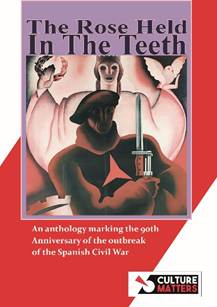
Culture Matters have 2 new books out that are essential reading. The Rose Held in the Teeth is a comprehensive anthology of poetry to mark the 90th anniversary of the commencement of the Spanish Civil War. The book has a detailed and thoughtful introduction by Alan McGuire, who makes the key point that “Looking at the Spanish Civil War is not only learning about a war. It is learning about an ongoing struggle over memory and class power.” Whenever we look at the present state of things we look also at the possibilities denied, beaten back. The struggle over historical memory allows us to look at how those possibilities might be brought to the fore again.
Included in the book are poems by International Brigaders Clive Branson, Margot Heinemann, Jack Lindsay and Tom Wintringham, and fatalities John Cornford, Christopher Caudwell, and Alex McDade. These are interspersed with poems by writers inspired by the Spanish events- Bob Beagrie, Rob Hindle, David Kessel, Gill Learner, Alan McGuire, Alan Morrison, and María Olivares Cano.
Alan McGuire tells us this:
The legacy of Francoism continues, with defenders of the regime often having some historical link to the dictatorship. Even though a law has been passed prohibiting the celebration of the regime, the fascist salute and the eagle-adorned Spanish flag remain a common sight and the Falange party continue to stand candidates in elections.
The Peoples’ Party has historical links to Franco, and the rise of Vox indicates that the anti-democratic legacy of fascism has real cut-through today – in Spain as elsewhere it is no longer possible simply to bracket off fascism as a “nasty smell” that must not be allowed to contaminate the fine liberal air. It must be fought, but also it must be understood, and what gives it political heft clearly grasped-the inability of capitalism to resolve any of its contradictions, even without its right to rule being contested by a militant working class.
This book helps us meet that task by bringing viscerally to life what it felt like to be compelled to stand against fascism in 1936 – what inspired this generation of anti-fascist poets to take up arms. It is their words that ring out most powerfully here: the “bitter hatred nursed / In a deep sadness” that Clive Branson writes of; Tom Wintringham’s extraordinary poem Monument, which, in 1937, defined fascism as “the eating gangrene of wealth, the grey pus of pride, / The black scab of those strangers / Who were choking your breath.” Our poetry should keep the memory of our struggles alive and allow the poets who fought in the wars of our past – Spain, the 1926 General Strike, the 84-85 Miners’ Strike – space for their words again.
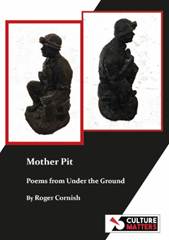
I also want to draw attention to Roger Cornish’s stunning book Mother Pit, and to let Roger Cornish set out his intentions:
I came to writing late, and almost by accident. A man spends his life surrounded by work that nobody outside the pit ever sees, and one day he realises that when his generation goes, all of it goes with them — the jobs, the danger, the words spoken in the dark. So, I began setting it down. Not to make it grand. Just to keep it. My poetry has always stood with the same people: the suppressed, the vulnerable, the ones bent double doing the work nobody thanks them for. That is who these poems are for, and who they are about. If they keep a few of those men in the light a little longer, they have done what I wanted.
That should stand as a manifesto for Culture Matters, and ought to be what all of us aspire to – keeping the people we live with and work and struggle and die alongside in the light a little longer. Because, as Camille Ralphs and Luke Kennard made clear, they don’t want the light to fall on us at all.
So, we must make our own culture, create institutions that facilitate our right to a voice. Because no one will speak for us. And neither do we need their permission to speak for ourselves. Cornish’s poems are funny, sad, gentle, hard as anthracite, romantic, angry. He’s having the final word:
SOME JERUSALEM, THIS!
Backwards, they said—
standing in the way of progress, protecting our way of life.
As our villages were emptied
and our dead lay in lonely graveyards, untended.
As our schools closed
and we were shepherded into tight streets—
yards, not gardens.
We were silk weavers—artisans—
and now: factory hands.
The
devastating alienation
of
piecemeal
production—
some Jerusalem,
this.