Available here
By Nick Moss
There is a particular kind of leftwing poetry, that is all too at ease with its own sanctimony. This poetry asserts that “we (socialists)are good and they (capitalists, fascists, overcharging vets, whatever) are evil” and is comfortable with thinking that this is a) accurate and b) all that needs to be said.
So all too often what we get is the equivalent of someone holding a “They’re Welcome Here” sign while pogromist mobs turn hotels into charnel houses. The poem does nothing to impact the particular issue, asks no questions about our own part in how we got here, but does make the writer feel they have the moral high ground for having written it. This is, ultimately, a poetry that consists of bland incantations to ward off evils that have already occurred.
How then to develop an improper, bilious, despairing, creative poetry that is able to engage with the dread and insecurity of modern life? The works under review here give us powerful ways in which the properties unique to poetry can be used creatively, without stumbling into either empty populism or deliberate obscurantism.
Radical transparency about working-class life
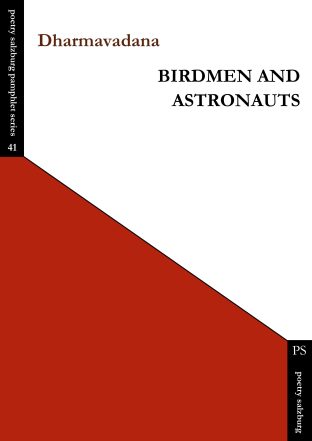
Dharmavadana (David Penn) was born in Kent and now lives in Norwich. Although he was for ten years the poetry editor of the Buddhist arts magazine Urthona and has contributed widely, Birdmen and Astronauts is his first book. He writes about class –about growing up as a working-class kid, about wonder, about dreaming and escaping and coming back, and about how youth and friendship mark you forever.
The real strength of his writing is his commitment to a radical transparency. By this I mean a kind of writing that sets out to communicate as if face-to-face, even though its writing might sometimes be elliptical or imagistic. Even when the technique is allusive the intention is to be understood (or perhaps by radical transparency, what I mean is something more like “felt” or “intuited”, rather than simply mapped out.)
The book’s first poem, Birdmen of London, is a good example of what I’m trying to get at.
Here, we are told, of a group of men, that, “No-one knows they are birdmen/No one knows any men/have such feathers or crests.” With a shiver of melancholy, we learn that “They reveal only to each other/in alleys and the backs of bars/the gorgeous plumage they hide/in daylight.” The poem then maps out that “In their grief the birdmen/cover each other with their wings/and whisper secrets, longing/for children they cannot have…. They dream of the day/when they will be understood-and rise on wings of fire/above a city amazed.”
Nothing is entirely fixed here – the men could be hiding their sexuality or simply concealing the tenderness that class and patriarchal norms kick out of us. What we do know, by the end, is that the “feathers and crests” we are forced to conceal are worth more, if we want to “rise on wings of fire”, than any medals or crests or bumps of approval we might get from doing what we are supposed to do and suppressing who we are. Birdmen of London feels like a simple poem, seemingly lucid and yet you look at the horizon, and you see a haze and you try to work it out. In that working-through, you, like the birdmen, “come alive.” This is the proper work of poetry.
When Dharmavadana turns to the subject of class, of working-class boyhood, in the post-war years through to the 80s, he gives us a time when nothing is quite how it is supposed to be; where adults don’t quite tell the truth and where things are never as fixed as we’re told – sometimes for good, sometimes not. In Through the Fence to the Dump, two friends make their way through their bombed-out “jungle” where the “air is a sting of wild garlic and tramps’ pee and we’re free.” Being free is encountering a couple hiding and kissing there. The kids hide and watch “It’s nothing like in films. /Paul taps me on the shoulder and we run.” Puberty is a fury of mismatched wants and possibilities and terrors.
Dharmavadana reminds me here of Brian Patten, and in his slippery plainness of Barry Hines and Alan Sillitoe. He sketches out his “Derby Great-Grandmother”; “The eyes don’t match: a gleam in one/ire in the other…Street comic/firepower’s in those lines round her mouth/lips that know bitterness, ready to use it.” This is a loving poem but without the rough edges smoothed down.
In Glam Nights, there is the brave self-mockery of the writer as a teen lothario, who, as “Mirrorballs star a hall/strobe lights strafe the floor and girls/line a pick-up wall, watching boys” gets himself a date but then is afraid to go out to meet her and instead thinks of the thin gold top/she promised to wear, hair Ziggy Stardust-spiked”; the reality of romance holding more terror than the fantasy.
In this all-too-true world of plain but not so plain words, everything casts a shadow – My Braver, Younger Cousin, “red hair flying/a helpless freckled god” all too soon reduced to “The sodden leaves you saw too late/spitting engine, smoke searing your eyes” and those left behind to “maunder through the hymns.” There is family breakdown and trauma, the mother who “lies all day on the sofa in a rage/for Valium/glotzing down stupid TV, /comedies that don’t make anyone laugh” and the father with “an apartment with a bar with whisky bottles lit/like a Versailles chandelier.” (Last Letter from Hamburg.) There is no pity in these poems, but there is a determination towards clarity and a kindness in not deceiving.
This is an important first collection. It is committed to a lucency which emerges in poems that talk of plane trees that “will hide you from the funeral sky” and are “implacably opposed to all shame”; “Porn night snacks”/the photo of a daughter home in Meath /who didn’t talk to you”; or looking at a tree and seeing “a tower of rats/streaming for another world/and in their midst/a crying boy-emperor.”
There is, in Family Story, a lifetime of repression and tragic evasions sketched out in the story of Charlie, who “shared with a man/he might have met in India/ And when the man died/your great-uncle Charlie/lived alone for the rest of his life.” Sillitoe was committed to mapping out “a little life, I know- but a life as full of misery and happiness and things happening as you can ever get really around yourself.” The same is true of these poems. One of the characters Dharmavadana writes of, says “I’ll tell you/ I’ve no time for deceit.” The same commitment operates throughout the poems.
Available here
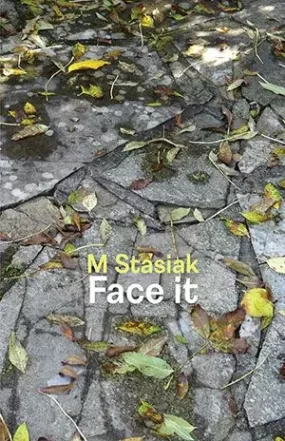
M Stasiak’s earlier chapbook, Enchant/Extinguish, gave some indication of her poetry’s ability to operate with a forensic but empathic intensity. The promise of that work is realised fully in Face It. The book is divided into 5 sections. The first of these, Slip into Hackney, is a celebration of the urban as a place of escape and reformation –somewhere to run to, to build a new life, but also somewhere in which economic and political forces can combine to destabilise life. Hackney is somewhere to “trust your weight to” and “Become another, other, any living thing.” (Slip Into Hackney.)
One of the joys of M Stasiak’s singular poetic voice is in her ecstatic materialism: “This is the physical world/that built you and birthed you/wrapped you in substance/set you in life/It’s with you to the end.” This is combined with acute recognition of the way inequality is encoded in cities, with “philanthropists/heaping poverty in dense blocks” (Made and Made Over) to form a “brave new /reckless/shiny sold-out world.” As she describes it,” to fit us for working/glib and quiescent, neat inside/certainties/perjured and priced.” (Hackney Brook)
Something that Stasiak achieves throughout the poems is to develop a musical intensity which rises until it is suddenly undermined by a brickbat of sharp irony. “Marshal the cowshit and gather your inarticulate soul”; “They are pulling the leaves/off the trees in Parliament/rather than let them fall.” What she generates in the Hackney sequence is a furious commitment to Hackney and those who hang on there in “blocks/chased down by money, worn out by neglect…surrender/ modest hopes of home/among the dirt of demolition.”
Poetry as solidarity and resistance
This first sequence contains poems of solidarity – but it’s a genuine solidarity, towards neighbours, kids who “ran from childhood and claimed their lives, then ran for London and claimed that too” not simply a gestural iteration of the word “solidarity” without any real investment. It manifests as a kind of secular prayer to Hackney (a place, a community) to offer a space of asylum to all:
Hackney: find them all and take them in
those who flow to the city.
Give them homes amid uncertainty,
room to find and lose themselves and
find and lose each other and the world.
(donna & lucy & all the rest)
The 2nd sequence, Persephone’s Field, a series of 10 poems which work through the implications of the abduction of Persephone by Hades, and Zeus’s role as patriarchy embodied, the God who sold his daughter into rape. In the poem Fathered, Stasiak skewers how language can be wielded as a particular form of mastery:
…words that offer no way in
for other words, a fly-trap disrespectful
language of assertion and mockery.
A language where winning the argument
means you have the truth
Stasiak’s writing throughout the book is a writing against this “language without bones/without referents…a code of small humiliations.” What she offers instead is something that I want to describe as a particular kind of poetic ethics.
I’m mostly against the ethical capture of poetry, but I think Stasiak has a commitment to truth and a cold, elegant clarity that can only properly be called ethical. The Catholic philosopher Paul Ricoeur in his 1965 book History and Truth, posited the need to develop an “ethics of distress.” For Ricoeur “Action, connected with speech, reveals man as an agent i.e. the one who makes change in the world.” We are, though, all of us, fallible. For Ricouer, we stand between fallibility and fault. Ricouer’s ethics of distress is how we then seek to hold ourselves to account.
Poetry, as Stasiak writes it, becomes one way of holding ourselves to account – of asking who, in a particular situation, has acted? Who is the victim? What, systemically, is responsible for the enabling of the act? How do we create each time a language which allows for truths to emerge on the basis not of who has control of the argument, but based on a critical assessment of what occurs? Poetry becomes the working-through of that ethics of distress.
This is made clear in the book’s third section, Closing Focus, which makes use of the Jungian theorist James Hillman’s work, A Terrible Love of War, as a way of examining two forms of brutality. These are the direct brutality of war, and the brutalisation of language by AI translation. The poems make use of two AI translations of a Russian battlefield report. The language in each is mangled, shredded, incoherent.” From the very unpleasant, the fly unwinds the rear.” “We are full of nerves and the count of four between the launching and the death.” Between translation and eyewitness under battle conditions it becomes impossible to hold onto a coherent narrative; except that, as Stasiak reminds us, brought up sharp at the poem’s end:
This place makes formless, worthless.
This field is blood and rot and takes us down.
Yes, that’s all.
In a later poem in the sequence, The Verge, we are shown 2 bodies, one dead, the other just about holding on to life, lying next to each other on the battlefield:
One draws, just, slow
Breaths
The other is the other
side of a terribly thin line.
Sequence 4, Reckoning, deals with the bureaucratisation of work and the language of work, particularly in relation to the provision of welfare, with its “elaborate fantasies of governance “(# Bring your true self to work.) The use of language here relies on patterns of repetition and attempts to break the patterns – “Disclaimer: I existed wild alone with breath. I ran from the room when the meeting ended.” “I don’t know what the story is you tell yourself, but it’s a good one, right?”.
In Reckoning, having “built a personality/that’s adequate for work” the narrator wishes “to tread from air-conditioned /buildings into a raw world”, to “lie stretched in flickered fields/where rationality can rest/ and nothing can or does add up.” The title poem, Face It, nails with stringent detail the malaise of life caught within the traps and lures of 21st century capitalism and its “wonderful garden of dopamine”:
…a custom-made
cosmology fine-tuned for our diversion
where the puzzles, words and purposes all beckon
with reward, a hiding-place, a holiday, a paradise
with a burning smell entering under the door.
M Stasiak gives us poetry as a smoke alarm to warn us that the house is on fire. She is an important poet, who writes with clarity and ferocity about the world and with warmth and generosity towards its victims.
Both these poets show how it is possible to produce a poetry that acts as a form of resistance to the nihilistic banalities of our time.