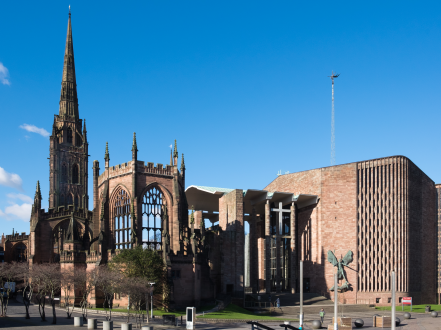
Coventry cathedral. Commons image
By Jenny Farrell
On the fiftieth anniversary of his death, the establishment remembers Benjamin Britten as a national treasure. But the archives reveal a different picture – a pacifist tracked by MI5, a conscientious objector who refused even non-combatant service, and a composer who accepted an official commemorative commission and then used it as a devastating indictment of war.
In 1953, an MI5 officer recorded a brief assessment of Britten. The composer, the file noted, “has been a pacifist for many years”. The files released in 2014 show sustained surveillance. Britten’s partner, the tenor Peter Pears, had been flagged in 1951 as vice-president of the Musicians’ Organisation for Peace, which MI5 classified as a “Communist front organisation”.
Eight years later, a newspaper cutting announcing a charity performance for the Campaign for Nuclear Disarmament, showing Britten and Pears alongside prominent socialists J.B. Priestley and Michael Redgrave, went into the same file. But the file is not the beginning of the story. It is the state’s response to something Britten had already put on record, in his own words, eleven years earlier, when he stood before the Local Tribunal for the Registration of Conscientious Objectors on 4 May 1942. His statement to the court remains the most direct account of the beliefs that would shape his art for the rest of his life:
Since I believe that there is in every man the spirit of God, I cannot destroy, and feel it my duty to avoid helping to destroy as far as I am able, human life, however strongly I may disapprove of the individual’s actions or thoughts. The whole of my life has been devoted to acts of creation (being by profession a composer) and I cannot take part in acts of destruction.
Anticipating the objection that pacifism meant indifference to fascism, he added:
I feel that the fascist attitude to life can only be overcome by passive resistance. If Hitler were in power here or this country had any similar form of government, I should feel it my duty to obstruct this regime in every non-violent way possible, and by complete non-cooperation.
When the tribunal assigned him to the Royal Army Medical Corps, Britten appealed and won unconditional exemption. The state, however, kept watching.
The War Requiem is the summit of Britten’s political art, but it was not an isolated gesture. His left-wing commitments shaped not only what he wrote but for whom, and they were on the record long before Coventry. In the 1930s, he worked at the GPO Film Unit, the centre of the British documentary film movement. The unit placed working-class life at the heart of its art, combining avant-garde music and poetry with sharp social critique.
Alongside the left-wing poet W.H. Auden, Britten created the legendary soundtracks for Coal Face (1935) and Night Mail (1936). This was not merely a theoretical commitment. In June 1935, days after the Nazi regime stripped Erika Mann – daughter of the exiled novelist Thomas Mann – of her German citizenship, Auden married her in a marriage of convenience that secured her a British passport. Britten’s cantata Ballad of Heroes (1939) honoured the British volunteers who died fighting Franco’s fascists in the Spanish Civil War. Later, he turned to community art, composing Noye’s Fludde for a mix of professional and amateur local musicians, and Let’s Make an Opera specifically for children. Even his grand operas, like Billy Budd (1951), focused heavily on the cruelty of institutional power and class oppression. For Britten, music was not an elite luxury; it had to be a useful, democratic tool for the community.
An Anti-War Requiem
Despite this track record, the British establishment commissioned Britten to compose a major choral work for the consecration of the new Coventry Cathedral. The old cathedral had been destroyed during the German bombing raid of 14 November 1940. The new cathedral was built alongside its ruins. In February 1945, Allied bombers devastated the German city of Dresden. By 1959, Coventry and Dresden had established a historic town-twinning initiative focused on reconciliation.
The occasion called for a major commemorative work. Britten, however, turned the commission into something much more challenging. He took the traditional Latin Mass for the Dead and violently disrupted it, interweaving the sacred texts with the raw trench poetry of Wilfred Owen, a soldier killed in action just days before the 1918 Armistice. What resulted was an artwork that turned a patriotic celebration into an indictment of anyone who glorifies war.
When the premiere took place on 30 May 1962, the Cold War was reaching a fever pitch, and the threat of global nuclear annihilation loomed large. To hear the piece, the audience had to walk past the physical ruins of the old cathedral. What they encountered inside was a blunt warning about their present. It was a masterpiece that flatly refused to offer easy consolation.
The War Requiem’s significance extended beyond Coventry. Britten had met Shostakovich in London in 1960, and the two composers developed a friendship across the Cold War divide. Shostakovich obtained the score in 1963 and wrote to Britten of having listened to the recording “many, many times”. Later, he dedicated his Fourteenth Symphony to Britten, who conducted its first performance outside the Soviet Union, while Britten dedicated The Prodigal Son to Shostakovich. Their dialogue – two composers shaped by the same historical catastrophes, working under radically different political systems – forms a significant backdrop to the War Requiem’s reception.
The Music
To make this political argument clear, Britten physically splits the performers into three distinct sound-worlds across the performance space, each representing a different aspect of conflict. The first layer is the Latin Mass for the Dead, sung by soprano, full chorus, and large orchestra. This represents official mourning – grand, public, and cloaked in the confident, traditional forms of the Church and state. It offers the illusion of a ritualised peace.
The second layer directly challenges the first with the poetry of Wilfred Owen, sung by tenor and baritone with a chamber orchestra – the personal voice of the soldiers, of those who suffered and witnessed the war.
The third layer is the boys’ choir, placed at a distance, accompanied by organ alone. The boys embody absolute innocence, singing the liturgical language of sacrifice from afar, completely unaware of the horrific realities that the adult world is sanctifying. Britten does not allow these three worlds to harmonise. Instead, he forces the listener to sit in the uncomfortable space where they collide.
The Requiem Aeternam begins with a heavy, dragging instrumental prelude in the orchestra, punctuated by the fateful, metallic tolling of brass chimes. The full chorus enters in a hushed, monotone whisper: “Requiem aeternam dona eis, Domine” – grant them eternal rest, O Lord. But the musical foundation beneath them is intentionally unstable. Britten anchors the entire opening around a single interval: the tritone. Historically known as diabolus in musica (the devil in music), the tritone is the most unresolved dissonance in Western music. The effect is beautiful yet eerie. The prayer for peace is trapped in a musical language that denies peace.
The atmosphere fractures completely with the entrance of the tenor soloist, singing Owen’s Anthem for Doomed Youth: “What passing-bells for these who die as cattle?” Suddenly, the grand institutional forces of the full orchestra recede, replaced by the stark textures of the chamber orchestra. The tenor’s question is direct, immediate, and accusatory. By superimposing this line directly over the Latin liturgy, Britten weaponises the contrast: the formal, sacred chimes of the Church are set against the absence of any meaningful ritual for the millions of young men rotting in the trenches. The movement closes with the full chorus returning for a solemn Kyrie eleison. But the tension is not resolved – only suspended.
The Dies Irae is the longest and most violent section of the work, and it is here that Britten’s anti-war argument becomes an auditory assault. The traditional Latin text is a medieval hymn about the Day of Judgment, when divine trumpets scatter destruction and the earth dissolves in fire. Britten sets it as a military catastrophe.
The movement opens with stark, distant brass fanfares. When the chorus enters, the meter shifts into an unsettling 7/4, time, turning the traditional proclamation of divine judgment into a limping march. The trumpets and horns enter pianissimo. Rather than sounding like triumphant fanfares of a heavenly host, they mimic the distant, thudding echo of artillery and the slow creep of approaching dread. When the chorus sings Tuba mirum spargens sonum (the trumpet scattering its awful sound), the brass erupts into syncopated rhythms that sound less like divine judgment and more like the chaos of a frontline barrage. On Quantus tremor est futurus the chorus shivers in detached, repeating notes; on Mors stupebit the music drops to a hushed whisper, like a wasteland littered with bodies.
Then the soldiers interrupt. The baritone sings Owen’s Bugles Sang, and the chamber woodwinds mimic the lonely, mourning call of distant bugles – the actual sound of the front line, set against the liturgical trumpet of judgment. In the duet The Next War, sung by tenor and baritone, the strings use col legno, striking the strings with the wood of the bow, and sharp pizzicato to evoke shrapnel and marching skeletons.
The Liber scriptus – the book in which all sins are recorded – introduces the soprano soloist for the first time. Her angular, sharply articulated lines, accompanied initially by winds, give the passage an austere, almost bureaucratic character: an image of judgment in which every human life is entered into an unforgiving ledger.
The movement ends with the Lacrimosa – the day of weeping. The soprano sings a wide, operatic lament over a limping 7/8 rhythm, the strings sighing on off beats like breathless sobbing. Then the tenor enters quietly with Owen’s Futility – Move him into the sun – a poem about trying to wake a dead comrade in the snow. The orchestra vanishes. The chamber strings slow to a frozen crawl. The universal grief of the Latin is interrupted by the specific, futile gesture of a soldier trying to warm a corpse. The chorus then returns, unaccompanied, for the Pie Jesu, a moment of almost unbearable stillness after the violence that has preceded it.
If the Dies Irae captures the physical horror of modern warfare, the Offertorium turns to its moral consequences. In the traditional Latin liturgy, this section is a prayer for deliverance, invoking the ancient promise God made to Abraham and his descendants. Britten uses this moment to stage the betrayal of youth by the state.
The movement begins with the boys’ choir, followed by the full chorus singing the traditional Latin text: Quam olim Abrahae promisisti, et semini eius (Which thou didst promise of old to Abraham, and his seed). The music here is energetic, driven by a dancing rhythm. But the mood shifts as the grand forces fall silent, leaving the stage to the tenor and baritone soloists accompanied by the chamber orchestra.
They sing Owen’s The Parable of the Old Man and the Young, a devastating retelling of the biblical story of Abraham and Isaac. In Genesis, an angel tries to stop Abraham’s hand at the last second, offering a ram for sacrifice instead of his son. In Owen’s – and Britten’s – version, the story ends in catastrophe: “But the old man would not so, but slew his son, / And half the seed of Europe, one by one.” As the soloists sing about the slaughter of Europe’s youth, the music returns to recurring lines suggesting a machine that cannot be stopped.
Then comes Britten’s most subversive stroke. Immediately after the words “one by one”, the boys’ choir re-enters from afar. By juxtaposing the children’s prayer with the adult chorus’s insistent repetition of God’s promise to Abraham, the music forces the audience to confront the gulf between religious promises of salvation and the slaughter of a generation.
The Sanctus forms a contrast: a solo soprano above shimmering percussion, like divine light. The chorus grows from a whisper to a mighty “Gloria!” Then the baritone enters with Owen’s The End. The poem asks, after the lightning blast, whether life will renew the destroyed bodies – and answers no: the earth itself says it is death, and its scars would not be glorified. The vision of heaven gives way to the grey mud of the trench.
The Agnus Dei sets the short prayer over a ground bass whose uneven stuttering paints the limping march of exhausted soldiers through the mud – and at the same time the road to Calvary. The tenor sings Owen’s At a Calvary near the Ancre, a poem about a shelled, broken wayside crucifix; the chorus quietly interjects the Latin prayer. At “Dona nobis pacem” the bass stops, the music dissolves into a long chord, the soldiers’ march ends. The plea that the tenor here voices in Latin does not come from the Requiem Mass but from the Mass of the Living. It is the only moment in which a soloist (soldier) speaks the liturgical language – a plea for peace among the living.
The final movement, in which the chorus prays Libera Me (Deliver me, O Lord), is the emotional and structural climax of the entire work. The music accelerates. The Doomed Youth theme, the musical material associated with Owen’s slaughtered soldiers, rises from the double bass through the orchestra. What began as a funeral procession becomes a frantic, rhythmically irregular march. The soprano cries Tremens factus sum ego (Trembling seizes me, and fear). Then the orchestra overwhelms the chorus: a thunderous chord bursts the musical order. The Mass has no answer to the violence in whose sanctification it was itself complicit.
After the explosion, silence – and the tenor begins Owen’s Strange Meeting: a dead German meets a British soldier: “I am the enemy you killed, my friend.” Britten sets this as a love duet – the reconciliation between two men whom war made enemies and death made equals. State and Church are absent. The boys’ choir returns with the In paradisum, bringing all three musical layers together for the first time. The last words of the two soldiers are “Let us sleep now.” Then the chorus sings: “May they rest in peace.” But the bells sound tritone again. The work ends on a quiet, sustained chord that does not resolve into triumph or consolation. The dead plead to be released from the purposes for which the living have sacrificed them.
The Recording
The 1963 Decca recording achieved what the premiere could not. Britten had intended the three soloists to represent the three major combatants of the Second World War: Peter Pears for Britain (tenor), Dietrich Fischer-Dieskau for Germany (baritone), and Galina Vishnevskaya (soprano) for the Soviet Union.
The Soviet Ministry of Culture did not let Vishnevskaya travel to Coventry (Heather Harper substituted), but she was permitted to sing on the recording. As Vishnevskaya recounts in her autobiography, the Soviet authorities objected that a Soviet woman could not stand beside a German and an Englishman in a “political work”. When she protested that it was an appeal for peace, they replied that the Germans had paid to restore Coventry Cathedral, and that a former enemy should not be turned into a friend.
A further reason, not recorded in this memoir, may have been the work’s profound pacifism. For the USSR, the war against fascism had been a war of survival, in which engagement was the only alternative to annihilation – a position that Britten’s unconditional pacifism could not accommodate. At fifteen, Vishnevskaya had survived the siege of Leningrad and served in the anti-aircraft defence. Over a million people had starved and frozen to death. When she sang the soprano’s lament in the Lacrimosa, she brought the full knowledge of this into her singing.
Fischer-Dieskau had been conscripted into the Wehrmacht and taken prisoner by the US. He sang the German soldier in Owen’s Strange Meeting and was so shaken by it at the premiere that he could not leave the choir stalls. The reconciliation the work demands was not an abstraction to the singers performing it. It was a living memory.
Fifty years after Benjamin Britten’s death, the War Requiem remains as urgent as ever.