By Srijani Dutta
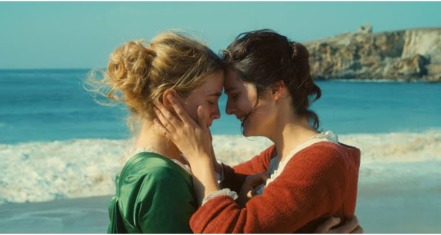
The film “Portrait of a Lady on Fire” is a romantic movie that celebrates the homosexual love and sexual identities of the lesbian women. This movie defies the conventional idea of heteronormative love that attempts to maintain the patriarchal tendencies in the society. The expression of women’s desire and assertion of love stands out as a resistance against stereotypical love.
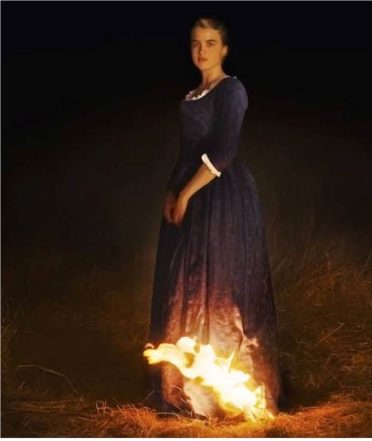
Fire symbolises passion and the flame of romance. The camera sometimes focuses on the eyes which are supposed to be the mirrors of heart. There is deep and subtle silence that intensifies the tension of their romance. It is the song of the forbidden love that posits romance as a strong voice of self. Having said that, the Romantic poets focus on imagination, memory and emotion.
This movie is artistically sentimental, lyrical and imaginative, as the painter paints the picture of her muse depending on imagination and memory. It is almost like Wordsworth writing down his feelings after seeing daffodils and Tintern Abbey. Wordsworth recollects his emotions and memory in tranquility to produce romantic poetry. Similarly, in this movie, the painter uses her memory, imagination to create the painting. The romantic poets portray the beauty of the nature to make an affinity between man and nature. In this film, the readers can also find the depiction of the landscape, sea, cliff.
This essay introduces the feminine voices and experiences as the subverting forces by exposing the structured, biased, masculine language of the society. Film, being the socio-cultural-political discipline of entertainment, is a way of shaping or formulating the unconscious of the audience. It tries to rebel against the conventional ways of the image production of women in the society. I have interpreted the movie “Portrait of a Lady on Fire” in order to go between the cinematic language, to portray the subverting female gaze and reconstruction of the feminine selves. This essay tries to analyse the different ways of ‘seeing’ and perceptions about women, desire, sexuality and their subjectivity.
Identities, generally, are constructed on the basis of socio-political-cultural relations of the society. Simultaneously, there is a constant and gradual urge to defy the conventional rigid boundaries of identities resulting in the formulation of pluralities and fluidities. This subversion reshapes the identities related to the body politics.
The oppression of women has been happening for ages, in different ways. In society, women are classified into various groups that are constituted on the basis of different images and connotations. The emergence of feminist studies brings out the onslaught of the patriarchal forces that silence the voices of women. The binaries between passive women and active women, fallen women and the ‘angel in the house’ – all are the denominators of the personalities as well as their subjective selves. They are reduced to bodies; they are sexually objectified as if they are the machines of reproduction.
On the other hand, desirous male eyes seek pleasure and satisfaction by looking at their silenced bodies. In the symbolic language system and discourse, women are termed as ‘others’ in respect to the male individuals. Film as the collaborative mode of artistic, intellectual mode of performance portrays its ethos and meaning not only through the linguistic function, but also through the different kinds of cinematic language like the camera’s gaze, portrayal of characters, music and poetic colours used in the films. These are the cinematic language, as well as the design of the film(s).
Laura Mulvey’s essay “Visual Pleasure and Narrative cinema” tries to find out the ethics and the pre-existing patterns working behind the taste, choice and gaze of the individual subject and how societal institutions have made an influence on them. The politics and meaning of ‘looking’ or ‘gazing’ is the primary focus of her essay. She also reveals how the unfathomable unconscious gets mingled with a political and patriarchal ethos, and everything becomes constructed.
She uses the medium of psychoanalysis in order to untangle the psyche of language. The woman is the correlational figure in the society. It is her lack that produces the phallus as a symbolic presence. Thus, women stand for something non-existent or an essence or an imaginary entity. Man perpetuates his male fantasy and obsessions through his linguistic operation. Man is termed as the torchbearer of meaning, the father of law. Mulvey also uses words like the sexually mature woman as non-mother, maternity outside the signification of the phallus, the vagina, to show how the image of woman has been established as the standard conventions. She focuses on the emergence of the alternative cinema that is politically and aesthetically radical and challenges the basic assumptions of the mainstream film industry.
The female and male gaze
In this essay, I will try to read how this particular film tries to establish the alternative gaze by creating an environment of resistance and how it becomes a romantic saga. In this film, the story centers on the lives of the female protagonists who settle the nerves of the male audiences. They become the rebels ,asserting their homosexuality by challenging the status quo of desire, pleasure, subjectivities and gaze. From being the star objects of male gaze to the active subjects, women reach the position and make their own utterances and behaviours.
This movie questions about the ethics behind the construction of ‘self’ and ‘subjectivity’ through the male gaze.
“Portrait of a lady on Fire” (2019) is the portrayal of lesbian love. It is a documentation of an erotic love that transcends the barriers of gender and social class. It is set in Brittany in the eighteenth century, and centers on the lives of women. Thus, the unique female bonding posits this movie as an avant-garde film narrative that defies the patriarchal conventions of society.
The director Celine Sciamma has termed her film as the “manifestation of female gaze.” Fire symbolizes passion as well as destruction. It celebrates the destruction of the established gaze and subjectivities. The passionate relationship between the painter and her model subverts the ethos of hierarchical power structures and destabilizes the rigid binaries between ‘subject’ and ‘object.’Simultaneously, the film tries to normalize the homosexuality through non- heteronormative narration.
Through the characterization of Marianne and Heloise, the interplay of glances and gazes is depicted, showing their mutual trust and respect. The beautiful, feminine language of the film captures the growing passion between the artist and her subject. Marianne, an independent painter, is commissioned to do a portrait of Heloise for her wedding. Heloise is betrothed to a man whom she does not even ‘see.’ So, the accuracy and the tenderness of the portrait will decide her beauty to him and it will hang on the wall of their house.
The portrait itself is an object that demands a certain kind of masculine observation. For that reason, Heloise, initially, does not want to be framed and reduced into a mere object of male desirous gaze. On the other hand, the portrait is a material that belongs to someone as the possession, just like the hanged picture of Porphyria’s lover. The meaning of portrait is thus full of contradiction.
The only way to draw her picture by Marianne is to hide the real intention of Marianne and introduce herself as her walking companion. During their long walks at the seaside, the painter observes at her face, curls and lips and tries to draw a picture in her mind so that it can get transformed into the ‘real’ portrait through her memorization. Gradually, these two ladies come close to each other and their chemistry grows into something else.
Singing the song of resistance
This film becomes an outcry of silenced feminine selves under the cover of an erotic love story that reconstructs the images of women. The erasure of the subject-object dichotomy between the painter and her model also subverts the power hierarchy.
In this movie, Heloise’s initial rejection to sit for the painter symbolizes her resistance to be ‘looked at’ as a sexual object. The removal of the eyes from the painting shows another way of resistance to the male gaze. Gaze is also used as a tool of memory. Through the memory of gaze, Marianne has drawn Heloise’s portrait. The memory increases their love as it is happening in the absence and silence. This silence is their power. The reference of Greek myth of Orpheus and Eurydice in this movie is used to justify the power of memory. In the Greek myth, Orpheus had a chance to get back his wife from the underworld. But, he could not turn back otherwise she would remain in Hades. He turned his head and Eurydice had to stay there.
The film looks at the mythical story from a new perspective. In the story, Orpheus is an active gazer whereas Eurydice remains a passive entity. In this film, the character Orpheus has been turned into a female character by giving her female identity. And Eurydice has been transformed into an active muse who has her own agency. This film narrates the transactional story of female gazes or the celebration of mutual and ‘alternative’ love. Here, the director empowers Eurydice through the characterization of Heloise. She is not a mere sexual object. Instead, she acts as an artistic collaborator and a subject.
In this film, the painter is haunted by the bridal look of Heloise. When Marianne was leaving, Heloise asks her to “turn around.” She did and her hallucination became the reality. She saw her in the white bridal dress. Thus, their love story ended in tragic note. Later, the painter teaches her students by revealing the events from her memory and she keeps her alive in her memory. This, somehow, refers to the idea of the ‘poet’s choice’ (choosing memory over the person). Thus, this movie shows how memory becomes a tool of resistance that does not reduce the muse’s body into the object of fantasy and desire.
This movie opens with the scene where Marianne poses for her students. Here, her students stare at her and tries to draw her. She becomes the object of their gaze. Then, the camera focuses on the canvas entitled as “Portrait of a lady on fire.” Through this portrait, the camera takes its audiences into the flashbacks of the past days. Gaze is a masculine behaviour, whereas memory is a feminine activity. Here, this flashback along with memory and gaze upholds the subverting theme of this movie and makes the film as a piece of resistance in itself.
The movie ends in the exhibition room where Marianne sees her portrait hanging on the wall. She exchanges a ‘glance’ with the portrait. She also notices her beloved and the camera only focuses on Heloise’s teary eyes. The ‘tear’ being the feminine emotion concludes the story, by highlighting on the eyes and the gaze(s) of the eyes. In this way, the eye/gaze tells the story of this film by exchange of assertive looks. Thus, this movie sings the song of female gaze, romanticism, activism and resistance against oppression and patriarchal norms.