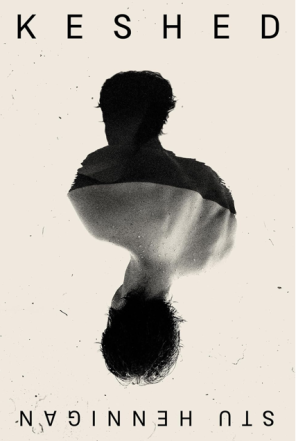
Keshed by Stu Hennigan (Ortac Press, 2026)
The point of view in Keshed alternates between close third person and second person, the latter employed to narrate earlier periods in the protagonist’s life, stretching all the way back to his childhood. To visually represent this shift in narrative perspective, typographically and in big block letters, the words NOW and THEN are each spread out over two full pages at regular intervals throughout the book. But to me, at least, those two words also suggest the typical Northern greeting, “Now, then!”
Be warned, there’s an absence of speech marks in Keshed, in the manner of Cormac McCarthy, which can be confusing at times, though on balance it shouldn’t be too much of a problem for the experienced reader. This is also true of the lack of apostrophes in words like “we’ll” and “she’ll.” When they crop up in the italicised passages of the narrator’s self-accusing persona, the novel renders them as “well” and “shell”.
As for the vocabulary, working-class idioms are commonplace throughout Keshed, for example “rollies” (hand-rolled cigarettes), “compo” (the mortar used in bricklaying and sometimes employed to refer to a mixture of plaster used to skim plasterboard), and there are also regional dialectal forms, such as “keshed” (stoned or drunk) “kaffle” (to fall asleep suddenly), “mardy” (grumpy) “mithered” (bothered) “radged” (crazy).
Its choice of characteristically working-class locations and artefacts marks the physical world, e.g. Spoons (as in the pub chain Wetherspoons), Greggs, Booze Busters, and Frosty Jack’s (a brand of strong, cheap cider). The location is Leeds, and actual place names are employed, e.g. Harold Terrrace, Otley Road.
Throughout, the prose is beautifully shaped. A broken football, for instance, “has holes in the sides and the rubber orange bladder sticking out like a haemorrhoid” and then there are the “rusty redorange [railway] tracks branching out like spiders’ legs”. I can easily visualise both.
The protagonist, Sean Molloy, attempts to deal with his deep-seated psychological problems by self-harming, and has a mania for drinking to excess and taking drugs (the latter primarily represented by weed, cocaine, ketamine, acid, and ecstasy). At regular intervals, he is prone to expressing his negative feelings in a self-accusatory interior monologue that switches to the second person and is also italicised to differentiate it from the third-person narrator. I should add that the book opens with a staccato stream of consciousness, as unpunctuated as Molly Bloom’s monologue in the final chapter of Ulysses. There’s only so much of this you can tolerate before it becomes tedious and repetitive, unless you’re James Joyce, that is. Fortunately, Sean’s stream of consciousness doesn’t outstay its welcome.
Almost suggestive of Emile Zola and his notion of how heredity shapes his characters’ destiny, we learn that Sean’s uncle Tez was prone to alcoholism, which eventually hospitalised him, and one could make the case that Sean, who is also predisposed to self-harm and alcoholism, shares the same genetic inheritance. Later, we learn of another relative, Sean’s cousin Hayley, who meets a tragic end as a result of her own self-destructive nature.
Sean ends up studying for a degree in Modern History at Manchester University, though he never shows any genuine enthusiasm for his subject. After graduating with a 2:1, he’s employed as a general labourer on a building site, as a van driver and later as an office worker. During a prolonged bender with his pal Rob, Sean strikes up a relationship with Amanda (Mandy) who works in a cafe. This comes as quite a surprise, and doesn’t really fit with what we already know of Sean’s morose and insular personality, given that he had studiously avoided forming any friendships with his fellow flatmates and other students on his course, and was pretty much an antisocial loner. Altogether, his protestations that he was unable to find anyone at university from a working-class background like himself strike this reader as rather feeble and unconvincing.
Social class matters a great deal in Keshed and is referenced throughout. At Leeds train station, for example, Sean disparagingly refers to the commuters as “worker bees” and “drones”, his exploitative landlord is a “parasite” and his boss on the building site is a “cantankerous, slave-driving shitehawk”. Politically, the bailout of the bankers during the 2008 economic crash and the David Cameron/Nick Clegg coalition government are both mentioned in predictably negative terms.
What’s more, it soon transpires that Mandy is thoroughly middle class and hails from Surrey, that affluent region comprising what Sean calls “Daily Heil” readers – witness his confusion when she uses the word “panini”, which to her is something utterly familiar, but not to him. In Sean’s world, such an item of food would be called a toasted sarnie. Then there’s Amanda’s flatmate, Poppy, who is descended from old money. The name alone tells you this is someone who is from a very well-to-do background. Yet Sean is soon necking bottles of wine with her.
Becoming a father is hardly the sort of thing that you feel is going to help Sean overcome his personal demons. And when his daughter, Daisy, is born prematurely, his life predictably spirals out of control. For this reader, the chapters devoted to Daisy’s time in the hospital intensive care unit felt as if they dragged on for too long, though another reader might disagree with this verdict. The denouement is as violent as anything you’d find in Zola, and just like Zola it’s rather contrived, but then that’s what literature is all about.
Ortac Press has done a terrific job with the cover design of the book and its handling of the text. As someone who used to work as a freelance editor and proofreader, I noticed only five errors. Five minor errors in a work of this length is not only perfectly acceptable but also comparable with the output of much bigger traditional publishers.
If you are interested in contemporary working-class literature, Keshed is definitely worthy of your attention.
Keshed by Stu Hennigan (2026). Published by Ortac Press, ISBN: 978-1-7384667-6-4. £12.99
Get it from the publisher’s site here