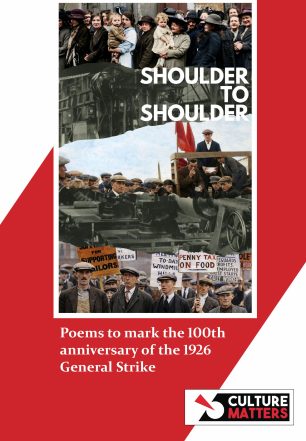
Culture Matters is proud to publish a collection of poems by more than 60 poets commemorating the 100th anniversary of the 1926 General Strike. These poems cover the strike itself and also other strikes, struggles and protests by our class since then. They show how working people, by standing shoulder to shoulder, can fight back against oppression and exploitation and create a better world for everyone. We are thankful to Unite the Union and Sharon Graham for their support with this anthology.
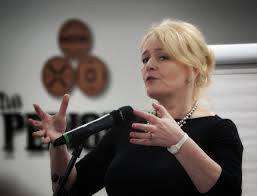
Foreword to Shoulder to Shoulder: Poems to mark the 100th anniversary of the 1926 General Strike, by Sharon Graham, General Secretary, Unite the Union
In 1926, working people did something that Britain’s ruling class never forgave them for: they held a general strike. For nine days in May, Britain came to a standstill. The trains halted, the mines went quiet and the government of the time went to war with its own people. The General Strike was called in defence of the miners, but it quickly became a confrontation over who actually holds power in this country, and it shook the ruling class to its core. What was the background to the strike?
After the First World War, the mine owners wanted longer hours and lower wages for miners, and the government backed them, rather than the men who had kept the country going. The miners said “not a penny off the pay, not a minute on the day,” and they weren’t being dramatic, they were defending basic dignity. The Trades Union Congress called the strike because this was not just about coal. It questioned the order of things. Did working people have the right to organise and resist being treated like cogs in a machine? The establishment closed ranks, drafted in volunteers, and even used the state’s machinery to try and break solidarity.
Winston Churchill, then Chancellor of the Exchequer and without his World War Two legacy, did not just oppose the strike in Parliament. He helped found and edit a government newspaper, The British Gazette, to counter what he called “propaganda” from the trade unions. The state understood that the industrial struggle was not fought only on picket lines, but in the messaging, the emotions, and most of all the narrative. It couldn’t afford to lose face in front of the unions and working class. It had to try to keep control.
A century later, the battleground looks different, but the principle is the same. Today it is not The British Gazette being edited by the Chancellor, but hostile headlines printed by corporate party donors, and rage
bait and fake news on social media platforms owned by anti-union oligarchs. As Jim Aitken shows in his poem ‘One Hundred Years On’:
Back then they called it ‘the depression’,
to be renamed ‘the recession’ in the 80’s,
to be termed ‘austerity’ after that, and now
it is called ‘the cost-of-living crisis’ yet all
these terms simply do not affect the rich.
But when it comes to the day to day news cycle, what is all this for? The aim remains the same: divide, discredit, demoralise. And yet solidarity persists. This collection marks one hundred years since the General Strike, but it does not treat it as a history from back when things were different. These poets ask what that moment means now, when working people are again forced to accept less for their labour.
Profits over people, and dividends over dignity
In the summer of 2023, we saw the biggest wave of industrial action in a generation. Rail workers, NHS staff, teachers, warehouse workers, bus drivers, manufacturing workers, energy workers—across sectors, across regions, workers stood up and said enough is enough. Unite alone has been involved in hundreds of disputes in recent years, from large-scale national negotiations to local struggles. There is a clear, recurring theme —working people will not go on shouldering the cost of an unfair economic system’s failures, while profits for shareholders and the bosses remain untouched.
The Birmingham bin strike has brought this home to many. Refuse workers, often invisible until something goes wrong, reminded the country that their labour is essential. When they stood firm over pay and conditions, it was not only about wages. It was about dignity. It was about the right to be treated as skilled, vital workers rather than another number on a council spreadsheet. This picture isn’t that different from 1926. The miners then were told wage cuts were necessary. Today, the bin workers are told inflation, budget pressures, or ‘the market’ or leave no alternative. The excuses are dressed in different vocabulary, but the logic remains. Profits over people. Dividends over dignity.
Wealth is created by working people. When labour is withdrawn, the system feels it immediately. That truth is captured here in these poems. The poems gathered here do not romanticise the past. They look at it from multiple angles—political, emotional, and historical. They explore the hardship, defeat, and repression that followed the General Strike. Yet they also show how the Strike changed the political imagination. It demonstrated collective power on a scale Britain had never seen. Chris Norris captures this feeling in his poem ‘Way-Markers: on the General Strike of 1926’:
No, a General Strike brings a change of sky,
A red tincture to each shade of blue,
And a sense that fresh pigments must henceforth supply
Dawn’s aurora to each shift of hue.
In the modern retelling of the Strike on mainstream websites, it often gets turned into a story of British eccentricity, with amusing stories of men in bowler hats driving buses and bankers delivering milk as if it
were Britain entering the Twilight Zone. It’s framed as a moment of inconvenience rather than a confrontation between classes in Britain after the Great War. That retelling isn’t accidental, but the ruling class’s version of events after the fact. Trying to turn one of the biggest classbased conflicts in British history into a charming story about middleclass volunteers “keeping Britain moving,” shows us that they don’t want us to get any of the ‘wrong ideas’. History is repackaged as nostalgia, a trick the right and far-right have played for years.
There is more to this anthology than poems about the General Strike. It shows the strength and emotion that the working class has endured in the last 100 years, the solidarity shown by struggling workers to each other. That solidarity is not some abstract slogan. It means hands making placards, quiet quitting, beeping your car horn, food, drink and messages of support brought to the picket line. It shows the courage of working people who refuse to let other workers stand alone.
Unite’s history and experience today tell the same story. From aerospace workers defending pensions, hospital staff fighting for safe staffing levels, or refuse workers demanding fair pay, the core principle is
unchanged. Collective action works. It wins improved pay, it protects conditions and it restores dignity. But it also does something less measurable—it rebuilds confidence. While solidarity is an act, the feeling
that it brings is a collective one that is shared no matter what the outcome. These poems help capture and express that feeling.
In 1926, the strike was ultimately defeated. Laws were tightened and trade union freedoms were restricted. But the idea that working people could work together on a large scale has not been erased. It resurfaces repeatedly throughout the twentieth and twenty first century, till today. Young workers in precarious industries are organising. Migrant workers are leading disputes. Women workers are taking decisive action in sectors long undervalued.
The story of our labour movement is not one that has reached its end because we are the ones who continue to write it, and poetry is part of it. There is an economic struggle, a political struggle, but also a cultural struggle, to make cultural experiences democratically controlled, accessible and enjoyable to everyone, not just the well-off. Words are weapons of inspiration, struggle, sorrow and celebration. Independent, sensitive and militant working-class voices, like the ones represented in this anthology, are an invaluable and essential part of the labour movement’s struggle for a better world, for everyone. That’s why we in Unite the Union are proud to support it.
Sharon Graham
General Secretary
Unite the Union