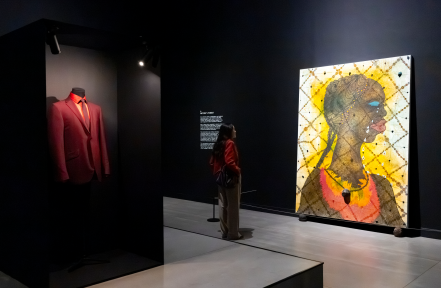
Photo © Tate (Lucy Green)
By Nick Moss
It would be naive to expect an exhibition subtitled Art and Fashion, curated by ex-Vogue and i-D editor Edward Enninful and others, not to focus heavily on fashion…but this goes heavy on the fashion, and in a particular way, decoupling it from any real political / social context.
According to Enninful/Tate Britain: ‘As Britain began to emerge from recession, a new dawn of optimism, freedom, and rebellion was ushered in, epitomised by a new generation of diverse creative talent.’
There is an obvious problem with this account. By 1992, inflation in the UK had fallen to 3.7%, but unemployment had risen to 9.9%, up from 7.1% in 1990. The economy also entered recession, with GDP growth averaging -0.2% from 1990 to 1992. (House of Lords Library statistics.)
In September 1992, John Major’s government suspended UK membership of the exchange rate mechanism (ERM) to allow the pound to depreciate and interest rates to fall. The reduction in interest rates boosted domestic consumption, as the proportion of income that households saved and spent on debt interest costs fell. After three years of relative stagnation, the economy recovered to grow by 2.3% in 1993 and 3.4% in 1994.
Thus, the art and music that Enninful wants to pitch as ‘an audacious renewal of British spirit’ was developed at a time of, and in response to, recession. The market that swarmed over it was a product of the later period of growth. The defiance at the core of the new art of the 1990s was a reaction to the dead weight of the final years of Thatcherism. The boosterism of the Blair years gave rise to a credit-based economic upsurge that exploded in 2008 but gave us the late 1990s Union Jack and glitterball era of Cool Britania and Brit Pop. (Thankfully, Enninful doesn’t drag that onto his stage.)
Mervyn King, then-governor of the Bank of England described the economy of the mid-late 1990s as rooted in NICE-ness, ‘non-inflationary consistent expansion’. (Mervyn King, Governor of the Bank of England, ‘Speech given at the East Midlands Development Agency/Bank of England dinner’, Leicester, 14 October 2003).
The driver for NICE-ness was the shift of the UK economy away from manufacturing and towards services, particularly those services most able to benefit from global economic and financial integration. The problem was that this disproportionately benefited the area where financial and business service activity was concentrated—London—while weakening yet further the UK manufacturing sector, which was predominantly based away from the South.
The Young British Artists’ provocations
The art of the Young British Artists celebrated here (Alexander McQueen, Damien Hirst, Sarah Lucas, Tracey Emin, Chris Ofili, Yinka Shonibare) was created in response to a hostile, reactionary racist and homophobic culture which was designed to keep congealed the disintegrating, hegemonic miasma of Thatcherism. It was intended as a provocation to that culture and to spit in its eye.
The YBAs benefitted from the boom of the late 1990s and the resurgent art market, but they were probably the last art movement in the UK to exist initially outside that market, and not produce works intended solely to feed it. When the YBAs started out, there was no art market for new artists. The art market emerged as a result of the mid-90s boom and the search for investment opportunities for new money – new money was titillated by subversion and sought it out.
Thus, the YBAs became captured by the new art market. They did not, though, start out in thrall to the market. So, the first problem with Enninful’s show is that he misrepresents the political economy of the 1990s and thereby misrepresents the originality and drive of the key artists of the period.
How much these things matter depends on how much you come to this show expecting to see art. There is one Hirst, a couple of Emin neon sculptures, and a few decent Sarah Lucas works. Hirst and Emin were the key artists of that decade. Hirst now produces tat for oligarchs, but his major works – A Thousand Years, The Physical Impossibility of Death in the Mind of Somebody Living, Mother and Child Divided – were attempts to engage with issues around death and rot and finitude in a confrontational and also extremely beautiful way.
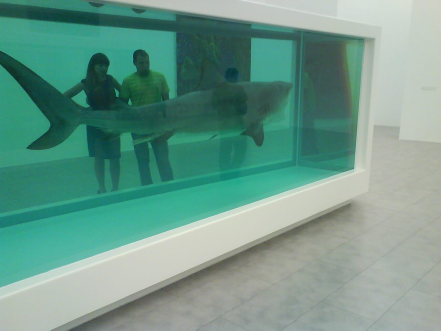
The Physical Impossibility of Death in the Mind of Somebody Living by Damien Hirst, By Agent001, CC BY-SA 3.0,
Emin’s work was then, and still is now, a confrontation with misogyny, bodily agony, abuse, but also a resource for resistance, kindness, sublimity. There is one (minor) work here. Is there nothing that could have been borrowed from the Tate’s own Emin retrospective? (There are 2 incredibly powerful video works there that could have been shown – but I doubt they were tasteful enough for Enninful.)
Failure to engage with race and class
The art here is an afterthought. One Rachel Whiteread, one Jake and Dinos Chapman sculpture, on its own, with no context. There is no attempt to look at their art as a key to understanding the way the YBAs sought to make art convey shock and pain and repulsion again – the spirit of Goya is in all the YBA art of the 1990s. Enninful neither notices this nor considers why this might be.

No Woman No Cry by Chris Ofili 1998 © Chris Ofili, courtesy Victoria Miro, London
There is a room that contains Ofili’s memorial painting for Stephen Lawrence, No Woman No Cry, Hamid Butt’s AIDS sculpture (made at a time he knew he was dying of AIDS) and Donald Rodney’s In the House of My Father (a photograph of a miniature house made from his own skin while having an operation in attempt to combat sickle cell anaemia. Rodney died from sickle cell in 1998.)

In the House of My Father by Donald Rodney, created 1996–7 courtesy Estate of Donald Rodney
All of these are positioned around a central display of an Oswald Boateng suit and some Alexander McQueen costumes. I’ve no wish to disparage either – Boateng produces lovely suits, and McQueen brought some of the darkness that haunts Hirst and Emin to high fashion. But the idea that their work should take centre stage and overshadow key artworks of the time that directly engaged with themes of race, class and what both Butt and Rodney saw, rightly, as medical apartheid, does not sit well, pitching everything in the room as just one or other form of commodity.
The couture matters more than the street
There’s a whole room full of photographs of people raving – at free parties, garage nights, queer raves, afternoon bhangra parties. The room though, is silent. What it needs is noise – a soundtrack made up from the parties it depicts. It’s tame and timid, when the musical culture it illustrates was anything but. Why have pictures of Goldie looking great, but nothing from any of his Metalheadz nights?
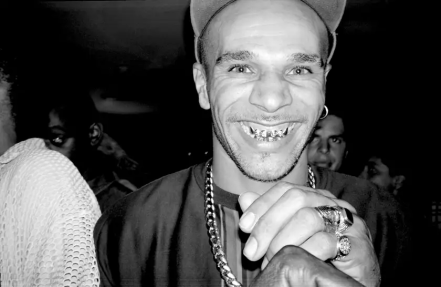
Normski Norman Anderson, DJ Goldie from Metalheadz at Blue Note club, London 1996
Again, all of this is fed to us through a kind of depoliticised fug. Nothing about the fact that during this period, AIDS had become the biggest killer of men aged 25-44. Nothing about the 1991 ACT UP London march on Trafalgar Square or the ACT UP London World AIDS Day 1992 Downing Street protest. A few mentions of acid house, but little of the tabloid /Parliamentary hysteria and police crackdown after the death of Leah Betts.
No recognition that the fashion around acid house was more to do with football terraces, Joe Bloggs, cagoules and flares than McQueen and Westwood. No link established between the free party scene around Spiral Tribe, Bedlam, Tekno Travellers, Smokescreen, Circus Lunatik, Desert Storm et al and the earlier traveller scene, or the way the combination of High Court injunctions and cop violence employed at the Battle of the Beanfield in 1985 was used again as a model by the state after the Criminal Justice Act was passed in 1994.
I guess whether you enjoy this exhibition depends on whether you think, as I do, that the free rave at Castlemorton Common in May 1992, where between 20-60,000 partied for 7 days, matters more than a Westwood dress, however stunningly beautiful from a purely aesthetic perspective that may be. Enninful sees everything through the lens of high fashion. The 1990s was one more example – like punk, like mod – of the street providing impetus and inspiration to haute couture, but in the end, it’s the couture that matters most here.
This is an opportunity wasted, the banalisation of maybe the last time art and music existed outside and against the capitalist market in any real sense. We’re told that the exhibition ‘reflects on the 90s as a moment poised between past and future’ – as I guess did the 1960s, the 1460s, the 1200s etc. We really are at that level of platitude.
The 90s: Art and Fashion is on at Tate Britain until 14 February 2027