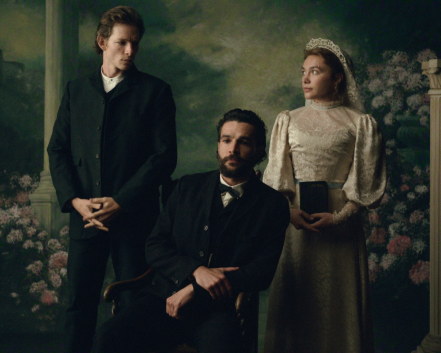
Mike Faist as Charles Trask, Christopher Abbott as Adam Trask and Florence Pugh as Cathy Ames. Photograph: Netflix
By Dennis Broe
East of Eden, the Netflix series based on the John Steinbeck novel and the ’50s film that followed it, is a work of two remarkable auteurs, the writer Zoe Kazan and the actress Florence Pugh. Steinbeck’s sometimes sprawling critique of American values and the American character and their moulding by a rabid capitalism where money and getting ahead are the primary values is refined and crystallized in Kazan’s adaptation, which makes her grandfather, the director Elia Kazan’s film, pale by comparison.
The series begins and ends with two wars, the American Civil War and World War I, with the Native American genocide in the middle of these. All three also victimise the Trask family, reminding us that the great events in American history happen around that history’s overarching pattern of bloodshed. This is a country, remember, that since its inception has been involved in 5 declared wars, 36 major conflicts and some 400 foreign military actions.
Steinbeck describes Americans as “a violent people…descended from the restless, the nervous, the criminals, the arguers and brawlers…” Likewise the series tracks the way this virulent form of American capitalism lays waste the country as a whole and its individuals.
The first episode begins with the revelation of two secrets about the original patriarch, Cyrus. One, that his war stories about planning the Union victory at Gettysburg are false and, two, that the inheritance he passes his sons was stolen from the veterans he is in Washington supposedly representing. Cyrus sends his son Adam to the army to follow his footsteps, and he is roped into a massacre of women and children in the Indian Wars. A generation later, Aron, Adam’s son, enlists and becomes a victim of World War I.
Over its eight episodes, the series also traces the growing increase in speculation in American society. Adam’s other son Caleb, trying to pay back his father’s debts, enlists in a war profiteering scheme of buying beans for five cents, trading on the idea that because of a shortage in the first world war, they will soon be worth ten cents. His is told by the businessman who is his partner, “That, Cal, is how you make a lot of money.”
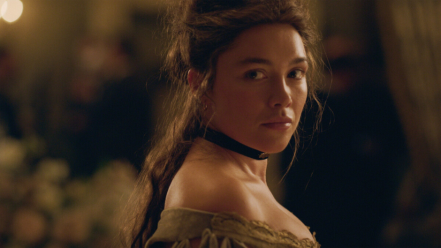
Florence Pugh as Cathy Ames
Adam’s wife Cathy, the most remarkable character in the novel and brought stunningly to life by Florence Pugh, begins as a teenage victim of a teacher’s “affection,” and learns early, that if she is to survive as an independent woman, she must manipulate the situations men consign her to. She escapes Adam’s repressive family trap and slowly becomes a madam, in her desire to control her own life. Her new role involves an understanding of and catering to male depravity, practiced especially by the towns and California’s state leaders.
However, the profit motive lays a hold of her as well in her management of the house of prostitution. “Add another show,” she barks at one of the women, “build demand then raise prices.” She betrays a woman who shows mercy to her and in one of the most stunning scenes of the series, which recalls Macbeth’s torment by the spirit of the murdered Banquo, she conjures that woman’s ghost, beckoning her. However Cathy, now called Kate, is not Lady Macbeth; she is Macbeth.
Kate’s desire, scheming and ultimate duplicity, all fostered by a male world that allows few avenues for female expression, is the heart of the series and the novel. When Kate departs, Pugh’s masterful performance leaves a gaping hole in the production.
Book and series are at pains to describe a split in the American character, evidenced by both sets of boys, Cyrus’ and then his son Adam’s. Adam and his boy Aron are the innocents, idealists who are stupidly blind to the world around them – including sex and female desire, which they regard as impure.
This is the Western, innocent of Graham Greene’s The Quiet American who plays the naïve do-gooder while exploiting those around him, linked to the idea of American purity and exceptionalism amidst a bloody history.
As Steinbeck describes it, “Aron didn’t grow up. Maybe he never will. He wanted the story and he wanted it to come out his way. He couldn’t stand to have it come out any other way,” while his father Adam is “the most rigidly honest man it was possible to find, living all his life on stolen money which his father pilfered.”

In this present moment of mass deception where those tenders of an increasingly virulent empire continue to pretend innocence of their violent motives, Washington is full of Adams and Arons.
Adam’s brother Cal and Adam’s other son Caleb are the realists, who at least have a chance of happiness, but only if they recognize the truth and the at least partial ugliness of the world around them.
The series contrasts the bleak world of the small farm in Connecticut with the verdant fields of California’s Salinas Valley. However, the promise of this new Eden is shattered by a culture of greed and easy money. Adam’s refrigeration scheme to ship produce east ultimately fails and causes him to lose his ill-gotten fortune.
Lee, the Chinese philosopher posing as nursemaid and cook and subject to extreme racism, sees his plan to open up a bookstore in San Francisco’s Chinatown flounder as he finds his countrymen herded into a segregated space, formed into Tongs for protection, and uninterested in any culture except that which is necessary to survive. Cathy/Kate’s dream of having her own business equally is destroyed by the actions necessary for her as a woman to achieve it.
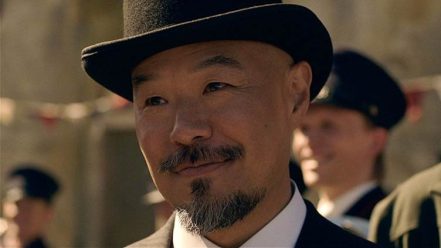
The Chinese Philosopher Lee
The Salinas Valley Eden is in the end a rotten garden, much the way modern-day Americans are experiencing the once verdant promise of their country. Nowadays, nearly 50 percent of working people living below, near or just above the poverty level, and home ownership is now realized and realizable by only a third of those in their 20s and 30s. The American Dream has become increasingly vacuous and hopeless, because of the immiseration of the working class.
“……in proportion as capital accumulates, the situation of the worker, be his payment high or low, must grow worse. Accumulation of wealth at one pole is, therefore, at the same time accumulation of misery, the torment of labour, slavery, ignorance, brutalization and moral degradation at the opposite pole, i.e. on the side of the class that produces its own product as capital.‘ – Karl Marx, Capital Volume 1, Chapter 25