Commons image
By Fran Lock
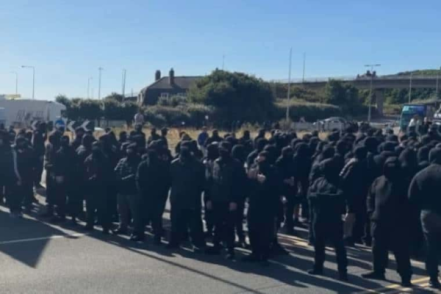
wanhope day in dover. want and bruise
of hope. in black. their unity is funeral,
a shirt reworked. this frugal dirge they
knead and grease like dough: die fahne
hoch. refrain is raised, revised. a voice,
a flag. the flapping of a grimy sleeve
exceeding its salute. this wall of boys
do not stand firm, they are stuck fast,
mistaking stupor for resolve. pity
them. we have been here before.
fear them. we have been here before.
this wall of force and noise. wanhope
day. their viscous prick-song spit into
the wind. an old, infectious fable. says
that it will fill them up. it cannot fill
them up, so makes instead a virtue
of their emptiness, a weapon of their
emptiness. they are not men, not now –
the hot and crackling aggregate
of rage. now they are joy, torn along
its leanest length; the gutless conjuring
of power, each hood without a head.
they live not in their bodies, but in
the sanctioned aftermath of white,
poor. pointed finger, feeble excuse.
inside the anonymous offices
of violence. the heart keeps
its corpse’s score. they walk
in disturbed circles endlessly.
it has nothing to offer. that is
the point: a surrender so severe
that it becomes transcendence.
yes, it is stupid. but stupidity is
formidable and pure. to be assumed
inside the uniform that holds them:
this is the fascist dream. those
ugly faces, limned in mission.
winged assemblies of error in the head.
wanhope day in dover. want and bruise
of hope. in black. yes, be afraid. but
be not afraid. this is not the end, we
can fight our way back.
if you google the latin phrase “noli timere” you will immediately discover that these were the last words of no less a poet than famous seamus, sent to his wife via text message mere minutes before he died. in fact, so ubiquitous is the association of this phrase with heaney’s legend, that you’ll be pushed to discover anything else about it. with that said, try, if you can, to put this so-affecting piece of poetry mythos quite from your mind. i don’t want to talk about famous seamus today, i want to talk about isaiah 41 in the vulgate latin bible (trans. your lad st jerome, 405 ad). because, while variations on the injunction “noli timere” or “do not fear”/ “do not be afraid” appear over seventy times across that text (it is often how supernatural emissaries announce themselves to their astonished human witnesses), the phrase gets its most thorough and subtle working out in isaiah 41. about which i have some very intense takes indeed.
from isaiah 41, then, two relevant variations on this motif. the first:
….so do not fear, for i am with you; do not be dismayed, for i am your god. i will strengthen you and help you; i will uphold you with my righteous right hand. (41:10)
the second:
…do not be afraid, you worm jacob, little israel, do not fear, for i myself will help you,” declares the lord,
your redeemer, the holy one of israel. (41:14)
okay so, i imagine there are questions? to answer which, context is about to be enormously important – bear with me: while it’s not possible to be one-hundred percent accurate, expert opinion cites the writing of isaiah 41 around the period of the babylonian captivity/ babylonian exile, which was not so much a singular event, as an on-going series of violent occupations and expulsions, most notably following the siege of jerusalem by nebuchadnezzar ii (c.597 BC). this saw a huge number of judeans forcefully dispossessed and exiled into babylonia by the neo-babylonian empire. i don’t know nearly enough about this period, so i’ll refrain from embarrassing myself by thrashing around in a thicket of historical detail, and, in a rare break with tradition, i’ll get to the point: the specific historical context for isaiah 41 and its injunction against fear is an address to a traumatised people effectively forced from their plundered and brutalised homeland; a people living with anxiety, uncertainty, and beneath great tyranny… yes… well. you can, for now, draw your own parallels.
on the one level, then, 41:10 is about seeking comfort in faith; looking beyond the turmoil of earthly things and turning one’s sight to/ drawing fortitude from eternal truths. which is… fine, but also, to my mind, pretty partial. what else? well, i’ve seen ‘for i am your god’ used to emphasise the identity/ election of the judeans as god’s people, and thus special recipients of god’s – if not the world’s – justice, and that’s not not in there. but i’m not wild about that interpretation, because rather than redressing or assuaging suffering, it turns suffering itself into a badge of special merit in the eyes of god: spiritual pride as a kind of passive sop. i’m not convinced by that idea. because, also: ‘i will strengthen you and help you; i will uphold you with my righteous right hand.’ as in, that’s not general, abstract comfort, that’s active concrete solidarity. you know, with the poor and the oppressed. as in, we’re not affirming identity as part of any special status claim, but in order to call us back to each other and to our community. the judeans – and by extension all of us – are being asked to stand with each other. what, after all, is held by the righteous right hand, but a sword – literal or metaphorical – raised in defence of each other, raised against tyranny… hey, it’s a thought.
and this is why jacob is called a “worm” in that fabulously unflattering bit of direct address: jacob is a synecdoche for an abjected and oppressed israel. “worm” as an insignificant creature, universally beneath notice, nevertheless named and noticed here; trampled by nations, abandoned by the world, seen by god. i like to think about what’s happening here, in that movement from a singular concentrated image, into something plural and necessarily diffuse – from “worm” to “israel”. because it dramatises something inherent to class consciousness: that while my portion of subjective misery matters, it is also part of a broader context, a bigger historical picture. in this sense, my own pain is shared with and by others: it is no longer something to be evaded or atomistically overcome, but a suffering we hold in common, a spur to radical sympathy with my fellow human beings wherever they are and suffer in the world.
it’s in this context that the phrase “noli timere” enters or sparks off the poem. the far-right have been a visible and viscerally intimidating presence here the last week. it is frightening. it is also appalling. i abjure them and i dread them, and their resurgence fills me with despair. which is why i found myself having recourse to the medieval word wanhope. as in:
now comth wanhope þat is dispeire of the mercy of god þat comth somtyme of to moch outrageous sorow and som tyme of to moch drede
which appears in chaucer, specifically ‘the parson’s tale’ (c.1400). the prefix wan expresses privation and neglect, and it was used in the middle ages to imply not only an absence of hope, but a profound loss of belief in the mercy or goodness of god – with all the uncertainty and doubt that this entails. oh, and if you would like a rackety ride through the many faces of medieval depression, you can read my vague reckons on that here. but now, back to wanhope – i was also interested in the movement of the old prefix wan as something lacking or neglected to the modern english adjective wan, meaning pale or sickly. here, confusion multiplies: in old english the adjective meant not pale but dark and leaden – perhaps from lacking in light? – which relates it, if only tangentially, to the old scots noun wan, meaning bruise. all of which feeds into the animating energy of the poem: a loss of faith, a feeling of despair, a rabidly enciphered whiteness as a kind of creeping malady, the encroaching “darkness” of racist and totalitarian thought, the implied – and echoing – violence of the bruise.
there were/are many stomach-churning aspects to the dover occupation, but something i continue to find disturbing in the extreme is the “patriot platform” self-describing as a bastion of “christian values”. because no. just no. the christian sect – you profaners of historical truth – the jesus movement, was/is a basileia movement. basileia, from the greek for kingdom or empire, a movement which rose against and proposed a counter-cultural alternative to, the imperial power of rome. against – just so we’re clear – any oppressive, hierarchical model of earthly power and its proliferating structures of sin. for equality, peace, compassion, and radical love. christ was not a reactionary. the jesus movement believed/s in something. unlike the fascist movement – and this is a fascist movement – which believes in nothing, has no ideology, scarcely any ideas beyond an appeal to the logics of physical force. the essential feature or quality of fascism is that it destroys – and openly aims to destroy – human lives. its one solid tenet, of which racism is the most familiar manifestation, is that there are classes of human being who deserve confinement and erasure, because, for some arbitrarily decided reason, they are deemed inherently inferior. these goons can (and do) dress this up in a discourse of national victimisation and self-defence, but that trajectory is only ever leading one way. to the-best-defence-a-strong-offence. history has shown us – disastrously and repeatedly – the logical conclusion to this line of thought.
so far, so repulsive, but to say that fascism is empty, isn’t to pour score on it for the sake of it. it’s empty, but strategically so. benjamin knew this. in the work of art in the age of mechanical reproduction (1935) he writes:
fascism attempts to organize the newly created proletarian masses without affecting the property structure which the masses strive to eliminate. fascism sees its salvation in giving these masses not their right, but instead a chance to express themselves… the logical outcome of fascism is an aestheticizing of political life. communism responds by politicizing art.
i’m not getting into whether or not this is an accurate image of what communism is and does right now, i’m sharing the mighty walt only because he grasped astutely the way in which fascist movements operate; the hollowness at their centre. which hollowness is why pricks like the “the patriot platform” attempt to cover themselves in a motley of buzzwords, cod-historical nostalgic evocations, and vague appeals to “values”. the attempt is not to present themselves as “acceptable” to some mainstream centre-right vision of politics, but to disguise their movement as a politics at all. strip away the veneer, and it is obvious to anyone with eyes in their head that they do not represent a position or opinion that can be debated, but a set of actions to be resisted at all and any costs.
this lack of content, incidently, is what has allowed fascist movements and leaders to adopt a policy of “pragmatic”/ ideologically bankrupt flexibility: changing their stated policies if doing so proves expedient to power – we can talk about mussolini here, and his 1922 pivot to monarchism, or, somewhat less dramatically, we can talk about farage’s move from a thatcherite libertarian ideology to his grubby opportunistic embrace of nativism a la the eternally loathsome viktor orbán – the principle is the same.
again, they’re like this on purpose: have always preferred a sinister cult of action to open debate or abstract reasoning. the timing of these “protests” should not be lost on us. as the reform party spirals, the hard-right scrabbles for power, appeals once again to intimidation and physical force. denied legitimate expression, it is seeking to regain/ assert control by other means. i find this horrifying. i’d like to be able to dismiss these actions as the tantrums of the eternally discredited, but sadly, i don’t think that’s true.
i’ll unpack: i’m currently preparing some notes towards a round table discussion on resisting the right through arts and culture. one of the provocations i’ve been set to think about is why the right are winning the war of ideas. to which my still incomplete answer is something like this: it’s not a war of ideas, it’s a war on ideas, one the entire media and communications architecture of the twenty-first century is geared to facilitate. it isn’t just that new platforms facilitate the spread of right-wing ideology, but that the kinds of discourse that they foster favour fascist thinking: shallow, aestheticised content, encouraging (also monetising) extreme declarative speech acts that admit no doubt, no otherwise, no challenge; information returned to us by algorithm, the nuance shaved out, instant answers only as good as the questions we know to ask. the medium matters, and this medium shapes and delimits thought, allows only certain forms of thought to root and spread. of course there’s a love-in between tech-bros and far-right politicians: tech is bringing about the material conditions for the fascist mind-virus to thrive.
sorry, that last sentence got a bit matrix-y, didn’t it? how early aughts of me. but it has been on my mind. it was on my mind when i sat down to write the poem, wondering if a poem could be a material tool/ an enabling architecture for (mental) resistance, could foster or incite another kind of thought – slow thought, ambiguous thought, historically and sympathetically rich thought? i don’t meant to suggest that my poem in particular was doing this, just that poetry in general, as a mode, might. which is where I chose to end the poem, on a fighting back that is first the writing of the poem, the reading of the poem – any poem – and a mental effort of understanding towards people whose moral position we find utterly repellent. can art create these conditions?
i don’t know, but my thoughts lead me back to ““noli timere”, which is a call to courage, but also an offering of aid. the message i want the work to carry – the intention i want it to transmit, whatever it is ostensibly about – is something like “i am with you”. to raise a voice and a mind. like a shield, like sword. a torch to light our way…