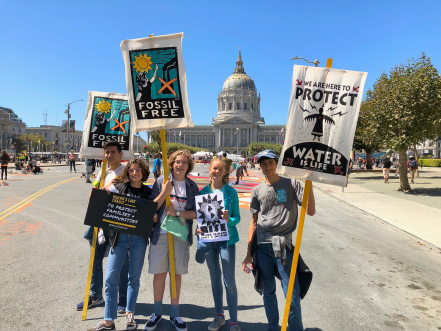
Art and activism for climate action. Commons image.
By Adam Page
The first time that I understood revolution was theatre and really understood it in that lizard part of the brain where you understand things instead of just know them, I was watching the news with my parents in July 1996 and I watched a woman get dragged off a motorway with paint on her hands and a smile on her face, as though she’d won something. Which she had, I suppose; she’d won the shot. The shot that runs on the six o’clock news and makes some pale accountant in Surrey put down his fork and say “Jesus, what are they doing to that girl” and not once ask what she was doing to him, and his portfolio, to the coal-fired future he’d quietly been financing between mortgage payments. That’s the whole rotten and beautiful trick, and it’s been the trick since before any of us were born, since your grandmother’s grandmother marched into a department store with a hammer concealed about her person and put a fist-sized hole through a plate-glass window on Regent Street for the crime of daring to want a vote.
You won’t really find this in the Civics textbooks as the Civic textbooks are written by the sort of people who think politics is all a matter of white papers and select committees and reasonable discourse done in beige rooms by men who’ve never once in their lives been afraid of the police. But politics, the type that actually moves anything, the type that leaves a mark, has never worked that way. It’s always been a production, or a show. A carefully blocked piece of guerrilla theatre staged for an audience of millions who weren’t even in the room. If you can’t understand that, or if you think the barricades and the banners and the bodies in the road are simply logistics, chess moves in some hideous utilitarian calculus of pressure and inconvenience, well you have seriously missed the point and you deserve the miserable and grey, unlived life that sort of thinking gets you.
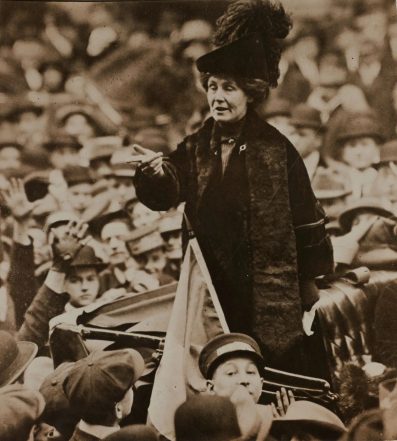
I’m going to start with the suffragettes, as everybody thinks they know the suffragettes and almost nobody does. They’ve been flattened into a Sunday-night costume drama full of high collars and righteous tears, when in fact the Women’s Social and Political Union was one of the most brutally disciplined propaganda organisations of the twentieth century, and I mean that as a high compliment. They didn’t just protest, they branded. Purple, white, and green. Dignity, purity, and hope. Or so the official line went, although I suspect that somebody in that organisation also just understood at a gut level that a unified colour scheme reads on a crowd from four hundred yards away in a way that a jumble of assorted overcoats never will.
Just check out the old photographs, the ones that are still there in the archives with the silver starting to go soft at the edges: women marching in matching sashes, hand-embroidered banners with the slogans stitched tight and clean, hunger strikers photographed luminous and gaunt for the papers like renaissance martyrs, because that’s exactly what they were being built to look like. This was art direction and not some accident of enthusiasm. Emmeline Pankhurst knew something that half the strategists running campaigns today still don’t: the state will always have more truncheons than people, but it doesn’t necessarily have more images, and if you can win with the image, eventually you can bleed the state’s legitimacy out through a thousand tiny cuts made of light and ink.
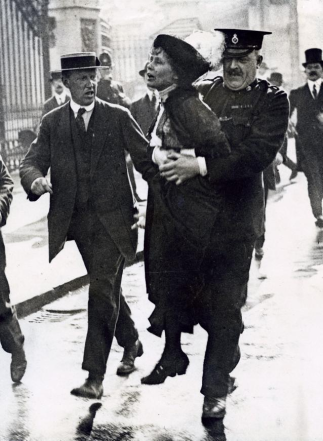
Emmeline Pankhurst under arrest. Commons image
When the marching and the pamphlets and the ladylike petitions didn’t move the mountain, they escalated to something that even now reads like performance art of a vicious and gorgeous kind; smashing windows on Oxford Street in a coordinated and simultaneous barrage. A whole shopping district changed in one afternoon into a stage set for the destruction of respectability itself. Postboxes were set on fire. They chained themselves to the railings outside Downing Street, a piece of stagecraft so elegant it’s practically Brechtian. The female body, made immoveable by iron and planted directly in front of the seat of power. It’s an image that does the political arguing for you because you don’t need a caption under an image like that, everyone already knows exactly whose freedom is in the room and whose isn’t.
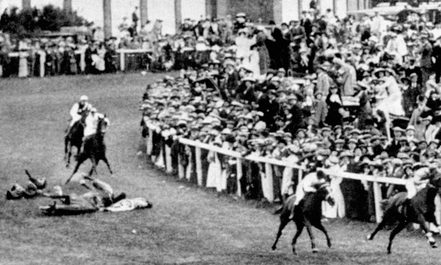
Emily Davison at the Derby, 1913. Commons image.
Then there is Emily Davison at the Derby, running out under the King’s horse, and of course I’m not going to sit here and tell you what was in that woman’s mind in the half-second before the world went white and terrible, nobody knows that, but I can tell you what happened after, which is the image of it. A woman’s body, a horse, a King’s Colours and a sea of hats all turning to the horror in unison. It has become one of the most reprinted and reproduced photographs of the century, more famous by some measure than any speech a suffragette leader ever gave in the House. That isn’t incidental to the movement, but rather the movement working just as its most instinctive practitioners understood movements have to work: unbearable images lodging in the collective eye like a splinter and will not be removed by reasoned argument as they were never reasoned arguments to begin with. They were art. It was art that was terrible and necessary, made from flesh and consequence only because the polite version wasn’t being listened to.
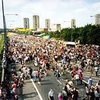
Now fast-forward eighty-some odd years, cross an ocean of political disappointment and two world wars and the grinding machinery of the twentieth century chewing up every radical hope that dared show its face, and you land in mid-nineties Britain, and in the stinking exhaust fumes off the M41, where a bunch of anarchists and ravers and bike couriers and people who’d read too much Situationist theory in squats with no heating decided that the way to fight the total and suffocating privatisation of public space and the criminalisation of the party itself was to throw the biggest and weirdest, most beautifully deranged street party London had seen in a generation. And they would do it directly on top of a motorway.
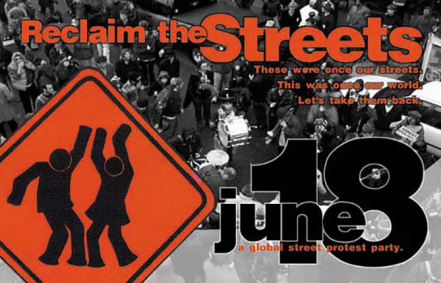
Reclaim the Streets
Reclaim the Streets. God, what a name, what a mission statement disguised as a slogan. They didn’t hold a rally, rallies are for those who’ve already lost and know it, standing in a field listening to speeches while the actual decision-makers are somewhere else entirely. Warm and unbothered, checking their watches. Reclaim the Streets threw a carnival, a real one with sound systems mounted on the backs of trucks blaring into the concrete canyon of the motorway. There were dancers in costumes, with two huge trip-tower structures disguised as scaffolding towers that hid activists locked at the top so the police couldn’t move without risking someone’s neck.
There was a woman in a hooped Victorian dress twirling under a parasol in the middle six lanes of the M41 like something from a fever dream mixed with a health-and-safety violation. And underneath the partying, jackhammers were being used to break up the tarmac and planting trees in the cracks, and that’s a piece of guerilla landscaping theatre so on-the-nose it’s nearly sublime. Here is the road, the grey artery of car culture and oil dependency and suburban creep, and here, live and in front of your eyes, is nature reclaiming it while several thousand people are dancing to a bassline that can rattle your molars.
That is not a protest as your local MP understands the word. It was a piece of environmental theatre with a political thesis embedded so deeply in its bones that you absorb the argument through your feet before your brain has even caught up. The art and the tactics were not separable. The disruption; traffic blocked, the cost imposed on the state’s capacity to move money and cars down that strip of asphalt, depended completely on the aesthetic and on the fact it was strange and gorgeous and impossible to look away from. It was simple really, a boring blockade gets a dull paragraph of page nine and a colourful one gets the front page and a legacy.
The street theatre groups that followed in its wake, those giant puppets that would show up at anti-globalisation protests in Genoa and Seattle and everywhere after, the huge papier-mâché effigies of corporate greed with their gaping mouths and dollar-sign eyes straight out of the Bread and Puppet playbook, they were never simply decoration bolted onto the “real” politics happening somewhere else. They were the politics, and they were delivered in a language that bypassed all the editorial filters of every newspaper too compromised or too cowardly to run the actual argument straight.
I’ll stop here a moment to lay out a truth I think, by now, we’re all aware of: this country, my country, your country, whatever wretched patch of soil you’re reading this from, is currently run by people who have turned the whole apparatus of the state into a hedge against their own accountability. The billionaires who own the pipelines help write the regulations that govern those pipelines. The men profiting from the wars sit on the committees that vote to fund the wars. This isn’t some tinfoil hat conspiracy, this is just Tuesday, and the ordinary grinding texture of how power moves money into fewer and fewer hands while telling the rest of us, with a totally straight face, that there just isn’t enough to go around. Not enough for your child’s school, your hospital, not for the flood defences that could have saved your neighbours house but there is, strangely, always enough for a third yacht.
Against a machine like that, a strongly worded letter or petition is a joke. Writing a letter to you MP is a joke told to an audience that already knows the punchline and just doesn’t care. What actually frightens power, and I mean genuinely frightens it and keeps the men in expensive suits up at night drafting memos about “narrative control” and “optics,” is an image it can’t control. A banner unfurled at just the right moment on just the right building so that the photograph runs everywhere and the story is no longer about quarterly earnings but about the fact that somebody, somewhere, was brave and clever enough to turn their headquarters into an unwilling stage set for its own indictment.
It’s this reason why the aesthetics matter, and why the choice of a colour or the cut of a banner, the whole choreography of a march is never frivolous. It’s never secondary to the “serious” business of politics, because there really is no serious business of politics that doesn’t run on images in the end. Look again at the sashes of the suffragettes. Look at the trip-towers of Reclaim the Street and the dancers. Look at the die-ins of Extinction Rebellion, with rows of bodies laid out flat and still on the pavement outside Parliament, red-robed figures moving through the crowd utterly silent like something summoned from a nightmare about complicity, because that’s exactly what they’re meant to summon: the spectre of what is coming painted in the colour of the thing itself, all rendered in a language that needs no manifesto to understand as the body on the ground is the manifesto.
Or even decades before this, the AIDS activists of ACT UP, staging die-ins on Wall Street with the same brutal and gorgeous logic, turning their own mortality into an unanswerable visual argument against a government that would rather they quietly and simply disappeared. None of this is just decoration. All of it is argument, made in a form that can survive being reduced to a single photo, as that’s the only form of argument that survives contact with a media ecosystem built to reduce everything to a single photo anyway.
And so when some editorial-page mediocrity, some chinless wonder with a pension and a parking space and absolutely nothing at stake sniffs about protesters being “attention-seekers” or “performative,” as though performative were an insult and not an accurate and pretty admiring description of what’s happening, I want to grab him by the lapels and shake him until his £20,000 veneers rattle and ask him what in the name of God he thinks politics has ever been other than performative, other than a fight over which story gets told and which bodies get to appear on it and on whose terms.
Those suits performing “stability” in the House of Commons, reading from a script written by a lobbyist and staged under lighting designed by committee, that’s performance too. It’s just performance so normalised and total that nobody bothers to call it that any more. The difference between their theatre and the street’s theatre is that theirs is funded, rehearsed, and designed to put you to sleep, while the streets is dangerous, improvised, and designed to wake you up.
So no, I won’t pretend that the barricade and the banner are separate arts, tactics dressed after the fact with some rhetoric about symbolism to make the actual violence of disruption feel more palatable to genteel and polite society. They were never separate. The suffragette who smashed a window was making an argument about womanhood and property in the same gesture that made her a criminal. The dancers on the M41 were making an argument about who the road belongs to in the same movement that made the traffic stop. Every banner and colour, every choreographed silence, every huge puppet with its terrible grin, is doing double duty as art and as tactic. Because in the world as it exists today; corrupt and cowardly and run by men who have priced your future into a spreadsheet, those two things were never, not for one second, two different things at all.