Football has long been described as the “people’s game” in the UK, a sport rooted in local working-class communities, and culture. However there is no deneying that it has changed. On one hand, it remains a source more than entertainment for millions of fans; on the other, it is increasingly dominated by global capital and corporate interests that don’t have fans or players needs at heart. Sky‑high ticket prices, costly kits, expensive players, elaborate stadiums, the commercialised match day experience, all show the prioritisation of profit which erodes the connection between clubs and the communities that support them.
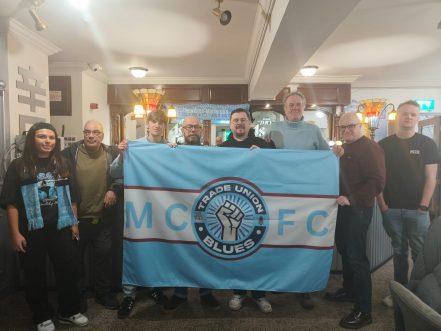
In this interview, Our Culture series editor Alan McGuire speaks with Chris Neville, Secretary of Trade Union Blues, a fan-led organisation campaigning for working-class rights and democratic participation in football. They discuss commercialisation, the role of trade unions in the sport, and the potential for football to reconnect with its working-class roots, all within the context of this multibillion pound industry. From stadium protests to cooperative ownership models, the conversation sheds light on how football can remain a game for the people, not just for profit.
AM: How do you see football’s relationship to the working class today?
CN: I would say it is by and large still a sport of the working class, but this is definitely in jeopardy. At City for example, and amongst other Premier League clubs, the fans have kind of become the victims of the league’s success. There’s so much money involved now and a global audience that we are seeing an increase for example in clubs catering towards corporate fans or tourists and it’s now become routine for clubs to cart long-standing season ticket holders out of their seats to make way for some overpriced ‘match day experience’ aimed at the rich.
I don’t think that is necessarily sustainable though and clubs at some point are going to realise that their core fanbase needs to be at the forefront of their plans but I think we will have to work hard to make the owners and the suits in charge of the clubs listen.
AM: In what ways has capitalism, and the commercialisation of the game, taken the fun and authenticity out of the game for fans and possible fans?
CN: I think some of what I already mentioned but also, I have seen with my own eyes lots of working class fans priced out of supporting their club. It also puts the future on thin ice as it costs so much for a family to attend a game these days that it will mean the younger generation doesn’t come through. I have to say as well that the actual competition for trophies has narrowed, even if we as a club have been part of that.
Ultimately, clubs have been about making money for the owners for a while but it’s gone so far these days. It used to be that a local businessman in the area could buy his local fop-flight team and probably put a few quid of his own money in and maybe get something decent out of it but now it’s all sovereign wealth funds, multi-billionaires or private equity. It’s interesting in a way that people who would be considered filthy rich are no longer rich enough to get into that game. And with the necessity for profit, of course it’s the fans who suffer, either through Sky Sports or increased ticketing pricing.
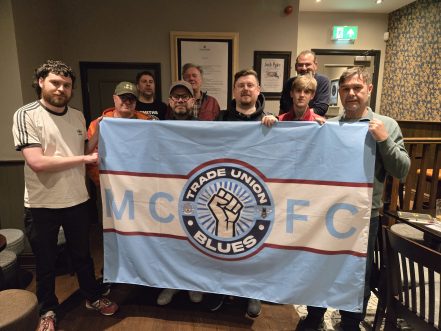
AM: What is your group Trade Union Blues and what are your objectives?
CN: We only formed at the start of this year but at the core were a group of friends who went to the games and were all either union reps, activists or officials. We wanted to formalise something and campaign around working class issues and 2025 was a good year to get into it. The FSA (Football Supporters Association) had a campaign called Stop Exploiting Loyalty which was gaining traction because it had fans of opposing teams doing banner drops at games together and to us that was great because it showed fans getting over their divisions to unite for a common cause. So we formed and were kind of thrown into action as we ended up working with some other City groups; MCFC Fans Foodbank Support and the 1894 to organise protests against some of the ticketing policies that City were coming out with. We ended up playing a part in two protests where fans didn’t take to their seats for the first few minutes of two games which were probably the biggest in stadium protests in Premier League history.
At the end of the season, the club announced season ticket price freezes, some new season tickets and a pathway for younger fans to get season tickets which were all things we had campaigned around. Unfortunately, they seem to have brought some pretty spiteful conditions around tickets in as a result so the fight is still ongoing there.
Also, as trade unionists and socialists, we want to see people working in football being treated well as workers. We got a motion through the FSA AGM around promoting trade unions for football workers and that will be where our focus goes to in the future. We also want to push for general working class unity as I think the right are massively on the rise in Britain and football has historically been one of their target areas.
When Britain First came to Manchester, we put out a statement saying they weren’t welcome and encouraging fans to oppose them which largely went down well but also had a fair bit of right-wing kick back online. I will say, the move which largely comes from the right to ‘keep politics out of football’ is massively counterproductive and misguided because capitalism has its grubby mitts all over football and that’s why fans keep getting shafted.
AM: What role have trade unions played in football in the past and present, and what would you like to see them doing in the future?
CN: The obvious one is that there is still pretty much a closed shop for the players in the PFA and certainly at the top of the pyramid, they do a good job of ensuring that footballers are well rewarded. We’ve had discussions on this around what to think and football is kind of unique in that you have the players, often from working class backgrounds, making a very good wage for themselves. For most clubs, wages are the majority of their expenditure which doesn’t really happen elsewhere in the economy.
But what I would like to see is players, who are served very well by their union, coming out with a more positive message about trade unions in general and encouraging supporters to become part of the trade union movement in their own workplaces. The PFA is part of the TUC but shies away from this kind of stuff unfortunately.
I’m part of Unite and within my branch falls the hospitality sector. Unite Hospitality have done amazing work in bars and hotels and hopefully can make some inroads into football to resolve issues workers in that industry are facing.
AM: What could a left or socialist government realistically do to improve football for fans and working class communities for example, in terms of ownership models?
CN: It’s a tough question because I think the kinds of things we would want in a socialist society could be a harder sell in terms of getting involved in football, but I would say to start, look at the issues fans are affected by and act on them. I think that fan democracy and fan participation could be the first steps, giving fans a genuine stake in the club to resolve the issues they have.
I just think of some clubs, including City where owners have come in, put money in and led to the most amazing period of our existence. Lots of people might view a socialist model as; fan owned, the silly money taken out, maybe a pool of players largely from the local area. If you present that to a club’s fans that have had massive success and beautiful football, it’s not so attractive so I genuinely think it’s a tough one to get around, but maybe we would be in a minority because that’s massively appealing to a club that’s not been able to put money in and turn that into on the pitch success. But if you look to Germany where the 50%+1 model is in place, that doesn’t automatically resolve the issues because Bayern Munich has a monopoly on the Bundesliga title.
I think that the clubs under socialism would be more worker-centric in terms of those employed behind the scenes and on matchdays. Football stadiums are hives of exploitation through zero-house contracts and outsourcing for security and hospitality workers which unfortunately, is representative of the rest of the economy. A stake in them for trade unions would be ideal.
We’ve got FC United in Manchester as a fan-owned club and despite their unofficial links to the red side of Manchester, I do like that model and respect what they are doing. I think it could do much better if they weren’t burdened with the threats to their survival that capitalism brings.
I’ve mentioned the MCFC Fans Foodbank Support and they are already doing great work getting working class football fans to support foodbanks as mutual aid. There’s a massive opportunity for trade unions to link up into that world too. There’s so much money sat in union branches. I would love to see it invested into community infrastructure where profit wasn’t a concern. I think about the decline of working men’s clubs and these places could be used as hubs for distributing the food collected, selling locally made beer from unionised breweries, having local union members running the place. It could act to stick two fingers up to the political class that everyone hates and give people a sense of being able to do things for themselves and each other.
Chris Neville is a Unite rep and the Secretary of Trade Union Blues
Read the rest of the editions from the Our Culture series:
Culture as Class Struggle: An Interview with Jenny Farrell
Our Culture: RIP British Working-Class Cinema (1935 – 2025) by Brett Gregory
Our Culture: The Uncomfortable Truth About Public Libraries
Our Culture: Breaking through the Class ceiling with bread and roses
Our Culture: Games and Class Struggle – with Scott Alsworth
Our Culture: Prize-winning Poetry Only Please! with Andy Croft
Our Culture: Democratising the BBC
Our Culture: Prison, Class, and Art – with Nick Moss
Our Culture: Can the Church Be More Democratic?
Our Culture: Putting the Class into Classical Music
Our Culture: Our Code; AI, Class, and the Fight for a Digital Commons
Our Culture: The World Transformed – Britain’s Socialist Festival