As a new production of Bertolt Brecht’s antiwar masterpiece Mother Courage and her Children is to open at London’s Globe Theatre in May 2026, this two-parts article reflects on the work of the great socialist theatre artist and his legacies in contemporary Britain.
By Francesco Sani
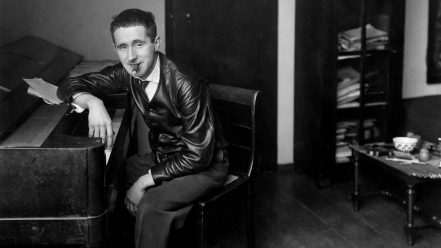
Credits: Zander & Labisch/ullstein bild/Getty
We are about to tell you
The story of a journey. An exploiter
And two of the exploited are the travellers.
Examine carefully the behaviour of these people:
Find it surprising though not unusual
Inexplicable though normal
Incomprehensible though it is the rule.
Consider the most insignificant seemingly simple
Action with distrust. Ask yourself whether it is necessary
Especially if it is usual.
We ask you expressly to discover
That what happens all the time is not natural
For to say that something is natural
In such times of bloody confusion
Of ordained disorder, of systematic arbitrariness
Of inhuman humanity is to
Regard it as unchangeable.
(Bertolt Brecht, Prologue to The Exception and the Rule In The Measures Taken and Other Lehrstücke
by Bertolt Brecht, page 37. London and New York: Bloomsbury, 2014).
This poem serves as a prologue to Bertolt Brecht’s 1930 short play The Exception and the Rule. The play is a parable that narrates the journey through the desert of a merchant with his servant and a guide. The aim of the piece was to unveil the dynamics of social oppression that are fundamental to capitalism, as the prologue states quite explicitly. The Exception and the Rule now holds a position as a classic of modern European drama alongside many other of Brecht’s plays, like The Threepenny Opera (1928), The Measures Taken (1930), Fear and Misery of the Third Reich (written 1930s), Mother Courage and her Children (written 1939), Life of Galileo (Frist written 1938/9), and The Caucasian Chalk Circle (written 1944). Not only did Brecht became a central figure in European culture, but he is one of the few mainstream artists in history whose name is inextricably interlocked with Marxism. But to realise the real power of his work we must put it in the context of his engagement with the socialist movement during his own lifetime and his indomitable faith in the possibility of change.
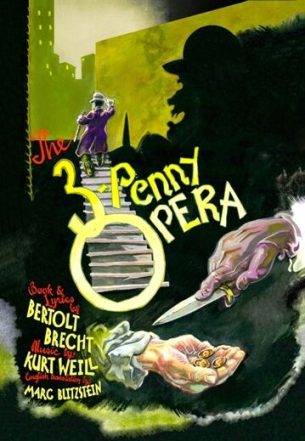
Born in Augsburg, Bayern, to a middle-class family in 1898, Brecht showed a rebellious spirit and an interest in the arts from a very young age. By his late twenties he was already an acknowledged playwright thanks to works such as The Threepenny Opera. The musical featured a score by renown composer Kurt Weill and became a sensational hit despite featuring a cruel critique of bourgeois morality. The play advocated that successful criminals behave like skilful businessmen and successful businessmen like skilful criminals. At this time, Brecht was a young man with an enthusiasm for social transgression and cultural experimentation, as testified by his love for the theatrical works of Frank Wedekind and for early cinema. Brecht was yet to develop his political consciousness as a Marxist, but in his earlier works we find a willingness to mock cultural conventions as well as challenging traditional forms of entertainment. By the end of the 1920s, Brecht had engaged thoroughly with the study of Marx’s Capital and of revolutionary literature, including the works of Lenin. Most importantly, he started a close collaboration with socialist theatre maker Edwin Piscator, who was one of the most prominent artists connected to the socialist movement in the Weimar Republic (Post-WWI Germany). Under the influence of his artistic techniques, Brecht developed the two strands of work that won him a place as a central figure in modern theatre: the Epic theatre and the learning play.
Brecht first used the term “Epic theatre” to talk about his and Kurt Weill’s opera The Rise and Fall of the City of Mahagonny (1927). He described Epic theatre as a new way to stimulate spectators’ critical engagement, in opposition to sentimental and acritical dramatic theatre. Brecht advocated an approach to theatre making that pushed spectators to be emotionally involved in what they saw while also feeling detached, as if put at a distance. In later writings, he called this the “estrangement effect,” in German Verfremndungseffekt (Often mistranslated as “alienation effect”). To explain what he meant, Brecht compared theatre spectatorship to watching a boxing match while smoking a cigar. Brecht wanted spectators to feel passionately about what they saw but be critical at the same time. In his ideal image, spectators would reserve undivided attention to the show, but they would also comment on the behaviour of the characters, just like we comment on the performance of an athlete while watching it with interest. At the same time, the ideal spectator would keep a measure of detachment, like someone who steps in an out of a conversation to take a puff.
The purpose of the estrangement effect is to show the behaviour of characters on stage as contradictory and dependant on the social conditions in which people find themselves. As stated in the prologue of The Exception and the Rule, the final goal is to show what is “not unusual” as “surprising,” “inexplicable.” Despite being deeply in love with theatre, Brecht saw the naturalistic drama of his time as bound to a conservative paradigm: a theatre that presented the social relations of capitalism as inherent to human nature, rather than the product of specific historical circumstances. Therefore, he developed an approach to theatre which showed reality as changeable. And he was looking at a specific way of understanding change, that of dialectical materialism. For him, theatre could help people developing a dialectical understanding of reality. It could show the contradictions between what people want and need and what the social order under capitalism (or previous forms of class-based society) forces them to do to survive.
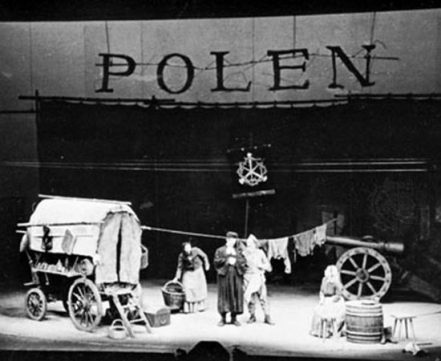
Many of Brecht’s most renown work are examples of Epic theatre, which later in his life he rebranded as dialectical theatre. Epic techniques defined the characters of works that thematize the nature of capitalism like Saint Joan of the Stockyards (written 1929-1931) or The Good Person of Szechwan (written 1938-1941), depicted revolutionary socialism like in The Mother (1932), or explored historical narratives like in Mother Courage and Life of Galileo. Brecht employed a range of strategies to establish this critical distance, many of which we now label as “breeches of the fourth wall” or interruption of the make-believe conventions of drama. The aesthetic strategies of Epic theatre included keeping the curtain half open so that spectators could see actors preparing the fictional scenes; using signs that summarised the action before it took place in order to make spectators focus on how things happened rather than on what happened; making actors speak in the third person to avoid for them being identified with their characters.
In the late 1920s, Brecht’s efforts to produce an active form of spectatorship went a step forward: the creation of a theatre where everyone actively participates in the action, of a theatre for producers. The learning plays were a series of experimentations with the active involvement of spectators in performance. They were devised with one idea in mind: that the reproduction and discussion of social problems through performance can help us understand the nature of social relations and how we can navigate them. The learning plays were designed to be minimalistic and push performers to focus on clearly established relations of conflict among individuals and social groups. They were also designed for repetition, to study and dissect social behaviour through a continuous process of rehearsing and experimentation. Brecht envisaged the practice as the theatre of the socialist world to come: one that was not concerned with providing messages to spectators but with establishing a ground to train critical thinking and the capacity of connecting thinking to practice.
The Exception and the Rule was designed as a learning play outlining the nature of capitalistic class relations. Performers would rehearse the piece repeatedly to experiment with all possible ways of reading the behaviour of each character. Learning plays like The Measures Taken (put in music by renown composer Hanns Eisler) were realised as musical performances that reserved a central role to choirs. In the Weimar Republic, choirs were a common artistic outlet for working class people, with hundreds of thousands of workers actively engaging in choir singing for leisure. Brecht attempted to employ this artform to push people to think critically about what it means to be part of a social collective. In the case of The Measures Taken, he was specifically looking at revolutionary organisation in a time when the German socialist movement was confronting the threat of Nazism. To allow critical reflections on the challenges and ambiguities of political organising, the play provokes its audiences with a narrative about a group of undercover socialist agitators who must kill a young comrade to avoid their mission being compromised.
When the Nazis took over in Germany, Brecht was forced to flee. He first went to Denmark, then Finland, and finally to the USA. In the United States, he was even put under trial for communist activities during the McCarthyite purges. This was a difficult time in his life: forced to flee Germany as a political refugee, Brecht would struggle to find an audience for his theatre in the years to come. Furthermore, he abandoned the work on the learning plays. The reasons for this were never made explicit. However, it is likely that he did not deem the practice suitable for the new social reality marked by the rise of fascism and WWII. Brecht returned to Europe in 1947, first relocating to Switzerland. Here, he staged his famous adaptation of Sophocles’ Antigone in the same year of his arrival. In 1949, he returned to East-Berlin to establish the Berliner Ensemble, his own theatre ensemble. In 1954, the ensemble took over the Theater am Schiffbauerdamm, one of Berlin’s most prestigious theatres. In these years, Brecht finally resumed his work as a director and was able to stage many of his masterpieces as well as adaptations of classics such as Lenz’s The Tutor (1950) and Moliere’s Don Juan (1954).
Until his death in 1956, Brecht dedicated himself to create a theatre that employed his many discoveries and innovation to intervene in war-torn East Germany. At the same time, the later years of his life were marked by clashes with East-German authorities. Brecht was never a supporter of Stalinism. In fact, he had never formally joined the German communist party despite being one of the most prominent intellectuals on the left. But he saw the Soviet Union as the only social force that could have led the socialist movement forward. This led to numerous frictions with the new East-German establishment. Brecht was also well-aware of the destructive effects that Nazism and the war had on ordinary people. He thought that his mission as a public intellectual was to support the creation of a genuine socialist culture and challenge the thinking patterns that years of dictatorship and war had embedded in people. With all things considered, the post-war years gave him a platform to freely experiment with stage performance. It is in these years that he solidified his artistic reputation worldwide, also thanks to the enormous international attention that his work received.
To this day, we can name many Marxist and socialist theatre artists. However, only Brechtian theatre is a quintessential expression of Marxism through performance. The reason for this is simply: Brecht knew that Marxism was a dialectical philosophy, and so he dedicated his life to develop a theatre that was under every point of view dialectical. Brecht understood Marxist dialectics to be about confrontation: a philosophy that looks at reality to find different social forces at play, coming into conflict with each other. But he also understood Marxism to be about change. Brecht observed firsthand the exploitation and alienation of workers under capitalism, as well as the genocidal madness of imperialist war. At the same time, he had witnessed the power of working-class people and their capacity to organise and build a new world. All of this led him to imagine a theatre that stimulates the appetite for change, whether as a form of intellectual spectacle (the Epic theatre), or in his experimentations with the learning plays. To this day, Brecht’s legacy gives us the instruments and inspiration to imagine a theatre that acknowledges the inhumanity of the world as we know it but also understands it as changeable. This is the healthiest and most enduring part of his legacy.
Read part two here