Credits to: Townsend Theatre Productions and Simon Jenner.
As a new production of Bertolt Brecht’s antiwar masterpiece Mother Courage and her Children is to open at London’s Globe Theatre in May 2026, this two-part article reflects on the work of the great socialist theatre artist and his legacies in contemporary Britain.
By Francesco Sani
Writing about the legacies of Bertolt Brecht in modern theatre is both simple and hard. It is simple because there are many examples of politically engaged and militant artists that draw from Brecht in creative and effective ways. It is hard because we live in a world where the social significance of theatre and the arts is fundamentally different. In the first instance, previous divisions between “high” and “official” art and popular art are not as severely partitioned as before. In Western countries such as the UK, mass media, public education, and later on the internet have allowed ordinary people to receive much wider and better exposure to the arts, also allowing many to see a creative careers as viable options. Such enhanced access to culture came with the many victories of the workers’ movement after World War II. In particular, the Arts Council created a reliable form of public subsidy for many working-class creatives in the UK, and the expansion of higher education and mass media communication helped popularising experimental and political art. Such victories were part of an historical compromise between the capitalist class and the workers’ movement advocating better living conditions for ordinary people. Contradictions and limitations in the access to the arts were always there for working-class people. However, an infrastructure was established to enable access to and participation in the arts.
With the rise of neoliberalism, this infrastructure was slowly turned into a grotesque parody of itself. If Margaret Thatcher raged war against the labour movement, Tony Blair’s New Labour further enforced privatisations and the establishment of market mechanisms to regulate society. Thanks to New Labour policies, theatre and the arts started being subsidised depending on their capacity to generate positive social outcomes, not for their inherent value in pushing for critical thinking and debate. Despite formally focusing on fostering artistic practice that supported community-building, New Labour pushed for a cynical vision of community-based art: one where art is either a way to educate people to be productive market players or that displays communities as something fetishised, to celebrate uncritically.
With the austerity measures introduced by successive conservative and labour governments form 2008 to this day, the situation has only got worse. A parliamentary inquiry from 2024 evidenced that working-class people in the UK are systematically denied access to the arts. Due to consistent lack of public funding, the necessity of a support net to go through the early stage of a creative career is simply not manageable for most working-class people, regardless of talent and academic qualifications. This is making the art scene poorer, with political and experimental work becoming increasingly difficult to present to the public. The need to make sure that contents are “a safe bet” also contributes to the simplification of the political discourse that artists can present to their audiences.
In this picture, the legacies of Brechtian theatre can find different forms. A production can also adopt new ways of conceiving theatrical space to propose a fresh angle on Brecht’s work and his critique of capitalism. In the summer of 2024, London-based theatre company Raven Row set up an exhibition on Brecht’s fragments of plays and other writings by the title of brecht: Fragments. The exhibition occupied a whole building and provided relevant insights into fragments of plays and other writings that Brecht wrote throughout his life, shading light on his thinking process and how fragmentary writing and collages were central to it. The performance was site-specific: it was developed for a specific space, in this case the building hosting the exhibition, to take advantage of the characteristics of the space itself. During the show, spectators were divided in groups. Each group would experience the performance differently, starting from a different room of the building. At times, two groups could meet. For example, one group could enter a room while another was leaving. The performance of each fragment assumed a different connotation because spectators were pushed to notice that there were different ways to watch scenes drawn from Brecht’s fragments. From the perspective of an audience member, this created an interesting form of immersive estrangement: we knew that our experience was affected by the itinerary we were assigned and that this changed our perception of the different fragments, and so we could ask ourselves how we would have perceived this same show if the scenes had been framed otherwise.
The fragments staged in Raven Row’s production showed Brecht’s early attempts to dramatise financial speculation and the condition of workers affected by labour exploitation or forced to migrate in search of employment. The performance also featured scenes from Brecht’s Fatzer fragments, a series of fragmentary texts about four WWI desertersin which Brecht developed his own thoughts on the historical significance of the October revolution. Raven Crow realised a production that could draw in a general audience thanks to the historical insight provided by the exhibition and the use of modern and engaging performance techniques. The piece adapted Brecht’s anti-capitalist work in a way that made it approachable to modern audiences, especially young audiences with an interest in experimental arts. Productions like this show that there is still significant value in going back to Brecht’s own writing even in more mainstream theatre settings.
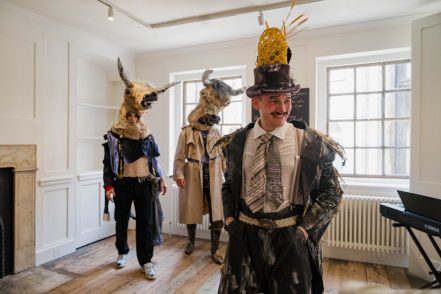
Raven Row’s work is positioned in an interesting middle-layer of the theatre industry. This is not purely commercial theatre of the likes of West-End musicals, but we are still looking at productions that are often realised thanks to the support of the Arts Council or other patrons. Such productions rely on the necessity to meet specific quality criteria, often making explicitly political discussion difficult to be carried out (even when artists are willing to do so). Brecht can be an ally to engage in political discourse even when operating on this layer of the cultural industry. His work still bears the potential to be a “conversation-starter” to introduce political discussions and the systemic critique of capitalism. But along with these examples there is also the work of socialist theatre makers who draw from Brecht to build a theatre of political intervention.
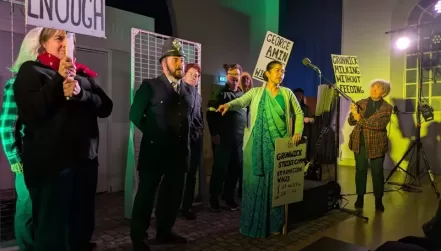
Townsend Theatre Productions’ groundbreaking play on the history of the Grunwick dispute (1976-1978), We are the Lions Mr Manager, adopts Brechtian techniques to spread socialist ideas. The piece was originally produced in 2017 and toured the UK again in 2025 with the of support of Stand up to Racism to challenge the spreading of racist propaganda from Reform UK and the far-right. In the opening sequence, documentarist footage of everyday racism and National Front propaganda from the 1970s is played alongside a soundtrack of Reggae and Ska music. The effect is estranging in an ironic way. The video sequence shows that music produced by migrants was central in defining British pop culture during the 20th century, highlighting the contradictions between far-right cultural purity propaganda and what daily reality in Britain is like. Throughout the production, the audience is often called to cheer or show support for the South Asian workers staging acts of protest. The actors explicitly identify spectators as the factory workers. Local choirs are also involved in singing songs as part of the picket line staged by the play’s characters, and audience members are invited to sing along. Spectators are involved through playful invitations, so there is a clear sense of the fictional nature of the role-play. But at the same time the idea of actively supporting the workers on strike encourages reflection on what it means to show solidarity and organise. This is what Brechtian estrangement is about at its very core: the encouragement of active and self-aware participation in political struggle.
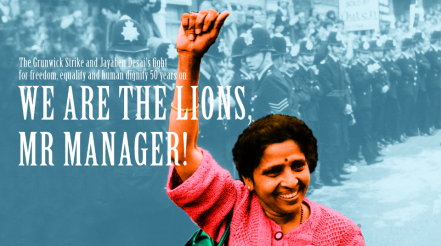
Credit: Townsend Theatre Productions
An assessment of Brecht’s legacy would however be incomplete without discussing the influence that the learning plays still exercise today. Compared to Brecht’s time, it is much more normal for us to use drama and performance in community settings. We often refer to such practice as applied theatre: a form of theatre practice involving non-professional theatre makers in artistic activities because of the beneficial outcomes that artistic practice can bring about, such as community building, educational outcomes, and improving mental health. Although Brecht has historically represented an inspiration for applied theatre practitioners such as Augusto Boal and many others, his own practice is not as central to the way many applied theatre practitioners work nowadays. Nonetheless, there are example of artists drawing from his work. Despite evidence of the positive role of applied theatre in community life, such strands of work are often a niche practice because they are commercially unprofitable and dependant on subsidisation. Practitioners engaging with different forms of applied theatre are sometimes professional artists, sometimes academics. In many cases, like me and Andy Smith whom I talk about below, they are both things at the same time. Practicing this kind of theatre is usually the consequence of a commitment to social justice, or democracy, or socialist ideas, or all these things at the same time.
Andy Smith’s project Plays for the People draws inspiration from Brecht’s learning plays and is based around the idea of involving spectators in a group reading of a play where people are assigned characters at random. Pieces such as A Citizen Assembly (2023) involve participants in a playful act of reading aloud and role-playing a community debate on climate change. Characters are assigned at random, but they are then given very specific identity connotations in terms of age, gender, and political believes and attitudes. While reading, one can notice that the language of the text bears a practical function: each sentence implies taking a position, or assuming an attitude. In this case, there is a perception of estrangement triggered by the fact that participation in this role-play exercise makes us think that we are tagging along a collective dynamic. However, we are not choosing what position to assume even though we keep saying that we are taking a certain stance or doing something on account of a certain belief.
The Brechtian learning play provides the tools to imaging community building as an act of critical challenge: one that emphasises the role of collective action and the need to understand a whole picture on the state of the world, even when we enter a discussion as an individual. My own artistic practice elaborates on the learning plays as a tool for political education. Looking at the learning plays to use drama to “test out” different attitudes towards social participation, I use the practice to explore narratives around labour rights and trade unionism, like in the theatre workshops The Crossing of the Bridge (First performed at Woodcraft Folk’s 2023 Venturer Camp in Biblins). In the workshop, dramatic acting and role-play are employed to discuss and put in practice different ways of understanding economic theory, the nature of employment relations, and how ideology informs everyday behaviour. I have developed this stand of work as an intervention for specific settings, including work of theatre for education involving young people and in cultural events sponsored by trade unions.
Brecht’s legacy can be found at all levels of the theatre industry, from community-based projects to high-profile mainstream productions such as the staging of Mother Courage that is about to open at the Globe Theatre under the direction of Elle While. His work can be employed for generic criticisms of social conventions, as well as for political education. In any case, it shows how the power of Marxist ideas and a genuine socialist approach to creative expression can inspire us. Brecht’s legacy is one of hope and one of confidence in the fact that art can be something that motivates and challenges us, enriches our understanding of reality, and encourages us to be active and critical. Brecht’s lessons for socialist artists today are many, but the most important is the commitment to create an art that entertains and involves but challenges at the same time: an art that acknowledges social contradictions and paves the way to action.