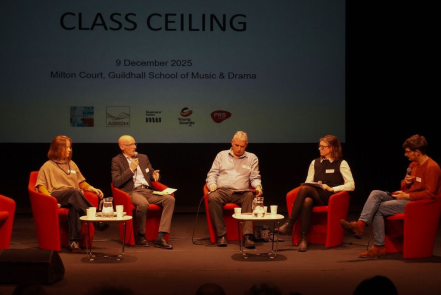
The Class Ceiling conference, December 2025
By Elise Brown
For a long time, conversations about inequality in classical music have existed at arm’s length from those who have lived experience. Too often, the voices being platformed on class inequality belong to junior staff: people whose own progression has already been limited by those very barriers. That isn’t true everywhere, and there are organisations doing genuine, meaningful work that I am proud to stand alongside. But if people with lived experience aren’t in the room where decisions are made, real change is always going to be harder.
The idea for the Class Ceiling conference (see image above) grew directly from my own life and work. I am a working-class woman of Caribbean heritage, and I have spent decades working to empower working-class communities, including through founding my charity, Mama Haven. Whether in music, education, or employment, the story is consistent: talent is everywhere, but access is not.
One of the most challenging barriers for families with low-socio economic background starts with early education. Access to instruments, lessons, and any kind of sustained musical learning is still mostly about money. From my work running a charity in areas of high deprivation, I’ve seen music organisations come in, run half-term workshops, maybe offer a handful of one-year scholarships, and then the support just disappears. After that, families are left facing the full cost of tuition, travel, and equipment. Simply put, most of them can’t afford it, and the children who were just getting started are forced out.
Even when children do manage to continue through primary school, the picture often changes again. In areas of high deprivation, the focus shifts toward music tech, sports or other activities deemed more “practical”, with orchestral instruments become much rarer and even then, low quality. Role models are missing. Children don’t see people like themselves pursuing classical music as a sustainable career. And crucially, because many organisations still lack lived experience within their own teams, which limits their understanding of what the barriers really look like.
All institutions across the sector have a role to play, for example conservatoires, funders, orchestras, hubs and major arts organisations. One of the biggest problems is the lack of joined-up thinking. We see opportunities at hub level, scholarships at conservatoire level, and initiatives within professional organisations, yet too often they exist in isolation. There is no clear, supported pathway that takes a working-class child from first access through to professional life. One of the strongest messages to come out of the Class Ceiling conference was the need for ongoing, cross-sector working groups, bringing together voices from education, conservatoires, the profession and policy so that access does not rely on isolated interventions. This is the first step we’re taking: to establish a working group.
There are examples of good practice. Leeds Conservatoire stands out for me. Their work on creative pathways for working-class students is exceptional. Their statistics are the strongest of any conservatoire for a reason: relationships with local hubs, the junior conservatoire, a wide breadth of teachers, and visible representation from people who share the backgrounds of their students. Yes, they produced English Teacher, recent Mercury Prize winners, but many of their classical students are also doing exceptionally well in opera, film and television.
Other examples are the generous sponsors who took part in our ‘pay-it-forward’ scheme. We had to charge for tickets due to the organisers, myself included, not attached to big organisations, we are a set of freelancers who worked together to put the event on. With the help of ABRSM, the Musicians Union, PRS for Music, and Young Sounds UK, 75% of the attendees were there free-of-charge, meaning tickets tended to be bought by bigger organisations, and those who could afford to.
If I had to prioritise three structural changes that would most benefit working-class musicians, it would be:
Access to sustained pastoral care and mental health support. The emotional toll of negotiating these systems is enormous, and resilience is constantly required just to survive.
Second, long-term funding that supports young people right through to the end of secondary school. Not just short bursts of provision. Alongside this, access to teachers from working-class backgrounds matters enormously for building confidence and belonging.
Finally, regular, supported access to performances for both young people and their families, including funded travel. These experiences are transformative, but without travel support, they remain out of reach.
In short: working together to remove all known barriers, rather than accepting them as inevitable.
Employers and orchestras often maintain socio-economic exclusion unintentionally, but the effects are still real. If organisations are serious about tackling class inequality, they must diversify their workforce at every level – especially in administration and senior leadership.
We cannot keep pretending that opening the door to opportunity is enough. People also need a ladder. When working-class musicians see individuals like themselves in positions of leadership and decision-making, they are far more likely to feel safe, understood and supported. Without that, classical music continues to appear insular and unwelcoming, no matter how many access schemes exist on paper.
One of the most positive elements of Class Ceiling was the research-led discussion that framed the day. That work set the scene, gave people shared language, and is already being taken forward into other contexts. Several conversations also pointed to the need for stronger lobbying and clearer policy expectations, including the presence of government and funding bodies in these spaces. If structural inequality is to be addressed at scale, the right people need to be in the room.
Looking ahead, the priority is action. That means taking feedback seriously, shaping future conferences differently. We want to plan for more interaction, fewer panels, ensuring that research, lived experience and influence remain central. Socio-economic diversity is still one of the least visible forms of diversity in our sector. Changing that requires deliberate choices about who is present, who is heard, and who holds power.
What motivates me is simple: giving children in these communities the opportunities that children in wealthier areas take for granted. Classical music belongs to everyone.