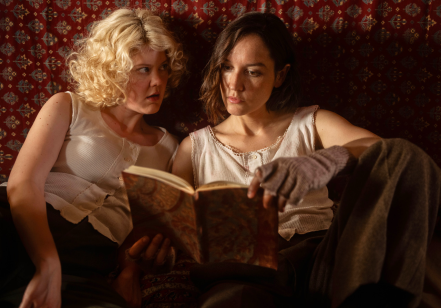
The Electric Kiss
By Rita Di Santo
The 79th Cannes Film Festival has opened with the world premiere of French director Pierre Salvadori’s The Electric Kiss. This romantic fairytale, set in 1928 Paris, delves into themes of grief, deception, and art. The story follows Suzanne, a young performer in a traveling circus who captivates Parisian audiences as “The Electric Venus.” Posing atop metallic globes, with hands raised over two generators, she becomes electrically charged and men line up to kiss her electric lips.
However, beneath the whimsical allure of the Belle Époque lies a critique of class politics, as Suzanne is recruited by a wealthy dealer to deceive a grieving painter into creating saleable art. The film serves as a sharp snapshot of how labour is exploited to feed the art market. While framed as a romantic farce, it quietly questions who controls creativity and at what cost.
A relatively quiet opening, without the presence of big-name celebrities, for a festival rightly regarded as the most powerful and influential film festival in the world. Over the next 12 days, Cannes promises a line-up of highly anticipated titles that will spark debates and champion the principle of freedom, advocating for politically charged narratives.
Adding to the festival’s unique atmosphere this year is the noticeable absence of U.S. studios. Both U.S. titles in competition, Ira Sachs’ The Man I Love and James Gray’s Paper Tiger, are independent productions rather than studio films. This year also passes without the presence of UK titles in official competition, although a few are featured in other sections, such as Clio Barnard’s I See Buildings Fall Like Lightning.
However, among the jury members is UK screenwriter Paul Laverty, known for his long collaboration with director Ken Loach. At the jury press conference, Laverty brought up the pressing topic of Gaza, stating, “Cannes has given us so much, especially in these really dark times – as Shakespeare said, when mad men are leading the blind – with genocide in Gaza.” His remarks highlight the festival’s role as a platform for addressing urgent global issues.
Also, Laverty expressed his disdain for Hollywood figures who have “blacklisted” actors supporting the people of Gaza. He praised Susan Sarandon, who features on this year’s festival poster, alongside Javier Bardem. “My respect and total solidarity to them,” Laverty said. “They’re the best of us, and good luck to them.” He also pointed out the roots of the word politics, meaning ‘of the city,’ emphasizing the importance of how human beings interact with one another. “In every story, there is the question of power and how it operates, and the values within the story are implicit. Many times, the people who say they are non-political are the most political and don’t realize it,” he explained.
Chilean filmmaker Diego Cespedes, the youngest member of the jury at 31 years old, added, “I am very political, and I think we need to take a political position. I hope that cinema gets diverse, that not just rich people ‘do’ cinema. I think I represent that, and I hope we can push that more in the future.” This conversation underscores the festival’s commitment to exploring the intersection of art and activism.
At the opening ceremony, Jane Fonda remarked that “cinema has always been an act of resistance,” adding, “let’s celebrate audacity, freedom, and the fierce act of creation.” As the festival unfolds, it remains to be seen how the films will address the pressing issues of our time and whether they will resonate with audiences around the world. The combination of artistic expression and political discourse promises to make this year’s Cannes a significant event in the cinematic landscape.