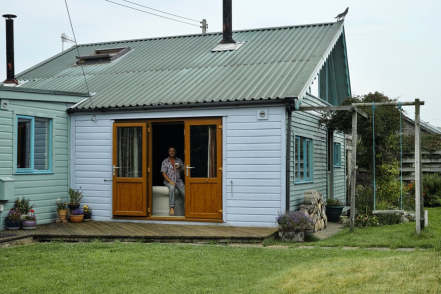
Chalet on the Gower, with builder Rob Ladd
By Stefan Szczelkun
His piece of land cost him £10 in 1934. It is 40 ft wide by 100 ft deep. First, he put up a tent which his family used at weekends, and he gradually accumulated tools, timber and glass which he brought to the site strapped to his back as he cycled down from London. – Dennis Hardy & Colin Ward, Arcadia for All, 1984, p. 200
In the first half of the twentieth century, and particularly in the inter-war period, up to the 1947 Planning Act, the appearance throughout Britain of thousands of self-built shacks, chalets, recycled buses and railway carriages was considered by the powers-that-be as a terrible eyesore. Middle-class planners like Clough Williams-Ellis, architect of Portmeirion, the set of The Prisoner, considered them a ‘blot on the landscape’ that needed to be eradicated. But from another viewpoint, 80 years on, they look like the beginning of a postmodern urban vernacular. They were a new working-class architecture in the process of being evolved, that was brought to a halt through ignorance and class prejudice.
Free Time
The main factor that made the plotland phenomena possible was the winning of leisure time by the organised working class. Disciplining a work force for wage labour had been a long and arduous task, as E.P. Thompson has attested. The first generation of factory workers often worked fifteen-hour days. They were practically imprisoned in the factories.
Such an onslaught on people’s old rural work patterns was not uncontested. By the next generation they were increasingly organized, and in 1850 ‘The Ten-Hour Act’ was passed. The two-day weekend followed. The Bank Holiday Act of 1871 was another milestone.
By 1900 the modern weekend, bank holidays and an annual week ‘holiday with pay’ were commonplace. In 1919 we got the eight-hour day. The new railways allowed easy access to the coast. Charles Booth could comment that holidaymaking “was one of the most remarkable changes in the last ten years.” Seaside towns such as Blackpool, Southend, Margate and Bridlington became established as working-class resorts. It was around these that some of the first plotlands houses were built.
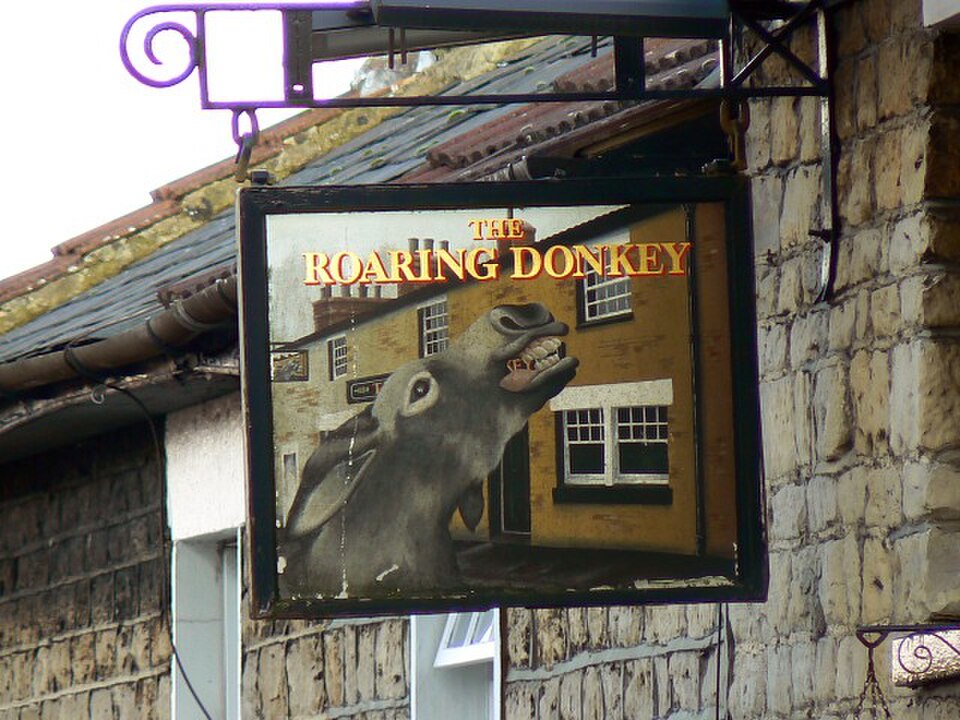
It wasn’t only coastal areas that attracted the shanty builders. The plotland communities thrived inland in places like Shepperton-on-Thames with its new railway connection. The Thames Valley plotlanders felt the full force of repression from the wealthy elite. Places like Eton, Windsor and Henley had been the heartland of the establishment, the undisputed sanctuary of a privileged caste. Suddenly greengrocers from Acton and printers from Fulham, making free with their ‘squalid little huts’, raised blood pressures in high society to dangerous levels. (Hardy & Ward, p.185)
As Pierre Bourdieu put it in 1979: the upper classes have ‘an obsessive fear of numbers, of undifferentiated hordes indifferent to difference and constantly threatening to submerge the private spaces of bourgeois exclusivity.’
By now these riverside dwellings have merged into their settings with matured gardens. They have also evolved architecturally and are generally accepted as some of the most desirable dwellings in the area.
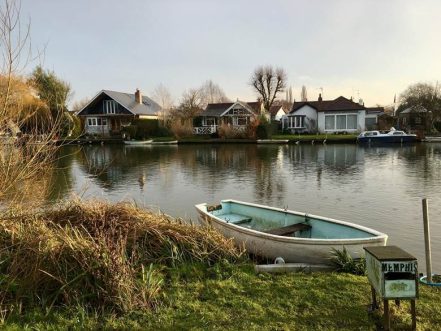
From ‘Plotlands of Shepperton’
A Modern Vernacular
Against the regimentation of urban housing provision in urban areas the shanties expressed fun, colour and improvisation, and however initially flimsy, they deeply belonged to the people who made them.
A quarter of England had changed hands in the period 1918 to 1922. Much of this land was bought by speculators, and some of it was divided up into tiny building plots, which could be bought or rented cheaply. These became the ‘plotlands’ of the shanty explosion. Sold without basic services, many of the plotlands became vulnerable to attack by local authorities following the implementation of new Public Health Acts; but the communities organized and fought to defend their homes and improve their facilities.
In the memories of the shanty dwellers there were many stories of how the exodus from smoky cities to these settlements by the riverbank and sea, with healthier air and fresh food from nearby farms, had distinct health advantages.
Between 1914 and 1939 the proportion of owner-occupied houses had grown from 10% to 31% of all dwellings. This was mainly in the form of conventional bricks and mortar houses financed by mortgage companies who made sure that the new home owners were in hock for the rest of their working lives. This was my family experience, and our mortgage was only paid off after my dad died early.
The plotlanders had a different story: “We never had a mortgage for any of them. I feel so sorry for young couples these days. They don’t get the kind of chance we had.” – Mrs Granger, whose first plotland house was started with a borrowed pound, in Hardy & Ward, p.271
Most of the shanty builders would probably not have even qualified for mortgages in the Twenties and Thirties. People on low wages still don’t have this option for housing themselves. Home ownership became a key issue of class division.
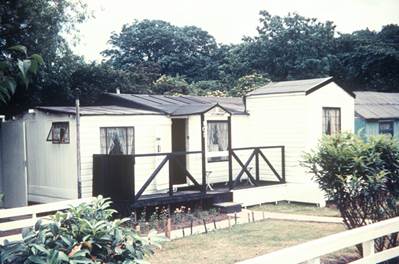
Chalet at Ovingham, Northumberland, 1972
Building a house for yourself on a minimal budget entails a large amount of collective activity in the collection of materials and sharing of building skills. This social interaction forges community bonds that last for decades. ‘Community’, that ineffable thing that all people desire but capitalism finds it hard to value.
The plot-holders had been making aesthetic decisions whilst making their houses. Every detail was available for intimate consideration and creative intervention. There is little that gives more satisfaction than the creation of one’s own home. Along with clothing, water and food, shelter is the most basic of our physical needs.
At least one prominent Labour politician had a close connection with the plotland developments. George Lansbury, from Poplar, was leader of the Labour Party in 1934 and had close connections with Jaywick in Essex.
In spite of this intriguing morsel, the plotland phenomenon was never seen as a significant issue by politicians, planners or architects. Even now an ominous silence surrounds any public discussion of the plotlands.
Repression
Opposition to the plotland self-builders was led by a body of parliamentary socialists along with voluntary groups like the National Trust and the CPRE, Council for the Preservation of Rural England. We can now see that these elite-led organisations, operating within the unstated boundaries of good taste, were actively repressing working-class culture. Often with a complete lack of understanding of what was going on.
Since the war innumerable wooden shanties have sprung up – better sociologically but artistically deplorable. Many of these are on wheels (although unmoved for years) in order to avoid rates; and whole fields have become so packed with them that they are extremely unsanitary … the preserver of rural amenities cannot allow any sort of old junk cabin to deform the choicest spots. – Patrick Abercrombie, 1926.
In spite of the negativity raining down from above the shanty dwellers put their proletarian background to good use. Time and time again, they resisted the efforts of local authorities and landowners to evict or restrict them:
I wish to register my protest against the County Council’s claim to have a royal prerogative over our livelihood, our destiny and our social life… The town planner dreams his way through life. There is no realism anywhere. I met town planners 40 years ago. They took a holiday in Germany and came home fanatics… the fantasy of the playboy town planner is no good to us. – An anonymous voice from Shoreham Beach, quoted in an enquiry on Shoreham Beach in 1949, from Hardy & Ward.
The legislation that could have given a real boost to the plotlands movement was the Holidays-with-Pay Act of 1938. It gave nearly 11 million people holiday pay for the first time. This seems to have brought the whole class conflict to a head:
All is changed today in the English (and most of the Welsh and Scottish) sea-villages. As the politicians say, the ‘danger of proletarianism is near.’ Nothing but a dictatorship will save the English coast in our time … when the millennium arrives, when battleships are turned into floating world-cruising universities, perhaps their guns, as a last act before being spiked, will be allowed to blow to dust the hideous, continuous and disfiguring chain of hotels, houses and huts which by then will have completely encircled these islands – R.M. Lockley, quoted by Clough Williams-Ellis in 1938.
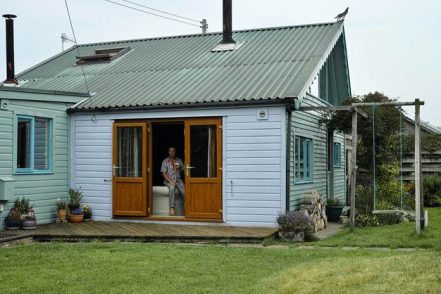
Chalet on the Gower, with builder Rob Ladd
After the war, the plotland phenomena was finally killed off, as an expanding cultural movement, by the comprehensive Town & Country Planning Act of 1947. Although the growth of the mass movement ground to a halt, the incremental maintenance and enlargement of the thousands of existing dwellings went on. This gradual process of ‘home improvement’ has resulted in many thousands of desirable properties surviving into the present day.
Plotland communities that had the potential for evolving on an urban scale were forcibly repressed. The ‘new’ town of Basildon in Essex is said to have been built on the heartbreak of those who lost their plotland homes to compulsory purchase orders. Now there is little that can be seen of its plotland origins except for a modest example preserved as a museum.
Photographs above by Stefan Szczelkun, from two books of photo documentation: ‘Chalet Fields of the Gower’ and ‘The Plotlands of Shepperton’. Some plotlands are still under threat from landowners in various locations in the UK.