In this edition of Our Culture Jack Clarke takes us on a tour of Salford and the stops includes several buildings that have been abandoned. Here Jack critiques the of the listing of buildings and heritage policy that sounds good on paper but, in reality, does very little if the building isn’t in the right postcode. He finishes with some suggestions on how policy changes can be made to give local communities more power over the protection, maintenance and restoration of local buildings.
Credit: Supplied by Salford Victoria Theatre Trust (SVTT).
I was born and raised in Kersal. Most of my life can be drawn on a single line: one long road, a Betfred, the wild green of Kersal Dale, and a BT phone box that used to stand on the corner like a half-melted tooth. It’s gone now. Back then, mainline taxi drivers used it as a marker “turn left at the phone box” a landmark so ordinary it mapped the local way of seeing.
That’s Salford all over: people navigating by memory and conversation instead of signs. The official maps are tidy, but the real pathways run through habit, humour, and stories, across stairwells, youth clubs, match days, and back alleys. And that’s what this is really about: the routes we’ve made for ourselves, and the ones that have been ripped up or sold off.
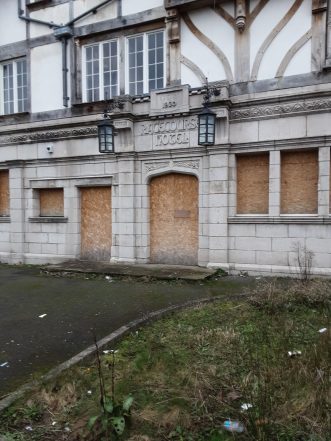
I learned those routes walking everywhere with my grandad, who, if pottering about with a rollie in your mouth was an Olympic sport would’ve had the gold. We’d set off nowhere in particular, just drifting, and one day we passed the Old Racecourse Inn. I remember asking, what’s that? it looks really cool, can we go in? The windows were boarded up, the sign faded, the brick still beautiful under the grime. He just grunted, said, it’s been left to rot, and carried on pottering toward Tesco. I kept wondering how something that looked so proud could be allowed to collapse in plain sight.
That moment stuck. Because once you start looking for what’s been left to rot, you see it everywhere: old pubs, cinemas, churches, halls. Every neighbourhood’s got a building that used to mean something, a place where people gathered before gathering became a “risk assessment.” And each one tells you who gets to have a past, and who just gets cleared away for parking.
Credit: Photograph by the author.
If you live long enough in a place like this, you learn that preservation means different things depending on your postcode. The word heritage sounds warm on paper, but the system that decides what’s worth saving was never written for streets like mine.
After the Town and Country Planning Act of 1947, the state began listing buildings by “special architectural or historic interest.” It was a good idea, stop the bulldozers, keep the memory. But by the time the categories hardened into Grades I, II* and II, the bias was baked in: stately homes and parish churches at the top; working-class infrastructure, music halls and factories somewhere near the bottom, if they were noticed at all.
Grade II, where most of Salford’s survivors sit, was supposed to mean “nationally important and of special interest.” In practice it means: important, but not that important. Protected, but not properly funded. Saved, until the roof goes. It’s heritage with its hands in its pockets.
That’s the story of Salford’s culture in miniature, always good enough to list, never quite good enough to sustain. Which might explain why, when you type “Kersal” into YouTube, the algorithm still offers you The Kersal Massive before anything else: three lads from a council estate turned meme, frozen forever in low-res bravado. We get archived as parody while the marble gets polished.
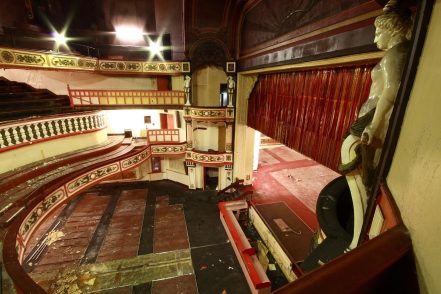
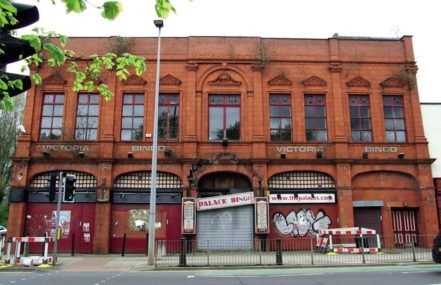
Five bus stops from my house sits the Victoria Theatre in Lower Broughton, the city’s Sleeping Beauty. It’s not just a building; it’s the full stop on that walk with my grandad. The same story in bigger brick. Built in 1899 (opened 10 December 1900), Grade II listed, terracotta face, near-intact Edwardian interior. By November 1901 it was already showing films; a cinema licence followed in 1913. Early. Hungry. Modern.
Credit: Supplied by Salford Victoria Theatre Trust (SVTT).
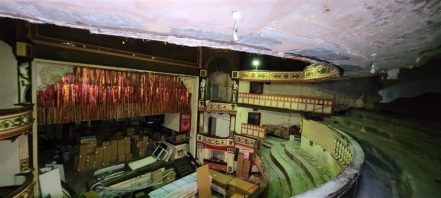
Beneath the boards, the bit that makes engineers grin: substantial wooden sub-stage machinery on English Wood Stage principles, a complete grave trap, and what specialists say is the only complete surviving scruto stage in the British Isles sliders curving down like a roll-top desk because the wings were too narrow. Improvised genius. Salford as hack: make it work, then make it sing.
Today the Vic is on the Theatres at Risk Register (2025) with an overall risk score of 8/12 the same banding as places like Hulme Hippodrome and the Palace Theatre, Plymouth. Vacant since 2008, bounced between owners, partial fixes and auctions, while the Save Victoria Theatre Trust (SVTT) does the patient graft: governance, planning, public memory work etc.
This isn’t a nostalgia piece. It’s class politics. The Vic isn’t just architecture; it’s evidence of what we built, what we lost, and what we might build again if the city trusted its own people.
Credit: Supplied by Salford Victoria Theatre Trust (SVTT).
Kersal is where the city’s contradictions shake hands: moor and floodplain, convents and council flats, Whit Walks and betting slips. Kersal Dale is a Local Nature Reserve and the Kersal Wetlands now double as flood infrastructure, the old racecourse pressed into civic service and if you run there at dawn you’ll catch herons, dogs, and the same bloke who’s been doing intervals since 2007. The official line is access and amenity. The unofficial line is: this is where people go to breathe.
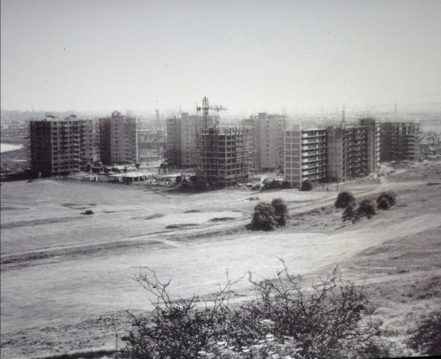
We’ve lost plenty. The Kersal Flats, twelve towers raised in the 1960s, were sold, renamed, and in the controlled explosions of 14 October 1990, eight of them came down together; the last two of the four survivors went in 1999. If you grew up here, the skyline is a before-and-after picture you can feel behind your eyes.
Credit: Still from The White Bus (1967).
Up on Kersal Moor the Chartists assembled in September 1838. The Manchester Guardian counted 30,000; the Morning Advertiser claimed 300,000 demanding suffrage and a say in their own lives. The exact numbers matter less than the fact: people met on common land to insist on being counted. Who gets to gather? Who decides what the gathering is for?
Those questions echo under the floorboards of the Vic. The scruto stage isn’t just a bit of theatre tech it’s a metaphor for working-class ingenuity: built to fit an impossible space, moving parts unseen but essential. The same hands that raised scaffolding, laid brick, carried flats. You can almost hear them.
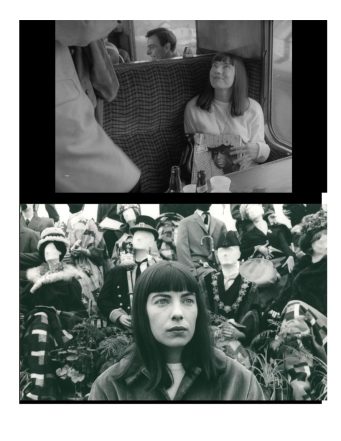
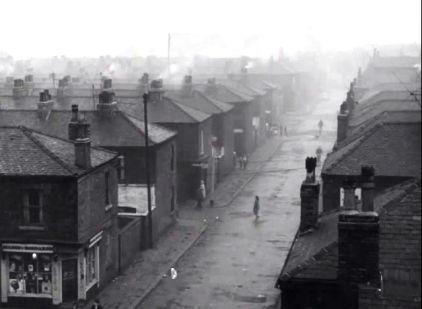
There’s another Salford thread to pull. Shelagh Delaney, Broughton-born, wrote A Taste of Honey at 19 and later penned The White Bus (shot 1965, released 1967), directed by Lindsay Anderson. The girl in that film rides an almost mythic bus around a city that is and isn’t named a Manchester-Salford chimera. It’s part tour, part elegy, part municipal fever dream: council pageantry against bomb-sites and bulldozers, official speeches over ground that’s been emptied out. Watch it and you see a city being remade, quickly, and not always for the people who live there.
Credit: Still from The White Bus (1967).
Delaney has always felt like our conscience, Salford’s sharpest voice on who gets represented and who gets written out. Her work keeps coming back because the questions haven’t gone anywhere. (A Taste of Honey still lands like a brick through a showroom window, ask anyone who saw the Royal Exchange revival.)
So yes: the Vic’s story isn’t just heritage. It’s extraction. You can trace the curve: music hall → cinema → repertory → bingo → vacancy, while across the river the renderings bloom in Greengate “dynamic residential and commercial place… exceptional public realm” a brochure chorus trying to sell back an idea of “city” that once came free with a wage and a weekend.
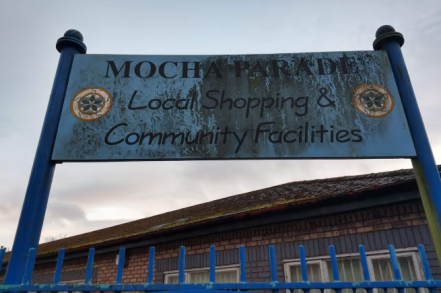
Take Mocha Parade, once a hub of everyday graft and gossip, now flattened and replaced with a Lidl. Regeneration, they call it. Maybe that’s the new model: civic renewal by discount retail. How long before we’re standing outside Blade Runner-esque Lidls, all rain-slick concrete and neon offers, squinting at the ruins of our own cultural sites next to a Greggs Outlet and a car park dressed as “public realm”?
Credit: Manchester Evening News.
We’ve seen what gets destroyed in the name of improvement. Whole districts cleared; towers raised, then dropped; flats “decanted” to create “viability.” Salford isn’t unique, see the Hulme Crescents over the border, or at a national scale the long list of at-risk theatres that go dark while money pools in the bright, central places. But the Vic is ours. And what’s rare here isn’t just the plasterwork, it’s the sub-stage thinking, the scruto solution, that says working-class ingenuity lives in the mechanisms as much as the murals.
But here’s the uncomfortable question underneath all of this: why do these buildings end up empty in the first place?
It’s rarely because nobody cares. It’s usually because the system makes caring expensive.
Across England, thousands of historic buildings and properties sit unused not out of neglect alone, but because ownership, finance, and law form a perfect stalemate. Renovation costs spiral quickly, especially when specialist materials and craftspeople are required, which is almost always the case with listed buildings. Conservation guidance consistently notes that restoring listed buildings is significantly more expensive due to specialist labour, materials, and longer timelines. What looks like a repair job on paper becomes a conservation project in practice. Roof tiles have to match, timber has to be right, mortar has to be lime, not cement. Time stretches. Costs climb. Investors drift.
Grade II listing protects character, but it also locks buildings into a regulatory maze. Even modest alterations can require listed building consent through the local authority, and unauthorised changes can result in prosecution or enforced reversal of work. For small trusts, community groups, or independent owners, that risk alone can stall action before it starts. Grants exist, but they are limited, with most national conservation funding historically prioritising Grade I and Grade II structures rather than the majority-category Grade II buildings.
Ownership itself can become another barrier. Some properties sit empty because they’ve become speculative assets, so-called ‘buy-to-leave’ investments held vacant while owners wait for land values to rise. Others remain empty after owners die, tied up in probate, inheritance disputes, or the practical difficulty of renovating inherited property without resources or knowledge. Multiply that across the country and you get a quiet inventory of absence: buildings waiting for money, permission, or clarity.
And then there’s the harder truth: commercial viability.
The original design of theatres, halls, and civic buildings doesn’t always translate easily into modern business models. Large auditoriums, historic interiors, and specialist stage infrastructure are expensive to maintain and difficult to adapt for contemporary use without major investment. Regeneration research repeatedly highlights that listed buildings often struggle to attract investors due to high restoration costs, planning constraints, fragmented ownership, and uncertain financial returns.
Credit: Sarah Renshaw / MCAU.
Without a clear, sustainable use, buildings drift into limbo. Not demolished, not alive. Just paused.
Across the UK, countless listed buildings now sit in that pause, historically important but economically uncertain, preserved in theory but deteriorating in reality. As heritage regeneration practitioners often note, preservation alone isn’t enough; without viable long-term use, listed buildings remain vulnerable to vacancy and decline.
That’s the paradox of heritage in places like Salford: we can list a building, but we can’t list a future for it.
The Theatres Trust calls the Vic ‘architecturally important, with rare substage machinery… the only complete surviving example of its kind in the UK.” They score it 8/12 on the 2025 risk scale. Read between the lines and the diagnosis is clear: at risk from neglect, at risk from speculation, at risk from a city that’s forgotten why rooms like this exist in the first place.
The easy story is to beg for rescue. The harder (truer) one is to ask: who gets to own and run a public stage? A theatre is more than a building. It’s a means of cultural production, a place to learn, work, argue, dance, test, fail, return. It’s a commons, or it’s nothing.
If we mean cultural democracy, we can’t keep hoping a benevolent developer takes a shine to us. We need powers, rules, and cash that lock in the public good:
1) Community Right to Buy with pre-emption for cultural assets.
When listed or at-risk venues come up for sale, the city (or a qualified community trust) gets first refusal at an independently valued price. (Scotland already points the way; England needs to grow a spine.)
2) A Municipal Cultural Land Bank.
Acquire, hold and lease Grade II/at-risk buildings to community operators on 50-year peppercorns with enforceable social covenants: guaranteed free rehearsal time, community programming quotas, and worker–resident governance seats.
3) A standing Public Maintenance Fund for working-class venues.
Roof, electrics, access, the boring stuff that stops buildings dying. Make it recurrent. (Not a rescue headline, a line item.)
4) Cultural Charters co-written with residents.
Every subsidised venue signs a charter:
• 10% of diary ring-fenced for free/low-cost local use
• 25% of programme non-ticketed or pay-what-you-can
• Annual citizen assembly to review budgets, access, impact
5) Developer Cultural-Repair Levy.
If you lift profits in the Greengate radius, you pay into a ring-fenced fund for the Vic and comparable assets. (We already do it for transport. Culture is infrastructure.)
6) Working Heritage Tech.
Treat the scruto stage as curriculum: fund apprenticeships with unions and colleges to restore, document and teach these systems, not as museum pieces, but as living machinery.
7) Platform & Streaming Levy.
A tiny surcharge on big digital activations shot in the city; hypothecate to a Local Venues Equity Pot for kit, staff and hybrid access (film your Q&As, but fund the stage that makes them).
This is bigger than one theatre. It’s about a classed geography of culture: who gets to live near a stage; who can book a room; who can fail safely; whose stories become seasons.
Grade II should mean more than “save the façade.” It should mean save the use-value for the people who paid for it, in rents, rates and lives, and for the ones who will make the next hundred years inside it. We’ve already watched too many listed cousins slide beyond reach. Look across the register: Hulme Hippodrome teetering; Margate, Plymouth, Morecambe fighting the same fight. Even where there’s momentum, Nick Smith at Queen’s Market, Morecambe, buying it outright in 2015 to stop demolition, the pattern holds: persistence + public money + community governance, or you lose the room.
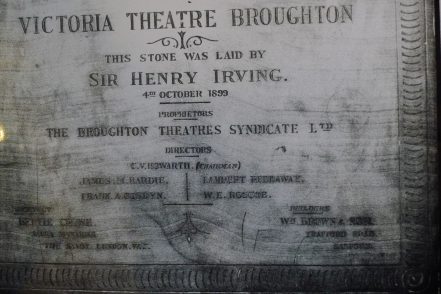
When Sir Henry Irving laid the Vic’s foundation stone in 1899, he called a well-run playhouse “a centre of rational recreation,” a place essential to a community’s health. He was right on the principle, wrong (perhaps) on the tone. What we need now isn’t “rational recreation” from above, but collective production from below, the municipal muscle to make rooms where people can set their own terms.
Credit: Supplied by Salford Victoria Theatre Trust (SVTT).
And that’s why this starts in Kersal. Because you can’t talk about saving a theatre without talking about who gets to use it. The Vic is the physical proof that we already built the spaces we need; they’ve just been boarded up, sold off, or memed into irrelevance.
If the early internet gave us The Kersal Massive, the next century should give us The Kersal Mandate, communities running their own cultural infrastructure with the same swagger, the same local accuracy, the same refusal to be edited down.
Delaney’s White Bus ends with a girl walking away from pageantry into streets that look like home and don’t. If we’re honest, much of the last decade here has felt like that: big speeches, bigger holes in the ground. But a bus is also a route. It can be driven by a council with a mandate. It can stop at Kersal Moor, the Dale, the Vic. It can pick up the barber who checks in on his lads, the bingo caller who remembers the names, the lighting tech who understands the old wood stage, the opera lover and the kid who’s never been inside. It can wait, doors open, for those who’ve stopped trusting that culture is for them.
Credit: Still from The White Bus (1967).
That’s the municipal imagination: not just saving buildings, but handing over the keys.
Give us the keys. We’ll do the rest.
***
Thanks to Karen O’Rourke in Doncaster who always reads my articles and who very thoroughly supported this article by proofreading it religiously.
Read more from the Our Culture series
Culture as Class Struggle: An Interview with Jenny Farrell
Our Culture: RIP British Working-Class Cinema (1935 – 2025) by Brett Gregory
Our Culture: The Uncomfortable Truth About Public Libraries
Our Culture: Breaking through the Class ceiling with bread and roses
Our Culture: Games and Class Struggle – with Scott Alsworth
Our Culture: Prize-winning Poetry Only Please! with Andy Croft
Our Culture: Democratising the BBC
Our Culture: Prison, Class, and Art – with Nick Moss
Our Culture: Can the Church Be More Democratic?
Our Culture: Putting the Class into Classical Music
Our Culture: Our Code; AI, Class, and the Fight for a Digital Commons
Our Culture: The World Transformed – Britain’s Socialist Festival