Commons image
By Jenny Farrell
On this 110th anniversary of the Easter Rising, we remember the first anti‑imperialist uprising in Europe – a moment when Ireland’s long tradition of popular resistance found one of its most powerful expressions.
For James Connolly, that tradition was no mere collection of isolated rebellions. In Labour in Irish History, he traced a continuous “second culture” running beneath the official narrative of Empire: a culture of democratic and socialist resistance, forged by the exploited and the colonised, and passed down from the United Irishmen of 1798 – whom he called “democrats and internationalists” – to the revolutionary working class of his own day.
This concept – later given its classic theoretical form by Lenin in Critical Remarks on the National Question – recognises that within every national culture there exist two opposing currents: a dominant “first culture” that serves the ruling class, and a “second culture” born from the struggles of the oppressed.
In a colonised country like Ireland, Connolly understood, the struggle for national liberation was the earliest historical shape of that second culture. And in 1916, that culture found an extraordinary concentration of its most articulate voices: the leaders of the Rising included an unusually high proportion of writers, poets, and playwrights. They did not simply take up arms; they had long been shaping a language of dignity, freedom, and cultural emancipation. For them, the act of writing was itself an expression of insurrection.
To mark this anniversary, we invite readers to revisit a selection of texts previously published and discussed here – poems by three of the Rising’s signatories, executed in the aftermath of the rebellion. In Pádraig Pearse’s Mise Éire and The Wayfarer, we hear Ireland speak in the voice of ancient sorrow and see a revolutionary face the beauty of the world on the eve of his death.
Thomas MacDonagh’s The Man Upright dissects the crippling posture of colonial life with sly, limerick‑like wit, then cuts to the sudden appearance of a figure who walks straight – a gesture of political and human defiance.
And Joseph Plunkett, the youngest of the signatories, composed the sonnet Die Taube (“The Dove”) days before a secret mission to wartime Germany – a poem of loving distance that refuses to romanticise militarism, affirming the internationalist conviction that Ireland’s freedom would be won from “both King and Kaiser.”
Finally, let us recall Maeve Cavanagh, author of Eastertide 1916 (below), much involved in the preparations for the Rising and well acquainted with James Connolly. Connolly called her “the poetess of the revolution” and published one of her poems in The Workers’ Republic. She also wrote a play about the Rising, The Test: a play of 1916, and was active in trying to secure a reprieve for Roger Casement. All these, alongside her eyewitness accounts of the uprising, are now held in the National Library of Ireland.
These writers were revolutionaries, and participants in the ‘second culture’ that Connolly conceptualised and lived. They understood that a republic is not won by force alone; it must be imagined, sung, and spoken into existence. Their poems remain living texts – proof that the Rising was fuelled by a vision of culture as a terrain of struggle, and that the fight for a just, socialist Ireland was always also a struggle over narrative: over who stands upright, who speaks, and who is remembered.
We present them again as an invitation: to read, to reflect, and to recognise that the spirit of 1916 still speaks through its poets.
Eastertide, 1916
by Maeve Cavanagh
The warring nations mazéd heard
The slogan cry of Eire ring,
And they who in her fain hope shared
Exultant watched her gallant spring-
The wolf-dog stood at bay once more,
And heard unmoved the Lion’s roar.
The hours were told – her time had come –
At noontide on an April day,
She bore the Truth – and Lie struck dumb
In all her glorious, deathless way.
Ere to his couch the sun sank down
Her flag flew over Dublin town.
And Connaught o’er broad Shannon ‘s tide,
Her noble challenge swiftly sends,
True as of yore from Slaney’s side
Brave Wexford’s thrilling answer wends –
And history stoops to write to-day
The fairest page she’ll pen for aye.
What tho our fairest, dearest fall?
We shall not grudge the awful price
To-day we stand in freedom’s hall,
And freely make our sacrifice.
We’ve seen our Goddess face to face
All times cannot this hour efface.
Written on the hoisting of the Irish Republican Flag over the G.P.O. – Dublin, 24/4/1916
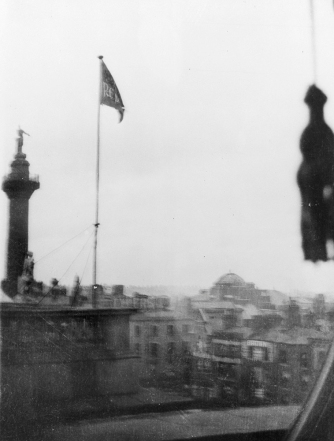
The Irish Republic flag, 1916. Credit: National Museum of Ireland