By Dennis Broe
As Donald Trump threatens illegal moves that would further increase what is already a global catastrophe, and with Europe now openly discussing fuel rationing preceding the food rationing that will follow the lack of fertilizer for planting season, in a quieter part of the world, Europe’s leading crime festival, the Quais du Polar in France’s Lyon, celebrated murder in the Holy Trinity Chapel on Easter without even a hint of irony.
These contradictions highlighted a festival with authors from around the world, but naturally was heavily accented toward French authors since that country exercises its “soft power”, not only in its own dominant position in publishing but also in which authors from the continent, Britain and the U.S. it anoints by inviting to the festival.
In the industry panels, there was a heated discussion about AI, with science fiction author Olivier Paquet extolling its virtues for writers while Samuel Sfez, the president of the French association of literary translators, describing how translators are facing extinction by a process that is ecologically devasting in terms of the resources employed to support it.
There were other bizarre moments in a conference that was long on extolling the virtues of European “democracy” and protection of human rights, while remaining utterly quiet about the suppression of dissent in both the U.S. and Britain and the embargo on information from the war in the Middle East.
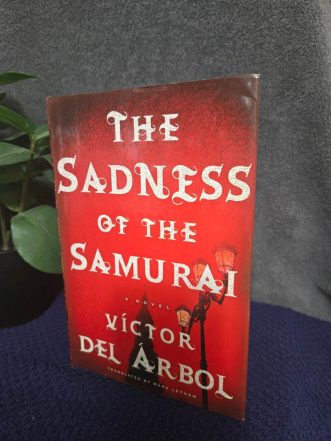
In a panel focusing on ever-widening Western corruption, Victor del Arbol, whose Sadness of the Samurai centers on a woman in Franco’s Spain who plots to kill her fascist husband, explained that over $26 billion of the global economy consists of money earned through drug and human trafficking, but then concluded that since that is part of capitalism, we must simply learn to live with it.
In a panel on True Crime, held in the Trinity Chapel on Easter, which had the youngest audience in attendance, a sign of the popularity of this sub-genre with younger readers, Victoria Charleton, the “True Crime Queen of Quebec,” justified the genre by claiming that she was interested in telling the stories of the victims. Cyril Gay, whose description of a man who murdered five innocents in 1937 and was guillotined in 1939, The Eugene Weidmann Affair, he saw as a prelude to the dark times of the Nazis which in France followed the workers’ resurgence of the Popular Front.
Gay traced the evolution of the genre, beginning in France in the ‘20s and ‘30s going under the name fait divers, then travelling across the Atlantic to become the True Crime podcasting craze and now returning to France such that a French writer McSkyz, also on the panel, has combined the two in a lurid glossy magazine titled Criminal Affairs.
The moderator posed a truly ludicrous question to the panel. After noting that many of their investigations exposed police and judicial incompetence, he asked, since European institutions are under attack, shouldn’t the authors be concerned not with exposing injustice but with building up these institutions. It was a head-scratcher for the authors who couldn’t understand why they should spend their time validating corrupt practices.
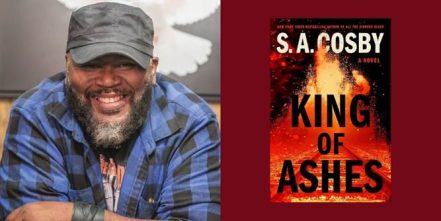
One of the better panels, on the subject of racism, featured African American author E.A. Cosby who described crime fiction, fittingly on Easter Sunday, as “the gospel of the dispossessed,” further delineating the crime novel as “the new social novel.”
Cosby’s King of Ashes is about a rundown deindustrialized town in Virginia, where the only thriving merchant is the undertaker – Cosby related that he himself worked in a funeral home. The son is called back to the town with the father in a coma, and the business and the family threatened by gangsters trying to collect debts owed by another brother.
Body weight was the subject of another, mostly female panel, titled “Girl Power.” Sarah Walker’s novel Dietland, which became a streaming series, concerns a woman who finds solace with a group of other women who defy society’s view of female appearance, amid a series of grisly murders of men. Walker wants to reclaim the word “fat” as no longer pejorative but instead simply descriptive, overturning patriarchal views of what women should look like. The author, whose work is now having an impact in France with the translation of her novel, criticized the use of diet or “anti-fat” drugs like Ozempic as reaffirming this traditional masculine view and forcing women either again to adapt to it or adopt it.
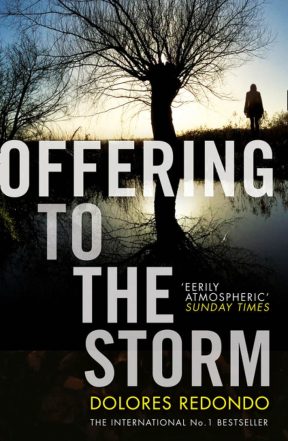
Part two of the Baztan trilogy
On the subject of matriarchy, the festival featured an hour with the leading noir writer in Spain, the Basque authoress Dolores Redondo. Redondo’s most widely known novels, about a curse passed down and initiated in the 16th century Catholic Inquisition, called the Baztan trilogy, have been adopted into a Netflix series.
She explained that in many of the small towns in the Basque country, the men disappear on fishing expeditions for months and so the women are the organizers and administrators of towns, as power passes in a matrilineal line. Her inspector, Amaia Salazar, employs a combination of up-to-date scientific police techniques with an understanding of the power exerted by more ancient and mysterious forces in solving crimes that also involve her family.
In a strange way the festival itself was a combination of a surface level repression of the events of the day, and a deeper exposure in unexpected ways of how these actual tensions lay just underneath the surface calm.