The book is available here
By Jon Baldwin and Brett Gregory
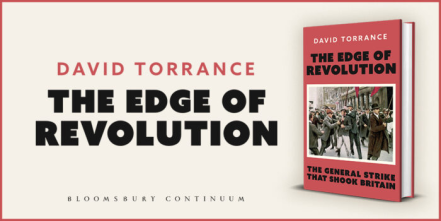
May 2026 marks the centenary of the General Strike in Great Britain. For nine days the country largely came to a standstill as nearly three million workers came out in solidarity and sympathy to support the miner’s industrial dispute. And three books have also come out to now cast an eye back. Nine Days in May: The General Strike of 1926 by Jonathan Schneer, Britain’s Revolutionary Summer: The General Strike of 1926 by Edd Mustill, and the focus of this review The Edge of Revolution – The General Strike That Shook Britain by David Torrance. Torrance’s public profile and publishing house reputation and reach might make this the more widely read. He tells a brisk-paced tale but not without certain issues that I shall return to.
‘Not a penny off the pay, not a minute on the day.’
The miners constituted throughout the first quarter of the 20th century around a tenth of the adult working male population. According to the Miners’ Federation the profits of Britains coalmines were as follows:
1922 Loss of £1.8 million; 1923 Profit of £15.8 million; 1924 Profit of £28.8 million; 1925 Profit of £6.9 million
Overall a profit of nearly £50 million, which is almost a profit of £4 billion in 2026 with adjustments for inflation. For the capitalist owners of the mines, however, this was simply not good enough. Perceived foreign competition and the hint of market volatility, Torrance suggests, ‘explained the owners determination to impose wage cuts and longer hours.’ The Conservative Government, led by Stanley Baldwin, approved the suggestion that miners wages be reduced and the working day lengthened. This was going to be totally unacceptable to the miners, and they retorted: ‘Not a penny off the pay, not a minute on the day.’ The Trade Union Council (TUC) set up to co-ordinate a national strike.
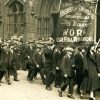
Meanwhile the ruling class had been preparing for this for nearly a year and arguably wanted the dispute as a show of power. This was a chance, with a glance at events in Russia and the October Revolution in 1917, to dampen down working-class enthusiasm for change. In early May, with the dispute heating and talks stalled, Baldwin signed a proclamation declaring a state of emergency under the Emergency Powers Act 1920. This was deemed by Ernest Bevin, at a TUC meeting, as a ‘declaration of war’. Delegates sang The Red Flag as they filed out of the meeting agreeing to strike action. Later that day, at 11.59 p.m. on May Day, Monday 3rd May 1926, millions of workers, instructed by their unions, ceased to work. When the bells of Big Ben rang for midnight at the Palace of Westminster, one section of the crowd sang The Red Flag, another section retorted with God Save the King. This dichotomy would reoccur as the strike came to be seen to as a battle of constitutional parliament versus anarchy, the Cabinet versus trade union leaders, between as Disraeli suggested, ‘two nations’, rich and poor, industrial and leisured – that is, a class war.
Although Torrance does not make this analysis, it can be seen that the strikers were up against the entire political and capital system whose arsenal comprised of the Repressive State Apparatus (RSA) and Ideological State Apparatus (ISA). These concepts, developed by Marxist theorist Louis Althusser, account for the maintenance of dominant power. RSA are the brute force of the ruling class, the full operations of the government under, for instance, an anything-goes ‘state of emergency’, partisan law and courts, police, and the armed forces. ISA are in the sphere of the ideas – with material effect – and propaganda of the ruling class such as education and schools, the media, religion, and the family. The way I was first taught about this was to imagine forcing the donkey to move with the carrot (ISA) and/or the stick (RSA).
In the General Strike Baldwin could call upon the RSA in terms of the military: the battleships Ramillies and Barham were recalled from the Atlantic and anchored in the Mersey, and gunboats, aiming inwards, were anchored in most major ports as a threat and to remind the strikers of their place. Soldiers were distributed around the country in a show of force.
‘Blacklegs’ is a term originated from strike-breaking miners being given away by their coaldust-coated legs. Special middle-class and upper-class volunteer ‘blackleg’ constables were handed responsibility for law and order. The Organisation for the Maintenance of Supplies was ostensibly a private and voluntary body of concerned and patriotic citizens. Keen to get a piece of the action, of course, were members of the British Fascists (BF), an organisation formed in the aftermath of Benito Mussolini. Affluent gentlemen volunteered as replacement workers and special constables to assist the government and supposedly keep the peace with their stiff-upper-lip and lie back and think of Eton and England ethos. Ralph Miliband pointed otherwise, claiming ‘numerous instances of baton charges by mounted and foot police against strike pickets,’ and ‘a fair amount of licensed brutality on the part of volunteer constables.’ Thousands of strikers or sympathisers were arrested for breaches, often tenuous, of the quickly imposed Emergency Regulations. Those disseminating dissenting leaflets were arrested and publications were confiscated.
In terms of the ISA the government had made a pre-emptive strike in 1925. The Cabinet had prosecuted the leadership of the recently formed Communist Party of Great Britain (CPGB) for sedition under the long forgotten, but handy for this purpose, Incitement to Mutiny Act 1797. Twelve were arrested and some served six months imprisonment. When the strike actually began around half of the CPGB’s membership, albeit several thousand, were arrested. New Scotland Yard and MI5 spies reported on alleged communist activities. A number of innocent men had apparently been ‘systematically lured’ into pubs, ‘where they were plied with drink and Red propaganda.’ The MI5 conveyed, however, that this was ‘without much result, apart from the consumption of an inordinate quantity of beer.’ The crackdown on ideas antithetical to the ruling capitalist class continued.
‘Crack the craniums’ of the strikers
Siegfried Sassoon, erstwhile war poet hero and on the national school curriculum to this day, spent the General Strike penning blackleg enthusiasm, expressing a desire to ‘crack the craniums’ of the strikers. Meanwhile, on Sunday May 9th, Cardinal Bourne, would declare at High Mass, Westminster Cathedral, that the strike was a challenge to a lawfully-constituted authority, and thereby the strike was ‘a sin against the obedience which we owe to God, who is the source of that authority; and against the charity and brotherly love which are due to our brethren.’
Winston Churchill would put together the propaganda-laden official government newspaper, the British Gazette. This would support Baldwin’s move to ‘frame’ the strike as a constitutional rather than industrial battle. He would tell and spin a political story simplified to be taken in by voters. Thatcher would later channel Baldwin framing the 1980s dispute as one between a democratically elected government and the supposed ‘enemy within’. The fledging British Broadcasting Company, with Lord Reith at the helm, which had pretentions to speak impartially to the nation, nonetheless excluded the dissenting voices of The Archbishop of Canterbury and Leader of the Opposition, Ramsay MacDonald. With the ruling class being economically sufficient to simply out-wait the strikers, and with such material and ideological advantage, it is an actual wonder the strike lasted as long as it did. Nine days in May never stood a chance of becoming ten days that shook the world.
It is clear that the rank and file were the heroes of the hour making huge sacrifices in solidarity. Not only were the government and ruling class the villains but also to a lesser extent were the unions. The TUC called off the strike, it is suggested, because it saw no prospect of success, and ‘it was led by people who did not believe in it.’ Indeed the TUC’s precise goal and the terms by which its success might be assessed were never clear. It is argued that a more effective and less self-defeating strike tactic would have been to confine action to the handling and transport of coal. This was, after all, what the dispute was about. The Communist Party of Great Britain denounced the TUC for the ‘greatest crime’ ever committed ‘against the working class of Great Britain and whole world’. Trotsky would insist that the Comintern break immediately with the TUC. Stalin would denounce Trotsky’s notion as ultra-leftism.
Workers went back to work. Railway men returned, ‘promising, like naughty schoolboys, never to do it again’. Other returning strikers found themselves blacklisted, sacked if they had been militant, or accepted on condition of lower wages, or other deleterious new terms of service such as undertaking to leave their union. Lord Birkenhead, at the end of the strike, would describe meeting the beaten union leaders in a typical elitist manner – ‘It was so humiliating that some instinctive breeding made one unwilling even to look at them.’ The miners fought on alone until 30 November, when they were forced back to work by want. They struggled back to the pits, resentful, beaten, and on the owners terms with longer hours. The wealthy gentlemen who had muddied their hands briefly with manual labour returned to their leisure. Manicurists revealed a significant spike in business as ‘members of society and professional people’ endeavoured to ‘remove traces of the grime of industrial warfare.’ The ruling class doubled down on their victory, passing the Trades Disputes and Trades Union Act in 1927. The principle clause made illegal a sympathetic strike or any action ‘designed or calculated to coerce the government,’ thereby prohibiting supporting strikes and curtailing mass picketing.
There was some comfort to be gained from defeat. In the face of rising mass unemployment Ramsay MacDonald would lead Labour to defeat Baldwin in 1929. Herbert Morris, the London Labour leader, suggested the strike had ‘assisted in developing political solidarity.’ The Communist Party of Great Britain saw its membership doubled in the year from 6,000 to 12,000. The trend was set towards a more constructive form of collective bargaining, later symbolised by beer and sandwiches at Number 10 Downing Street. And arguably the seeds for sown for what Ken Loach has called, in his documentary film, the spirit of ’45, with the radical changes in postwar Britain under Clement Attlee.
Torrance’s book is a compelling narrative with a sense of urgency and pace. Counter to his excited choice of title however, this was only the edge of necessary economic and workplace reform, not revolution. Some comments on content and method are necessary. He acknowledges the book is written under the influence of Victorian historian Thomas Carlyle, who ‘postulated the ‘Great Man’ theory, an historical philosophy which contended that major events are shaped by exceptional individuals.’ Therefore the volume contains chapters on the leading individuals of the conflict – Baldwin, the King, Churchill, the mine owners, leaders of the church, Reith, the civil commissioners, law-makers, the Royal Commission, as well as the ‘big three’ union leaders. We learn more about these ‘great men’ and even the travails of middle-class blacklegs than we do the thoughts, hopes, fears, actions and courage of the actual strikers and working class supporters.
We read, for instance, lots about Henry ‘Chips’ Channon, a wealthy socialite and diarist, role-playing as special constable, who very much ‘enjoyed the strike’. Indeed apart from major union personnel or Labour politicians I do not recall a single quote from the rank and file, let alone from working-class women with children facing the prospect of juggling meagre resources, fundraising, rallying communities, supporting families, providing food and clothing, running soup kitchens, and so on. We do, however, learn that the King had to cancel that year’s Trooping the Colour, because the strike had prevented erection of the terracing at Horse Guards.
Erasing working-class voices from history
Torrance accepts that he has ‘produced a largely unavoidable ‘high politics’ and middle-class emphasis, for politicians and volunteers were more inclined to record their experiences than striking railwaymen, printers and bus drivers.’ This is certainly true, but also slightly disingenuous. There are sources other than the public record. Opposed to the Great Man thesis is the notion of a ‘history from below.’ This emphasises the life of the ordinary masses creating overwhelming waves of smaller events which carry leaders along with them. There are working-class archives, unpublished diaries, notes, minutes from minor meetings, interviews, folklore, poems, oral histories, alternative sources, banners, popular song and culture, later reflections captured, and ways for the historian to recover the silent majority voice of those from below. The method employed in the book is rather myopic, armchair history, surveying text upon text produced by the Great Men. Nothing new is offered that sheds light on the many, this is a history of the few. History is written by the winners, and with former Conservative Parliamentary Aide Torrance, it continues to be.
One final example: Torrance writes of a game of football between policemen and strikers. ‘At Plymouth the chief constable suggested a game of football which was kicked off by his wife. Watched by a crowd of more than 10,000… Half-time was enlivened by the Tramway Band.’ This plays into the mythology of the strike as being a quaintly British affair with somewhat of a despite it all, we are ‘all-in-it-together’ camaraderie. Alternatively a less sanitised version was carried by The New York Times, on May 8th 1926. ‘After clubbing a gang of rowdies who had created a strike disturbance, policemen at Plymouth donned their football clothes and played a match against a team composed of strikers.’ This bop them on the head, then win hearts and minds, with the chief’s wife, a brass band, and game of kick-about is a seamless move from RSA to ISA. However, the strikers emerged victorious for once, winning by two goals to one.