A stroll along the tow-path of the Forth & Clyde Canal leads to a chance conversation with an ex-soldier at the Stockingfield Bridge, on the northern outskirts of Glasgow. The man raises deeply felt issues of suffering and peace, leaving them unresolved, although held “meantime” in a parenthesis of kindly coping.
MAKING DAYS
By David Betteridge
      But meantime…
              ELEANOR RATHBONE (1872 – 1946)
I. OUT
Shades of green surrounded me
as I walked in our local park.
May was morphing fast towards high Summer.
An old plane, as if a motor-bike,
droned doggedly across a cloud-free sky.
Quickly, memory came alive,
transporting me to childhood years,
several wars ago, when nights and days
were filled with this same rough sound,
but multiplied and magnified.
Unfathered like so many at that time,
I lived no more than a field away
from an air force base, from where,
wave upon wave, squadrons of such planes
as I saw now, and heard, flew out
on epic raids abroad, so making history.
Innocent of bombs,
today’s lone plane continued
its slow grind, until I lost both sight
of it and sound.
II: MEETING RAB & ANDY
I arrived, beyond the park,
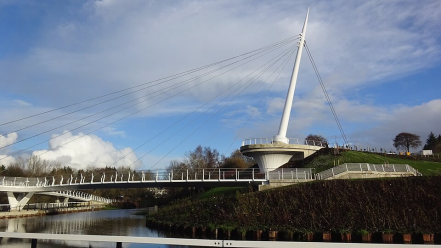
at a place where two waterways converged.
An intricacy of bridges, sculptures,
and a garden of wild flowers
made this edge-of-city scene a work of art.
A Border collie barked at me,
from where he stood in a parking lot,
beside a van.
His master, a tall and scraggy man, tattooed
and pony-tailed, surveyed me as I passed,
saying not a word until I stopped
and turned, and greeted him.
“Hi,” I called.
“Hi,” he replied, using that one-word
sentence that can span the world,
as powerful an utterance as “Hallelujah”,
“Peace”, or “Friend”.
The dog ran up to me, to add
his own tongue to the welcoming.
Over the next short while, the man spoke
with me of his soldiering in Afghanistan,
his near-death there, his PTSD, his drug-abuse,
his sleeping rough, and his failed attempts
at suicide.
“But now,” he said, “my life is good,
this van my home; I’m always on the move,
sometimes by bike or skateboard,
or on foot, exploring places, meeting folk,
with Andy riding or running with me
every day and every yard.
“Towpaths such as we have here,
crossing Scotland, linking Forth and Clyde,
are our best terrain,
good for every kind of wheel.
“Tomorrow we drive to Dunnet
for a surfing course, to add that sport
to my list of skills that I can teach,
especially to those poor desolates
who need a helping hand to pull them back,
out from their valley of the shadow
closing in, out from their pain,
out from their dark, just as I needed
once myself, and – who knows? –
might need again.”
We spoke some more,
discovering odd things that we shared,
knowledge of certain places
in two continents, for instance,
and poems we could quote in full
by heart; also tendencies in politics
that we fear.
Then, reaching a natural pause,
“Meeting you,” I said, preparing then
to leave, “has been an unexpected treat.
You’ve made my day.”
“And you’ve made mine.”
Fiercely, in a warm ritual of good-bye,
my new acquaintance shook my hand,
then said: “It’s curious that you use
that phrase, in fact uncanny:
the group that I support, that saved me
when I needed saved,
identifies itself as “Making Days”.
III: RETURN
Re-rossing the park on my way home,
there was no plane this time to give
a soundtrack to my walking and my thinking
there – All Clear – but, listening hard,
I heard instead a hidden choir, a choir composed
of several Blackcaps, surely the best singers
of any kind of bird.
From deep in the park’s green thickets,
these Blackcap choristers poured out
what seemed to be a natural Sanctus
of their tiny souls.
Today by chance was a day made well,
deserving of remembering,
a day with at the heart of it
a living truth to tell.