by Ross Wilson
DOG EAT DOG
‘the populist right in the UK
look like puppies compared
to the far right across Europe.’
So a writer wrote the day
I read about an XL bully
eating a man alive.
That dog was a pup once:
so small and cute and harmless
it ticked a box for children.
THE 20s II
William Easton, I raise a dram to your shade.
It’s the twenties again and voices bleat
on enemies within and how they’re made.
A ‘Great War’ hero, you pished on their parade.
Sentenced to prison in 21,’ a traitor to be beat.
William Easton, I raise a dram to your shade.
You fought the powers that be who’d degrade
via pay cuts, increased hours, and who’d cheat.
In punching up enemies within were made.
I lift a glass to a spirit I hope will not fade.
I toast a heart to resist in the face of defeat.
William Easton, I raise a dram to your shade.
Your ghost haunts us now, making some afraid
as fists close on flags or open like minds to meet
facts head on. Either/or, enemies within are made.
‘Hero’ inflates, distorts man, but let it be said
it is the twenties again and history repeats.
William Easton, I raise a dram to your shade.
When patriotism’s in, enemies within are made.
Note:
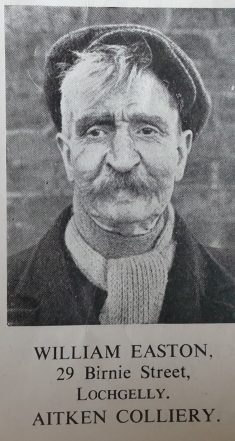
You won’t come across William Easton (1879-) in many history books though I discovered a paragraph about him and a photograph in my Di’s (grandfather’s) Service: Record Book of Veteran Employees in the Service of the Fife Coal Company LTD August 1945 where he blended in among hundreds of other veteran miners. That book mentioned how Easton served his country in the First World War but there was no mention of his being arrested and imprisoned for fighting the police in a conflict in Lochgelly during the 1921 lockdown. I came across that information by chance while doing research for the feature film The Happy Lands (2013) when Easton’s name popped up in another book I inherited from my Di: A History of the Scottish Miners (1955.)
‘One middle-aged miner was arrested, William Easton, whom the newspaper described as having ‘for some time been actively identified with the Communist movement . . . next morning William Easton was brought before the Sherriff at Dunfermline and committed to prison for assaulting the police.’
Easton was imprisoned for ten months.
The central character in The Happy Lands is a proud Great War survivor decorated for bravery whose loyalty to his country is tested when the British army he proudly served take up arms against his mining community during the 1926 General Strike.
I was six years old and learning to write in a mining village primary school when Margaret Thatcher infamously referred to the miners as ‘the enemy within.’

SALT OF THE EARTH
Because our boiler has been leaking
I gardyloo a bucket first thing.
A silver arc splashes the lawn
as I turn towards the kitchen.
In the back garden my torch
lights up a fox on the hill.
My boots crunch frost to the bin
concealing chicken feed.
In the run I open the coop:
Mable the Rhode rock scuttles free
with a cluck and a peck;
Zara the Polish’s funky punk hairdo
headbutts air; Grace the Bluebell
gracelessly bulls Tina the Araucana
who flaps and squawks as my torch
scans the hill: no fox just frost, ice.
I lock the run as the flock forage.
In the house I open the fridge,
take a pre-packed lunch box,
fill a flask with coffee and
flick and scroll and skim the news:
grim happenings in America while
here friends are hooked on a slogan
baiting them with a simple solution.
My work bag and daughters school bag
are propped against a bookcase
like workers sleeping on the job.
An NHS uniform cushions the Brecht
I slip into my bag.
Unicorn trinkets, rainbow stickers
and Disney characters
decorate my daughters bag.
Cold dark hits me as I step outside,
the latest murder in Minnesota in mind:
the victims profession, ICU nurse,
bringing the horror closer to home.
I have a friend in St Paul
where it’s -7 as the heat cranks up;
armed masked men without identification
prowling the streets.
An educated woman, my friend
will know the word grit means
perseverance, resilience, but perhaps not
that in Scotland it also means
the salt we spread to deal with ice.
There’s been little salt on our paths
since the financial crash; austerity cuts =
a shortage of grit to keep us safe.
Some I know are absentminded as hens,
others aggressive as cocks,
many easy prey to the cunning
running things on hills above them.
All too easily dismissed as stupid
or bad by ideologues who spread
bitterness and anger rather than grit,
and prefer to slam doors than win over.
I recall the fishing tackle Brecht
hung on a wall where he was living in exile.
Ornamental, but also a symbol;
rusted and worn and abandoned
by fishermen driven from the coast
into camps: foreigners suspect then
as now. Traces of work and use,
Brecht thought, lent the tool great dignity.
As some friends swallow the slogan:
Britain is Broken. Britain needs Reform
I think of Rab our boiler repairman
due back with a new part to fix the leak.
I imagine his toolbox in a van
as my friend’s ICE OUT SAINT PAUL sign
is screwed into a frozen lawn.
I wish her well. I wish her grit.
Note:
‘Salt of the Earth’
‘gardyloo’ (from the French “take heed of the water”) was a word residents of upper-storey tenements in Edinburgh used to holler before emptying chamber pots and slop buckets into the street.
Renee Good and Alex Pretti (an ICU nurse) were shot dead by ICE agents in January 2026.
The Fishing-tackle, a poem by Bertolt Brecht
The concluding line is a nod to the Scottish poet Douglas Dunn’s poem A Removal From Terry Street:
‘That man, I wish him well. I wish him grass.’