By Alan Morrison
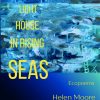
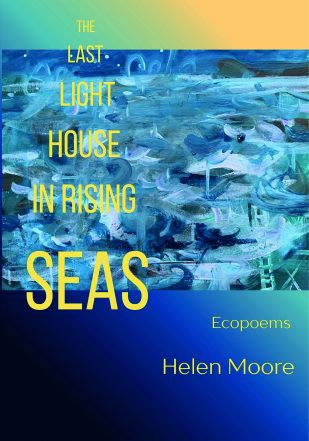
With her much critically praised debut collection Hedge Fund and Other Living Margins (2012), Helen Moore established herself as a passionate proponent of eco-poetry. This, her fourth collection, The Last Lighthouse in Rising Seas, published by the ethical Palewell Press, shows how Moore can combine eco-socialist and feminist polemic with highly accomplished poetic form to maximum effect on the page, infused with a deep optimism cultivated through a long-standing intimate engagement with the natural world. The climate crisis, the plight of migrants, and the Covid pandemic are seamlessly merged into one combined macro-theme of planetary momentum.
‘Madonna & Child, portrait in blue’ is a beautifully wrought depiction of a refugee’s life under canvas: ‘A downtown icon/ in Old Master colours – the ultramarine/ tarpaulin you crouch beneath to shelter from the rain,/ a jet-black veil enhancing pensive beauty,/ the ailing child you cradle/ wrapped in kingly garnet. A crown/ of white cloth’. The refugee’s ambition is to reach the “socialist utopia’ of Sweden’— even if that destination is latterly less willing to extend the arms of its welfare state—Folkhemmet: “people’s home”—to immigrants and refugees, like much of Fortress Europe.
Moore’s natural descriptions have a painterly attention to detail: ‘The house next door/ has primrose yellow walls// Spring sprouts blousy/ sulphur-coloured Poppies’, ‘Snails are fevered mouths/ glued to walls. Grass has changed to straw’, ‘the bright semaphore of Bluebells’, ‘banks that slope steeply to a path/ dark rents in the crisp pearlescence’, ‘sip nectar from raggy/ yellow blooms’, ‘this old henhouse of friendship’, ‘Beyond, like drenched eiderdowns, the/ low-lying fields of Meare’.
The powerful ‘Carpet beater’ at once eponymously references the poet’s grandmother at her domestic chore, the tool of the chore, and conceivably the grandmother again as a metaphorical carpet herself in terms of being beaten by both her father and husband.
Moore uses many different poetic forms throughout the collection, including concrete poetry, and occasional use of strikethroughs. The poem ‘Market Forces’ is presented in landscape.
‘Tale of an Australian opal’ depicts the poet’s aunt on her deathbed bequeathing a ring to Moore set with an opal ‘Bluey-green set in silver filigree’. There’s some wonderfully consonantal and assonantal sculpting in the lines ‘bids us both round the cool blade of/ air into her corner of the hospice’. Moore closes this poem by acknowledging pillaged aboriginal heritage: ‘Lucky opal, I wear you proudly, despite miners’ silicosis,/ ravaged Country, wounded souls. Shadows of the settlers’/ burning for all that glitters in the spirit’.
‘Approaching Britain, necropolitics, 2017’ describes a trip back through London from a Parisian honeymoon, punctuated with italicised asides detailing migrant deaths in airless trucks.
‘Firebreaks / a wild wedding’ details ecocide by cigarette: ‘Gorse had blazed along cliff-tops near Hopeman –/ dense prickly thickets/ (hiding warm-breasted birds, nests of pale, speckled eggs)// into which a cigarette was flicked’.
In ‘The secret economies of English houses, snapshots 2020-21’ Moore objectifies her own poetic identity as if interrogating any unconscious self-commodification: ‘On my social media feed, I style the room as ‘ecopoet’s/ studio’, posting pics of flagstone sills with jars of/ Snowdrops. A lit pillar of wax. River-sculpted driftwood’. Elsewhere in this poem about the iniquities of renting during the pandemic, the poet notes ‘RENT STRIKE! appears in large white letters on the/ tarmac of the park’. There are again breathtaking descriptions of the natural world: ‘Mumma Blackbird, a/ purring dart with protein twitching from her beak, flies to/ & fro to serve her nestlings, who fizz like effervescent/ liquid. Their nest is housed amongst a vine, which/ stretches above the pergola’s rotting wooden beams’. As Moore puts in an apposite aphorism: ‘In time of plague, rentals are hen’s teeth’. Nature, at least, flourished during the cleaner-aired lockdowns.
In ‘Quizás’ there is a startlingly figurative passage: ‘From each temple, the Gardenia blooms, which her tearful/ mother sent her back with from Spain, loose spirals of/ perfume. Such moments as these, when star-pricked night/ gathers skirts around us’. ‘What the Owls say’ is a wonderfully descriptive naturalistic poem: ‘Hill-top woods when sacred darkness comes long & early./ Owl-light drawing Ivy curtains across afternoon…// Our season, when Rooks hunch like sacks in bare Limes,// polar breath stirs our fluffed-out camo,/ this plumage patched like bark’—and the eponymous nocturnal Strigiformes themselves: ‘We, shadow-/ dwellers who occupy dark margins, which you diurnal/ creatures usually resist’.
The titular portmanteau of ‘Petronarcosis’ has echoes of Heathcoate Williams’ Autogeddon, his pioneering 1991 ecopoem (cue also his campaigning poem Whale Nation, Naxos, 1988). This eponymous poem of the book’s second section empathises with exploited male manual workers: ‘We choose workers with bodies built/ for rigs, cranes, scaffolds,/ dockyards, factories –/ burly boys born to beat steel, rivets,/ to fight along sectarian lines/ as we monetise their muscle// Their poor mothers raised them so –/ & we name them Hercules,/ Samson,/ Goliath …// We’ll have their sons/ & daughters/ as our resources too’.
The eco-feminist ‘Petroleum Girls, 1971, an ecocritical reconstruction’ closes on the crashing and crushing: ‘that climactic gusher,/ all sticky & unstoppable/ to usher in the age/ of Chevrolet,/ Cadillac,/ Buick’—the poem at once calls to mind the polemics in Susan Sontag’s Notes on ‘Camp’ or Roland Barthes’ Mythologies.
In the Ballardian ‘Auto eroticism, a petrolhead’s onanistic dreams’ we get ‘throttle, his pistons, his gallons of ancient unlight’, and it closes on a Marxian apothegm: ‘Human desires are the steam which makes the social machine/ work. Only by understanding them can the propagandist/ control society’.‘Auto / mobile’ again recalls Heathcote Williams’ Autogeddon: ‘purgatories of pollution with Babylon/ temples to the drive-by lifestyle/ where you stop off to worship/ with your purchase of vapes, tat/ gadgets with built-in obsolescence’. The poem aptly crashes to its close with the words ‘exhaust-/ion, break-down’ broken up on the page. ‘Making inroads, two voices’ describes the ubiquitous S.U.V. thus: ‘King of the roadway, I am/ ubiquitous – a black crust/ baked in the devil’s kitchen’.
“P’ is for Play!’ effectively evokes the noise and violence of construction vehicles and/or agricultural machinery in vivid images that might also be referencing the bulldozed mass graves in Gaza: ‘nausea, anxiety,/ trauma as drills tall as windmills/ serve to pulverise & split/ layers of our skeleton’. This visceral response to mechanical apparatus immediately brought to mind Anna Home’s eerie children’s dystopian TV serial The Changes (1975) which is based on a trilogy of novels by Peter Dickinson, in which a sonic signal suddenly emitted from all technological items triggers the human population to destroy them and revert to a pre-industrial society. The source of this strange happening is eventually found to lie dormant in a stone in a cave which appears to imprison the spirit of Merlin.
Such folkloric supernatural dramas depicting the clash of ancient natural or pagan powers with the forces of industrial modernity permeated Seventies television—The Owl Service, Robin Redbreast, Sky, Penda’s Fen, Children of the Stones, to name a handful. Moore’s eco-poetics in many ways feels sourced from similar wellsprings though is significantly infused with an empirical relationship with the natural world, and what our suburban mindset might term an ‘alternative lifestyle’.
‘Portrait of a ‘domestic extremist’’ shows how those who try to live such alternatives, such as new age travellers, are demonised by the right-wing press: ‘Dirty hippies, say the tabloids, pitching up unbidden/ with our pallet kitchens, compost toilets,/ caravans & tents – layabouts & scum blighting the town./ True our camp is decidedly ‘rainbow’/ with prayer flags & banners’.
Moore’s way of juxtaposing the natural world with sudden human psychological insights moves into the sublime in ‘Spectrogram, Sparrows’: ‘Then, from these feathered/ dendrites of Earth’s nervous system/ rapid spurts of flight. Frequently as a kid,/ your own sensitivities were critiqued’. The poem closes on a thought-provoking apothegm which recalls Hegel’s and Marx’s concept of Entfremdung whereby workers are dehumanised while copywriters imbue the products of their labour with personalities—reification: ‘Persisting for his rent, one man grows ill –/ yet each time he recovers & returns,/ symptoms flock into his body, come home to roost’.
‘Thom’s Co-op Bike Café & Workshop’ recounts various cyclists killed in car collisions. There is ‘Jorie on her bright-green Raleigh/ decked with fake flowers & an old Dutch bell/ which tinkled, silvery-warm like her laugh’, and Bobbie ‘back in 1930, first mounting/ a Sunbeam. At ninety, with cataracts & cycle-clips/ he’d peddle to the duckpond with crusts of sliced white’.
‘Of poets’ tools’ is an exquisitely descriptive and precisely sculpted poem: ‘the tricorne nib/ & ribbed, beetle underside all run dry.// No longer did your craft employ the tools/ of Snyder, Forché, Lorde …/ you’d dropped the mythic thread// of ink incising cellulose – lineage of iron-gall script/ & quills, volumes of charms,/ love letters between// Abelard & Héloise, monks scribing The Book of Kells./Instead, each time you lost one or the last ran out,/ your fix of five-gram plastic tipped// with Lászlo Biró’s sticky ball meant paradox./ Through theft of Mesozoic sunlight/ from pitch-black pools your polished poems’. There’s also the tangibly alliterative ‘the mechanical extrusion of strings/ your lines as toxic spaghetti’.
‘Dog’s message’ is a phantasmagorical dream song which seems to be recalling childhood abuse through grotesque transmogrifications: ‘just the bus shelter/ glass between those fists and me, the turnip face/ retreating with a crazed grimace’—it closes hauntingly: ‘the animals are stressed, sense the intense/ threat to life, and will assist (we only/ have to ask) in resisting the forces that would break us’.
‘Sumud, for Maisara Baroud, 2024’ relocates to the occupied West Bank of Palestine: ‘After Zionist bombs destroyed the college where you/ taught, turned home & studio – archives, books, paints,/ canvases – to rubble, your broken heart alighted on a pen/ beneath the seat of your car.// Since then, it’s served you night after night as you’ve sat/ under flapping tarpaulins…// Here the missing arm of a musician/ cradling a violin/ an angel guiding the bow.// Here a bandaged refugee, belly held open to reveal/ the dark space/ where a single flower grows.// Each piece you make proclaims I am still alive/ is an act of witness & resistance’. This beautifully figurative but harrowing poem closes with a prayer: ‘May Gaza rise free from the rubble/ be a mecca for healing bodies/ souls, land, trauma!// May peace & justice reign!/ May we live as one Earth,/ as one conscious heart’.
In ‘Mycelium and the Mental Dance of Fruiting Bodies’ there is a genitomorphic focus on plant life worthy of Plath: ‘Stinkhorn’s pointy, hollow finger/ texture of sliced white,/ and capped/ with a slimy/ dark, olive head’. While ‘Seed yoga sutra’ might be termed sito-erotic: ‘Inside your raw, sour orb (this power-house/ of singular intention), my mind curls,// Soon your radicle will descend – pointy teenage/ tip, a pale straw to suck the chill soup,// an impeccable asana, rootlet below/ as your plumule burrows up to sunlight’.
More soulful and Wordsworthian is ‘Wood Ants in April’ which flourishes with assonances refreshing as cool woodland balms: ‘dashes pillboxes and block fortifications/ left in the wake of world war,/ erodes concrete, exposes rusted bones –// lies wrapped in a moss-green, down-filled/ coat, soaking up the vague rays/ face turned upwards in prayer/ toward bristle-ended branches’.
Still spiritual is ‘Climate adaptation, #3’ with its almost Buddhist concept of what Dr Daniel J. Siegel described as ‘intraconnected wholeness’ (similar to Arthur Koestler’s notion of ‘oceanic consciousness’) of all living things over and above ‘the solo self of separation’ and this ‘MWe’ and ‘MWus’ permeates the poem, which seems to steer towards a post-capitalist utopian future: ‘Billionaires are long gone./ They came to share their vast hoardings/ to serve the highest good.// The giant digital screens once inflicted on our streets/ became outdoor cinemas, vertical canvases/ with honeycomb visions of artists & poets.// hive mind now connects through telepathy & touch/ shun division, profit,/ helping Mwus adapt to economies of gifting/ for the truly common wealth’. Here I’m reminded of Swedish poet Harry Martinson’s epic space-bound dystopian poem Aniara.
This deeply figurative, varied and spiritually rejuvenating collection closes on the title poem, which swims in aphorism: ‘Still, we pilgrims pray beneath our breath/ & sometimes mirage a giant lighthouse’. There seems to be an allegory regarding migrants drowning. The poem closes with the hashtagged plea: ‘#leavenoonetodie’// Meanwhile, our progress is slower/ than an average human can run’. The Last Lighthouse in Rising Seas consolidates Helen Moore’s reputation as the foremost ecopoet of our time.
A condensed version of this review was published in The Morning Star 7 July 2006 under the title ‘Spring sprouts blousy’