The Land of Youth, by Lucas Cranach the Elder, 1546
By Gregor Gall
In 1987, as a student seeing indie bands play live in Aberdeen, I first came across a reference to ‘Big Rock Candy Mountain’ in a song of that name by The Motorcycle Boy, an Edinburgh band formed from the remnants of another Edinburgh band, The Shop Assistants. It was The Motorcycle Boy’s debut single. It reached No. 2 in indie charts that year. The lyrics ran:
Every day in this house seems the same
I don’t want to go where no one knows my name
I hope I never led you to believe
That the day would never come when I would leave
This is no way to say goodbye
But I never was good at telling lies
These four walls are closing in on me
Is this the way that life’s supposed to be?
… Sitting in each day on my own
Just waiting for you to come home
I never meant to cause you any pain
But I never want to see this place again
… It doesn’t matter what you say
‘Cause I’m already on my way
Look for me tomorrow and I’ll be gone
… Dancing with the working man
Looking for the big rock candy mountain
Rolling down the hillside in the sun …
Clearly, wanting out of a failed or failing homelife and relationship meant looking for something far better and that was some kind of idea of a preferred paradise by way of ‘The Big Rock Candy Mountain’.
As I was soon to find out upon further investigation, this could only be taken to be a reference to the song of the same name, albeit as in the plural as ‘The Big Rock Candy Mountains’ by Harry McClintock (1884-1957). McClintock recorded the song in 1928 as ‘(Haywire) Mac’ for the Victor Talking Machine Company. McClintock claimed, somewhat unconvincingly (at the age of eleven) to have written the lyrics in the 1895 though the consensus is that whenever he did write the lyrics he drew upon many other existing songs and stories in order to produce a synthesis.
Listen to his version of it as you read the lyrics:
One evening as the sun went down
And the jungle fire was burning
Down the track came a hobo hikin’
And he said, “Boys, I’m not turning
I’m headed for a land that’s far away
Beside the crystal fountains
So come with me, we’ll go and see
The Big Rock Candy Mountains
In the Big Rock Candy Mountains
There’s a land that’s fair and bright
Where the handouts grow on bushes
And you sleep out every night
Where the boxcars all are empty
And the sun shines every day
On the birds and the bees and the cigarette trees
The lemonade springs where the bluebird sings
In the Big Rock Candy Mountains
In the Big Rock Candy Mountains
All the cops have wooden legs
And the bulldogs all have rubber teeth
And the hens lay soft-boiled eggs
The farmers’ trees are full of fruit
And the barns are full of hay
Oh, I’m bound to go where there ain’t no snow
Where the rain don’t fall, the wind don’t blow
In the Big Rock Candy Mountains
In the Big Rock Candy Mountains
You never change your socks
And the little streams of alcohol
Come trickling down the rocks
The brakemen have to tip their hats
And the railroad bulls are blind
There’s a lake of stew and of whiskey too
You can paddle all around them in a big canoe
In the Big Rock Candy Mountains
In the Big Rock Candy Mountains
The jails are made of tin
And you can walk right out again
As soon as you are in
There ain’t no short-handled shovels
No axes, saws, or picks
I’m a-going to stay where you sleep all day
Where they hung the Turk that invented work
In the Big Rock Candy Mountains
I’ll see you all this coming fall
In the Big Rock Candy Mountains
McClintock was an itinerant worker and hobo, and for a time and active member of the Industrial Workers of the World (IWW), commonly known as Wobblies. The IWW were revolutionary syndicalists. McClintock was active as a Wobbly in the 1910s and 1920s before his radio and recording career took off. He was a member of the relevant unions thereafter for these trades.
Though the term came into use in the United States in the 1890s, the exact etymology of hobo is unclear. However, whether hobos were tramps or bums seeking to avoid work or migrant workers travelling in search of work, there is a clear sense that hobos are somewhat rootless and alienated, if not also oppressed and exploited as per the lumpenproletariat.
So, what has a tale of a hobo utopia got to do with a communist contra-culture? And especially so, when it draws upon the lineage of many songs to represent a modern version of the medieval pre-capitalist concept of Cockaigne (where the exploited and oppressed peasantry dreamed and desired of a blissful life).
The lyrics present the idea of a happy and carefree utopia – of free and easy food and drink, of free housing, heating and transport, and of freedom and liberty, with effectively no police or other repressive authorities, and no enforced work. This utopia is one that can be found if one searches for it and follows a certain trail. It is also a collective one where a collection of individuals travels from many different directions to find together this utopia.
All this cleverly conjures up in the imagination a world not so much of surrealist idleness and gluttony, but rather a world where labour does not equate to work as we know it under capitalism and a world containing places of pleasure and leisure.
Put to such a simple and appealing melody in such a short form of just two minutes and twenty-five seconds, the lyrics joyfully present a world of attainable happiness and contentment.
Communists are duty bound to consider producing their own communist cultural artefacts – songs, novels, poems, comics and the likes – to help spread the cred of communism as a more appealing and appetising avenue for individuals to travel down (as opposed to going straight to reading books and study groups). In time, progression to reading books and study groups can then happen much more effectively.
Notes
[1] In The Big Red Songbook: 250-Plus IWW Songs, edited and introduced by Archie Green, David Roediger, Franklin Rosemont, and Salvatore Salerno (Charles H Kerr Publishing Company, 2007), the song is mentioned several times as ‘The Big Rock Candy Mountain’ and the lyrics of the song are not reproduced even though Rosement (p32) believed the Wobblies ‘surely sang’ the song. Hal Rammel also uses the singular of mountain in the title and text of his Nowhere in America: The Big Rock Candy Mountain and Other Comic Utopias (University of Illinois Press, 1990).
[2] Fittingly, the song was used in the soundtrack in the Coen brother’s film, O Brother, Where Art Thou? (2000), about three escaped convicts in 1937 in Mississippi looking for a hidden stash of cash, in other words the means to achieve they own utopia.
[3] There is a darker side to some of the early versions of the song, where the idea of free candy and the like was used to recruit homeless and parentless children into the ranks of hobos where they were sexually abused. This is evidence by the last stanza in the song which McClintock did not record in 1928.
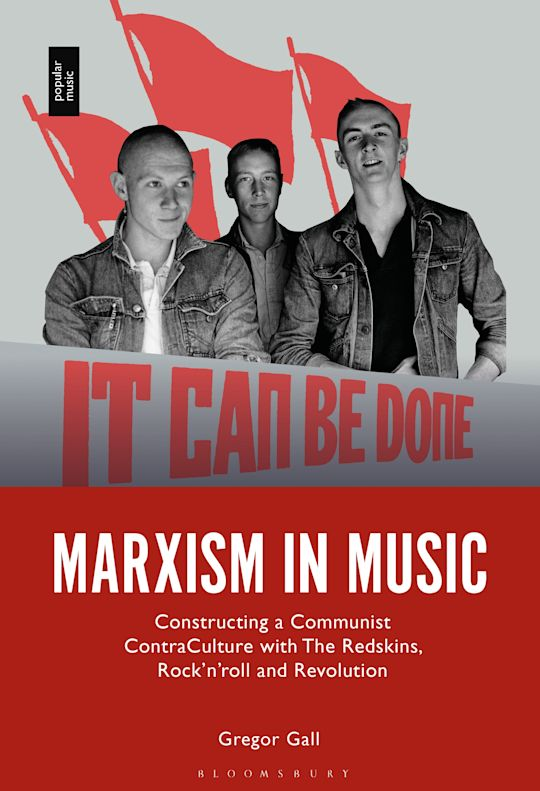
[4] The arguments about what a communist contra-culture is and what role it can play are fully laid out in my Marxism in Music: Constructing a Communist Contra-Culture with The Redskins, Rock’n’roll and Revolution (Bloomsbury, 2026). Until the 31 January 2027, there is a 35% discount code available – MARXISM35 – on the hardback book so £52 (with free postage within UK). Use it here