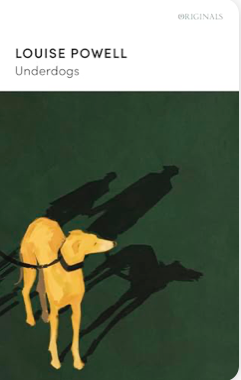
Underdogs is available here
Underdogs is the first novel by the working-class, Middlesbrough-born writer Louise Powell. The book is set in 1998 in County Durham and is written from the point of view of a likeable ten-year-old boy called George, which is an interesting choice, since one might have wrongly assumed that the author might have been more inclined to make her principal narrator female.
Another authorial choice is the use of Pitmatic throughout the book, which is the name given to the dialect of the Durham coal mining region. So, as a result, you will encounter words such as “bairn” (child), “gannin” (going) and “summat” (something). But these lexical choices are purely authorial – so, for instance, we still get the word “father” rather than the North East/Scottish pronunciation, which would equate to something like “faither”.
Politically, the book mentions Margaret Thatcher, the mine closure programme of the Conservative government in the 1980s, and the so-called “Battle of Orgreave”, the violent suppression of picketing miners by the police at a coking plant in South Yorkshire. However, let us not forget that the neoliberal government of the day in 1998 was that of Tony Blair and the Labour Party. At the time, the unemployment rate in a place such as Easington Colliery was in the region of 10% for males.
Overall, George, with his aptitude for basic maths, comes across as a pretty old-fashioned character. Inexplicably, he’s not aware of the popular film Men in Black, nor does he mention any of the innovations which at this time were being rolled out in education – e.g. the use of computers in schools.
Stylistically, the book offers us a rich seam of figurative language. Thus, we read of a Honda “with more dents than a reduced tin of beans” and how one character was “nee fatter than his fag.” Note also the dialectal “nee” in the latter example, instead of the more familiar “no”.
When it comes to the story itself, George’s unemployed father Reg pretends to be the owner of a greyhound called Goldie, which belongs to Bertie, a local ex-miner. Once this plan is set in motion, Bertie instructs his stooges to lay sizeable bets on the greyhound, knowing in advance that the dog will win the race into which Reg has entered it. Provided Reg goes along with this scheme to fleece the bookmakers, he will also make a tidy sum himself, which will put a stop to his house being repossessed.
That the story takes place at one of the unlicensed “flapping” tracks in County Durham makes for a very suitable location. For isn’t a greyhound running hell for leather around an oval track, trying to catch a fake hare that’s propelled along an electric rail, the perfect symbol for working-class ambition? In many ways, it’s also reminiscent of the fate of Sisyphus, rolling his boulder up the hill.
My dad kept and raced greyhounds, so the story naturally appealed to me because of that. Besides, anyone living in County Durham knows that if you take the train between Durham and Newcastle, you go past the Chester-le-Street greyhound track. You can’t miss it, and I’ve actually been there once upon a time. But, of course, Chester-le-Street represents official greyhound racing, not flapping.
Underdogs is most definitely what one might call a “feelgood” piece of writing, and there’s even a somewhat heavy-handed allusion to the title in the work itself when a character says, “Them that act like underdogs never become champions.”
Ultimately, my only criticism would be that the novel descends into a sentimental tearjerker towards the end with its Goldilocks subplot. Moreover, for this reader at least, the ending did seem to be unnecessarily drawn out. Nevertheless, Underdogs was certainly an enjoyable read, and I look forward to further work from this author.