
By Ciarán O’Rourke
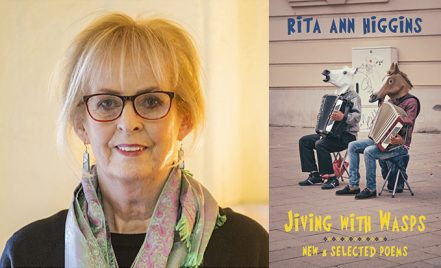
“Nostalgia takes me back – / the shirt factory toilet.” So opens Rita Ann Higgins’s ‘Work On’, a vision of labour that is also a feminist place-poem, with sass and weariness in its bones. “Boisterous laughter echoed and betrayed lost time”, the recollection continues: between bathroom stalls, where “country girls met / and sucked cigarette ends on Monday mornings.”
As nostalgic reveries go, Higgins’s reminiscence arguably introduces a new chord to the score of Irish poetry. Yeats had the imagined home-place of Inisfree for inspiration, quickening the pulse of his poetic striving; Heaney, the memory of Mossbawn, humdrum and lost, a known idyll lit by sorrow and longing. For Higgins, who left school (for a job) aged fourteen, the place of origin and moment of inspiration revolve instead around a toilet-break between work-shifts – a scene perhaps unfamiliar to many of her literary peers, and in any case largely absent from their productions. Needless to say, but our understanding not only of Irish life, but of the whole project of lyric expression and representative experience, will change depending on whether and how we rank each of these contrasting evocations.
Jiving with Wasps: New and Selected Poems affirms the impression of Higgins as a vibrantly political writer. Often portrayed as a free-verse humourist, down to earth and colloquial, the Galway bard – whose début, Goddess on the Mervue Bus, was published in 1986 – might also be regarded as an astute critic of neoliberal Ireland and its transformations: an author intent on puncturing the myths and exposing the inequalities that have accompanied Ireland’s FDI-driven, privatisation-prone economic model in recent decades.
Mixing tones of indomitable irony and careful chronicle, her early poems record what it feels like – and what it might mean for thousands of citizens – “to wait in Community Welfare waiting-rooms full of smoke / to wait two years to have a tooth looked at / to wait another two years to have a tooth out (the same tooth)”. The people she describes appear as driven to distraction, and farther again, by pains that have to be lived with, if rarely named aloud. “Mona doesn’t dies here / any more”, reads one piece, “she lives / in a house at the back / of her mind”, a dream-home “with no gable ending, / a high wall / but no door.” Mona “was a coupon saver”, we’re told: “she saved them / but they never saved her.”
Higgins has been justly celebrated as a wit and an entertainer – there’s a deadpan comedy to many of the home-video-clips she transposes into verse – but she also documents the rituals of survival that women have evolved in response to everyday pressures and punishments. “Some people know what it’s like, // to be called a cunt in front of their children”, she suggests, “and other people don’t” – a shot across the bow, aimed as much at a male-dominated critical tradition (that would classify or dismiss her work), as at the patriarchal flag-bearers in Irish society more generally, in the open or behind closed doors.
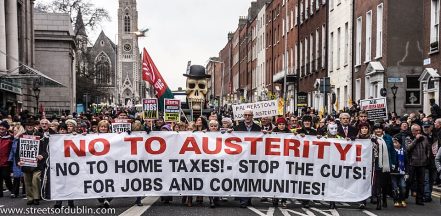
In subsequent collections, she has continued to extend this style – bemused, compassionate, and latently angry. One of her distinctive gifts, indeed, alongside her bristling social perceptions, is her refusal to succumb to political amnesia.Her output since the 2010s has been damning in its portrayal of inequality and hypocrisy as typically Irish traits. “Here austerity is a road sign going nowhere”, she observes, in 2013:
We’ll end up eating grass
while prancing and Riverdancing.
We’ll dress in green jerseys
and place the fools,
we’ll crack the whip,
we’ll take skelps off our own backbones.
Complacency is disallowed, among the otherwise democratic and inviting ambience of her work. “We are talked down to again”, she posits in a more recent piece, with eyebrow-arching clarity:
We are back to a time when people
wear their coats in the house,
and leave the oven door open to heat the kitchen.
Higgins, we sense, is less interested in constructing counter-narratives per se (to the stories spun in government press releases, for example), than in mapping the truths that permeate the evicted streets and battered housing estates of an Ireland usually erased from its own tourist brochures. “This was no Ithaca / no sweat was ever broken / trying to reach here”, she rues. “The swans in the canals all know,” she continues in another poem:
we underpay our nurses
we underpay our teachers
we overpay our consultants
and we don’t know why.
Higgins is the ultimate master of this kind of propulsive plainsong, deploying a conversational address that builds, gradually and almost casually, to a critique of the nation, brassy and stinging. “Some people live their lives”, she notes, with stark exactitude, “so they can die on a trolley / in Galway’s A&E.”
Higgins’s Galwegian snapshots contain jagged insights, alternately arresting and disturbing, into a wider world – thrumming with tensions, and shadowed by violences, that implicate our lives: “in this cage, ladies and gentlemen, / we have the powers that be”. One piece begins as a scathingly wry conversation between daughter and mother, before effecting a sudden pivot, which alters the tenor of the poem as a whole:
Just now a B52 bomber flies over
on its way from Shannon
to make a gulf in some nation’s genealogy.
Called “Grandchildren”, Higgins’s familial reflection chimes here, emotionally and politically, with the London-based rapper Akala’s pummelling anthem, “Yours and My Children”, which excoriates the dehumanisation (of children) and destruction (of lives and cultures) wreaked by imperialist wars. The same theme resurfaces near the end of the book, in a prayer-like dispatch dedicated to “Sarah Clancy on the Global Sumud Flotilla”, and titled “The Children of Gaza”. It reads:
They are too tired
to move again,
they are too hungry.
Their eyes say,
better to die here
than run the gauntlet
and die down the road
with an empty bowl.
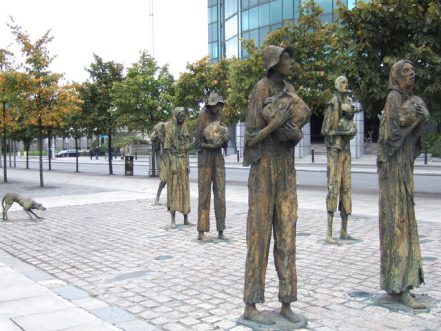
In the lambent soundscapes of contemporary poetry, hunger is frequently employed as a metaphor – for the poet’s own desiring, say, or for the tenacity and efflorescence of the natural world. Higgins, however, is an artist whose sophisticated, word-woven tapestries never forget (nor allow us to overlook) the realities of deprivation and disappointment that people, including children, endure – and sometimes defy.
Importantly, Higgins has little patience for the stereotype of the social victim. Instead, she paints pictures of living personalities, voices that persist. Engineered scarcity (of whatever kind) can generate suffering, she realises, but also inventive patterns of response. “It wasn’t until our Anto / got fourteen months / for borrowing other people’s cars / from their driveways”, reads one poem, “did we realise / what an insatiable appetite he had.”
This is a poet for whom glorious irreverence is a constant resource, as well as a force of potential cultural transformation. In ‘Donna Laura’, she adopts the persona of Laura, muse to Petrarch – the medieval Italian sonneteer, sometimes credited with launching a new movement of intellectual humanism in European thought. “Petrarch you louser”, she sighs, more in pained exasperation than amorous yearning, “I’m here plagued with the plague / and you’re off chasing / scab free thighs.” She continues:
As for the sonnets
you were seen tearing them up
and throwing them petal-like
around the marketplace,
the Pope thought your piss was lemonade.
If upturning idols is one of Higgins’s recurring preoccupations, there is little spite – and in fact, a great deal of warm, human affection – in her approach. It’s no surprise that she can be both subtle and unabashed in her depiction of love-lust, that sensation at the root of so much life and history. “Platonic my eye”, she zings:
I yearn
for the fullness
of your tongue
making me
burst forth
pleasure after pleasure
after dark,
soaking all my dreams.
Higgins’s poetry not only encompasses the many, multifarious experiences that make up the human story; in its tilted pep and humour, her work becomes a part of that story, holding open possibilities of political critique and social recognition that few writers would even think to credit. Give “us time to process / the space we are suddenly in”, she writes: “Allow us the giddiness, the fears. / Gift us the dove, the olive branch, the years.” She remains (as she was once dubbed on RTÉ Radio 1) the people’s poet: her poems are vivid and matchless, and form a continuing drama – with the blended flame of love and justice at its core.
You can get her book from the publishers here





_-_24_November_2012_(8214021379).jpg)