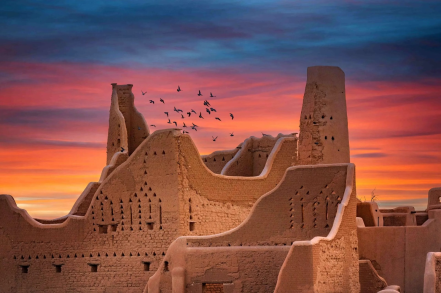
At-Turaif District of Diriyah. Photo: Ali Lajami. CC BY 2.0 / Wikimedia Commons
By Tarique Ahmed
For decades, oil has shaped the economic, political and social landscape of the Arab Gulf. Petroleum wealth transformed relatively small trading and pearling societies into some of the world’s most prosperous economies, financing spectacular urban development, global investments and modern infrastructure. However, growing concerns about hydrocarbon dependency have encouraged Gulf governments to explore alternative sources of economic growth. Within this changing economic landscape, culture and heritage have emerged as increasingly valuable resources.
Across Saudi Arabia, the United Arab Emirates (UAE), Qatar, Bahrain, Kuwait and Oman, traditional music, architecture, clothing, museums and heritage festivals are being incorporated into national development strategies. Historic neighbourhoods are being renovated, traditional performances are entering commercial entertainment industries, and cultural institutions are attracting international tourism and investment. Heritage, once primarily associated with collective memory and historical continuity, is increasingly being transformed into an economic asset.
The central question is no longer simply how Arab heritage is being preserved, but how it is being converted into capital, who controls its representation and who benefits from its commercialisation.
This article argues that the transition from oil to culture does not necessarily represent a departure from the existing political economy of the Gulf. Rather, it demonstrates how petroleum-generated wealth is being redirected towards new forms of capital accumulation through cultural industries, heritage tourism and international cultural institutions. Drawing on Marxist cultural studies and Raymond Williams’s cultural materialism, this article examines how traditional cultural practices are being reorganised according to the demands of contemporary capitalism.
The Political Economy of the Post-Oil Gulf
The contemporary cultural transformation of the Gulf must be understood through its history of petroleum-driven development. Oil revenues enabled governments to construct modern cities, establish welfare institutions and participate in global investment networks. Following the oil boom of the 1970s, cities such as Dubai, Abu Dhabi, Doha and Riyadh underwent extraordinary transformations. Nevertheless, this development model also generated structural economic dependencies. As Ewers (2015) observes, oil-driven development created economic and labour-market structures that complicated the diversification of Gulf economies.
In response, culture, tourism and entertainment have become important components of national economic strategies. Saudi Arabia’s Vision 2030, for example, identifies cultural development, heritage preservation and tourism as significant areas of economic diversification. Similarly, the UAE has invested in museums, heritage districts and international cultural institutions, while Qatar has established itself as an important centre of Islamic art, architecture and cultural diplomacy.
These developments reveal a significant transformation: oil wealth is increasingly financing the commercialisation of the very cultural histories that existed before the petroleum economy. The Gulf is not simply moving beyond oil; it is using the capital generated by oil to create new economic opportunities through culture.
Marxist Cultural Studies and the Commodification of Heritage
Marxist cultural studies capture this transformation. According to Marx in his Capital, “in capitalist modes of production and circulation, objects acquire exchange value.”In capitalist systems, objects are valued for their usefulness and for their potential to produce economic returns. This is also the case for objects and cultural life. Music, clothing, architecture, artifacts, and customs can be packaged and sold in a commercial system and become commodities.
Raymond Williams elaborates on this in cultural materialism. In his Marxism and Literature (1977), he contends that culture must be analyzed in relation to material conditions, social practices, and historical relations. His contention that culture is ordinary is particularly important because it challenges the constraining of culture to high cultural productions, museums and other official institutions. Applied to the Gulf, Williams’s approach raises an important question: what happens when everyday cultural practices become institutionalised and commercially managed?
A traditional musical performance, for instance, may originally emerge from communal celebrations or social gatherings. However, when incorporated into a tourism programme, its organisation, presentation and audience may increasingly be determined by commercial requirements.
The practice does not necessarily disappear, but its social function changes. The fundamental contradiction of cultural commodification lies in transforming collective inheritance into an economic product whose value is increasingly determined by the market.
Music, Architecture and Dress: Selling Cultural Identity
Traditional music represents one of the clearest examples of this transformation. Across the Arabian Peninsula, musical traditions such as Al-Ayyala and Al-Ardah are connected to collective celebrations, historical memories and expressions of regional identity. Traditional pearl-diving songs also preserve memories of maritime labour and the economic conditions that preceded the oil era.
Today, such practices increasingly appear in heritage festivals, cultural exhibitions and professionally organised entertainment programmes. Institutional investment can preserve endangered traditions and create opportunities for musicians. However, performances designed primarily for tourist consumption may become standardised spectacles, with their presentation shaped by commercial expectations rather than community participation.
Architecture reveals a similar contradiction. Historic neighbourhoods, traditional markets and older urban landscapes are being restored and incorporated into tourism and commercial development. Dubai’s Al Fahidi Historical Neighbourhood, Doha’s Souq Waqif and Saudi Arabia’s Diriyah illustrate how historical environments are being transformed into destinations for tourism, hospitality and investment. Thani and Heenan (2021) examine how elements of Arab heritage in the UAE are packaged for tourist consumption, sometimes producing sanitised representations of cultural identity.
The important point is that commodification does not necessarily require the destruction of historical buildings. It can occur through the transformation of their social functions. A traditional marketplace may retain its architectural appearance while becoming primarily a commercial destination.
Traditional clothing is similarly entering luxury fashion, retail industries and national branding campaigns. Garments such as the thobe, bisht, abaya and kandura communicate historical identity and social belonging. Their incorporation into contemporary fashion creates opportunities for designers and textile producers, but it also transforms cultural symbolism into commercial value.
In the contemporary Gulf, cultural identity itself is increasingly becoming part of what the market sells.
Heritage Festivals: From Living Traditions to Commercial Spectacles
Heritage festivals provide another important example of cultural commodification. Camel festivals, falconry competitions, traditional poetry gatherings and handicraft exhibitions have become significant components of Gulf tourism. In the past the Janadriyah heritage festival also has included traditional crafts and music as well as cultural practices specific to different regions of Saudi Arabia. Similarly, the UAE’s Al Dhafra festival highlights camel traditions, falconry and Bedouin heritage to a wider audience.
Such initiatives can raise awareness of the culture, provide a source for craft workers and reintroduce interest in past traditions to younger generations. But they can also regiment cultural traditions as packaged experiences for tourists. Theoretical perspectives from Guy Debord’s The Society of the Spectacle (1967) are helpful. Debord argues for increasing mediation of social relations through representation and images. Within the Gulf’s heritage economy, traditional practices can similarly become spectacles through which national identity is displayed, marketed and consumed. A festival that once represented collective participation may increasingly become an organised representation of tradition.
This raises an important question: are heritage festivals strengthening living cultural practices, or are they producing commercially attractive images of an idealised past?
The answer may involve both. The challenge is ensuring that commercial expansion does not undermine the participation and autonomy of the communities responsible for sustaining these traditions.
Museums and the Production of Cultural Capital
Museums are especially significant in the developing Gulf cultural economy. Traditionally a site of preservation, education, and history, museums have also come to be associated with tourism and issues of diplomacy and nation branding. The emergence of cultural institutions as central elements of international cultural positioning is best illustrated by the Museum of Islamic Art and the National Museum of Qatar in Qatar, and the Louvre Abu Dhabi in the UAE.
These museums do not merely act as repositories for historical objects; Their choices, their architecture, and their exhibits reflect regional and national identity.
This development can be explained by the concept of Pierre Bourdieu’s cultural capital. Cultural institutions produce the symbolic prestige and the international recognition of the countries. In this respect, the museums help convert cultural authority into economic wealth. However, their expansion also questions the representation of the past. Which histories and communities do institutions affirm? Whose experiences remain marginalised? Can museums adequately represent the diversity of Gulf societies while operating within official narratives of national development?
Museums have therefore become more than repositories of the past: they are increasingly institutions through which states produce cultural authority and participate in the global economy.
The Contradiction Between Preservation and Profit
The commercialisation of Arab heritage presents a fundamental contradiction between cultural preservation and capital accumulation.
Investment in museums, festivals and heritage districts can generate employment, support artists, restore historical buildings and encourage cultural participation. It would therefore be misleading to suggest that every commercial engagement with heritage necessarily destroys cultural authenticity.
The more important issue concerns ownership, participation and the distribution of economic benefits.
Can musicians make a living going to commercials? Do artisans receive payment for selling their designs to the luxury market? Are local communities being consulted about changes to historic neighborhoods?
These questions point to the unequal consequences of the commercialization of cultural resources. A heritage district may become a world-renowned tourist destination with little or no fair share of benefits trickling down to the original inhabitants. In the same way, heritage of traditional cultural practices can become internationally renowned while the communities that are sustaining the practices remain economically disadvantaged.
Williams’s cultural materialism is particularly relevant here. If culture is embedded in everyday social relationships, its preservation cannot be measured exclusively through restored buildings, museum exhibitions or organised performances.
Preserving the visible forms of culture while marginalising the communities that produce them risks turning living heritage into an attractive but disconnected commercial image.
Towards Cultural Democracy: Reclaiming Heritage from the Market
A Marxist understanding of cultural commodification suggests that the problem lies not simply in commercialised festivals or the loss of authenticity, but in the ownership and control of cultural production. Heritage becomes a commodity when institutions prioritise tourism revenue, investment and exchange value over collective cultural needs. Addressing this requires cultural democracy – transforming who controls and benefits from cultural resources.
Marx’s concept of alienation provides a useful framework. Musicians, artisans and local communities produce and sustain cultural traditions, yet decisions about their presentation, branding and commercial use are frequently controlled by state agencies, corporations and tourism investors. Cultural democracy must therefore restore decision-making power to those who create and preserve heritage. Raymond Williams’ idea of a common culture reinforces this argument by understanding culture as an ordinary, shared experience rather than the exclusive property of elites or commercial institutions. Similarly, Gramsci’s concept of hegemony highlights the need to challenge dominant cultural narratives through community-based institutions.
Practically, this requires establishing community trusts, cooperatives and neighbourhood councils to manage heritage sites and cultural spaces. Public institutions should include representatives of artisans, performers and residents in decision-making processes. Revenue generated through cultural tourism should be fairly distributed through guaranteed payments, cooperative enterprises and direct market access for craftspeople. Furthermore, public investment in community theatres, oral histories, local archives, languages and traditional arts can protect cultural practices from excessive market dependence.
In the Gulf, cultural democracy must also recognise migrant workers, whose labour has shaped modern Gulf societies but remains marginalised in official heritage narratives.
Nevertheless, meaningful participation requires more than symbolic consultation; it demands institutional accountability and collective power. Ultimately, cultural democracy means transforming heritage from a commercial asset into a shared public resource, ensuring that culture is owned, produced and governed by the people rather than subordinated to the interests of capital
Conclusion: The Past as the New Frontier of Capital
The Gulf’s movement from oil-centred development towards cultural and creative industries represents a significant transformation in its contemporary political economy. Traditional music is entering entertainment markets, historical architecture is becoming a tourism resource, traditional clothing is acquiring commercial value, heritage festivals are becoming organised spectacles, and museums are functioning as instruments of international cultural influence.
These developments demonstrate that Arab heritage is increasingly being incorporated into the mechanisms of contemporary capitalism. However, the transition should not be understood simply as a movement from tradition to modernity. It is fundamentally a transformation in the ownership, representation and economic function of culture.
Marxist cultural studies reveal how cultural practices acquire exchange value, while Raymond Williams reminds us that culture cannot be separated from the everyday experiences and social relationships through which it is produced.
The central contradiction of the post-oil Gulf is therefore between heritage as a living collective inheritance and heritage as a commercially managed economic asset.
The Gulf may be discovering a new source of wealth in its historical identity, but the decisive question is whether this cultural economy will empower the communities that inherited and sustained that history or primarily benefit the institutions and markets that have learned how to sell it.
The age of oil may be giving way to an age of cultural capital. But if heritage survives primarily as a commodity, what is actually being preserved: the culture itself, or merely its marketable image?