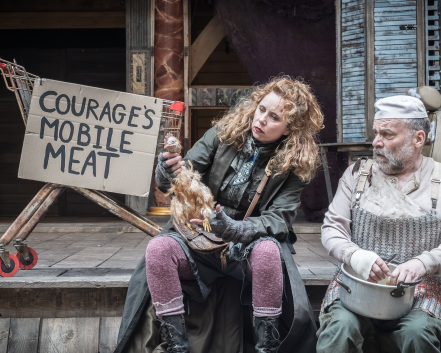
Photo: Marc Brenner
By Flora Leeper
The Globe’s production of Mother Courage and her Children, translated by Anna Jordan, directed by Elle While and starring Michelle Terry, was disappointing. It missed an opportunity to recast Brecht’s anti-war polemic into a new historical relationship that questions our present, and, rather, wandered into the realm of what Peter Brooke diagnosed as Deadly Theatre. Moreover, the production’s failure to face, let alone challenge, the war machine happily chugging away throughout the UK has not been a point of criticism in the reviews of the show. On the contrary, it has been commended as an ‘anti-war masterpiece’.
In this review, I want to examine the issue of removing the historical specificity of the original play from the production, which has been a strangely absent point of discussion in the reviews of the piece. I think that this choice has a profound impact on the relevance and challenging potential of the play.
First, I want to frame this text with a brief reminder of some of the wars the UK government is currently engaging in, financing or providing diplomatic cover for (naturally a non-exhaustive list). This is to help situate both me as I write and the reader as they read. It is to remind us both that there is little value in abstract critiques of ‘War’ per se when there are real, contingent, and utterly devastating acts of destruction happening at this moment that should be the focus of our critique.
British arms are being supplied to Israel as they commit a genocide against the Palestinian people. In June 2025, the High Court ruled that the UK government’s decision to allow exports of F-35 jet parts to Israel is lawful, despite being in potential breach of international humanitarian law. Britain is providing diplomatic cover for Israel as it commits this genocide. Among the littany of examples I could choose, most recently the newly elected PM Andy Burnham refused to call Israel’s mass killings a genocide saying ‘I can’t judge things of that enormity from where I am as mayor of Greater Manchester’. This despite the International Association of Genocide Scholars declaration last year that Israel is committing a genocide. Israel has killed 72,000 Palestinians since 7 October 2023.
The UK government is allowing the USAF to use UK airbases to bomb Iran. This includes RAF Fairford in Gloucestershire. Targets of the US strikes in Iran include a primary school, where 168 people were killed, mostly children, civilian infrastructure such as electricity and desalination plants, (leaving 10,000 people without water), train stations, bridges and an airport. Since April 2026, 3500 people have died in Iran as a result of US airstrikes. These deaths are made possible by the UK Government.
If you have the time, cast your eye over the 83 military interventions the UK has staged since 1945.
Why Brecht wrote the play
Given this context, a production of Mother Courage and Her Children seems like a fantastic idea. This play was written by Brecht in response to the rising tide of fascism and the increasingly likely outbreak of war in Europe in 1938. It was explicitly written as an anti-war intervention which intended to demonstrate the brutalising, devastating and morally impossible scenarios that war generates. In a note delivered to a Scandinavian audience, Brecht reflected:
“As I wrote, I imagined the playwright’s warning voice would be heard from the stages of various great cities, proclaiming that he who would sup with the devil must have a long spoon. This may have been naive of me, but I do not consider being naive a disgrace.”
He chose to deliver this ‘warning’ through a text set during the 30-year war of 1618-1648; a war that was fought some 300 years before he was writing. Why did he choose to do this? Was that choice important to the type of warning he wanted to deliver? What is lost from the text if one chooses to remove this frame?
Brecht wrote extensively on the importance of historical specificity in theatre. He felt that theatre presented a unique opportunity for an audience to reflect on the values, decisions and events of a given time. His emphasis on specificity is designed to draw attention to the contingency of the features of a particular moment. For me, an attractive aspect of his writing is that it encourages us to meditate on the plasticity of organised human life. Specificity is central to achieving this end because it liberates features of a society from timeless inevitability and situates them in a factual and historical matrix that is necessarily in flux.
He encourages the audience to compare the conditions that gave rise to the events that he has chosen to highlight, (whether this be the 30-Year War in Mother Courage, or the gangster worlds of 1930s Chicago in The Resistible Rise of Arturo Ui) and to compare these conditions to the ones outside of their theatre. By splicing his stories with historical moments, he liberates the audience from any grumbling sense of inevitability and frees them to recognise cause and effect, difference, opportunity and agency.
In his own words in a A Short Organum on Theatre:
“The field has to be defined in historical relative terms. In other words we must drop our habit of taking the different social structures of past periods, then stripping them of everything that makes them different; so they all look more or less like our own, which then acquires from this process a certain air of having been there all along, in other words permanence pure and simple. Instead we must leave them their distinguishing marks and keep their impermanence before our eyes so that our own period can be seen to be impermanent too. (It is of course futile to make use of fancy colours and folklore for this, such as our theatres apply precisely in order to emphasize the similarities in human behaviour at different times).”
It is clear from reading the original text of Mother Courage and Her Children that the distinguishing marks of the 30-year War are crucial to understanding the action of the play. The first words of the play are: “Spring 1624. The Swedish Commander-in-Chief Count Oxenstierna is raising troops in Dalecarlia for the Polish campaign.” Immediately, the audience/reader is situated in a carefully selected slice of space and time. The action flows from this point as the play spans 12 years – from this moment in Spring 1624 to January 1636. The audience is marshalled through this period by glimpsing Mother Courage and her entourage in snapshots of time as she travels through Dalecarlia, the fortress of Wallhof, Poland, Moravia, Bavaria, Italy, Bavaria again, Inglostadt town, Fichtelgebirge, central Germany and finally the Protestant town of Halle. Each scene uncovers another moment defined by historical circumstance.
For example, in Scene 5 we are told that ‘Tilly’s victory at Magdeburg costs Mother Courage four officer’s shirts.’ At Scene 8 the death of the Swedish King Gustavus Adolphus at the battle of Lutsen ushers in a period of peace, which threatens to ruin Mother Courage’s business. She hurries off to sell her stock to those who do not know the war has ended, thereby missing the last moment to see her son Eiliff. In Scene 9 we are told that “it is the 17th year of the great war of faith. Germany has lost more than half her inhabitants. Those who survive the bloodbath are killed off by terrible epidemics. Once fertile areas are ravaged by famine, wolves roam the burnt out towns.”
Amongst this devastation, Mother Courage and her friend, an army cook, are driven to beg for food. It is clear in these examples how each decision a character has to make is knitted together with the historical moment. Moreover, the social structures that populate the text are derived from the 17th century, similarly acting as reminders of the historical context of the action. For example, the religious antagonism between Catholics and Protestants in Eastern Europe, monarchical-feudal society, the use of a cart as a mode of transport, the use of florins, reference to dowries etc. All of these root the action in a transient historical moment; one that no longer exists for the audience watching the play. Again, this historical definition is crucial in engendering a feeling of impermanence, and by extension reminds us of the possibility of change.
Interestingly, despite this emphasis, Mother Courage’s own arc in the play is imbued with a sense of dread and inevitability. Brecht approaches his anti-war critique through an embodied contradiction: the mother-merchant Mother Courage. This contradiction is mobilised to demonstrate that war is fecund terrain for the merchant but deadly for the mother. The contradiction grows steadily more acute and leaves Mother Courage ruined by the irreconcilability of making a living and being a mother in the context of war. While Mother Courage never realises this contradiction, the audience is immediately aware of it. Brecht uses it to build dread and foreboding throughout the text as the audience guesses that Mother Courage will lose each of her children to the source of her profits.
One of the perverse tragedies of the text is that despite Mother Courage’s sisyphean efforts to profit from the war, her class status means she is simply unable to do so; only the elites are able to profit from the conflict. She is the 17th century petit-bourgeois Superstar Tradesman, annihilated by the context of war. Brecht traps this inevitable annihilation within the coordinates of the 17th century. This allows him to simultaneously lean into cultivating the dread of inevitable personal demise whilst also reminding the audience that this war occurred under a specific set of circumstances and did in fact end, some 300 years ago.
Juxtaposing the personal experience of inevitability with the historical contingency is a delicate balance to strike, and it is debatable whether Brecht managed this tension well in the text. However, by totally removing the counterweight of contingency to the swelling feeling of endlessness and horror in the text, any balance that Brecht did achieve was totally lost in The Globe’s adaptation.
Anna Jordan’s translation altered the text in a number of ways to create a more accessible and ‘modern’ atmosphere. In doing so, however, she stripped the text of all references to time and place. In The Globe’s production, the action took place in ‘grids’ with Blue and Purple teams acting as opposing powers, latterly joined by the Orange Union. There were no dates, times, places, historical actors or events. In short, nothing that created historical contingency. The action took place in a ‘modern’ capsule: references to drone warfare, oil barrels on the set, burgers and the sweary language acting as vague temporal signifiers for the audience.
The use of colours to blot out historical actors is striking, particularly when read in conjunction with the last lines of The Short Organum on Theatre quoted above. Jordan has indeed made use of ‘fancy colours’ in order to generate a flattening, uniform temporality. The eradication of historical context places the outbreak of war in the realm of natural disaster, as something that just happens in a featureless, timeless world. This proposition disables the empowering and liberatory element of Brecht’s writing which impresses on the audience that events stem from specific circumstances and do not have to be so.
Taking history out of the play
In an interview with Guy Jones, Jordan comments about her decision to remove specificity from the text:
“Part of Brecht’s ‘alienation effect’ was to set the action in the 30 Years War in the 1600s. What’s powerful about that is that the audience don’t necessarily have a strong take on who is wrong or right. With this distance, you can see war for what it is: this ridiculous regurgitation of power and conflict. I’m sure people have sat down and found a specific conflict to slot into the story of Mother Courage that feels relevant and of the moment. In this adaptation we have not specified a war: we’ve removed country names and place names, and we use grid references and colours rather than countries and religions.”
Interestingly, Jordan sees the 17th century of the original text primarily as a distancing device, one that removes the audience from an emotional experience of the action. Earlier in the interview, she states her opposition to Brecht’s alienation technique saying “I’m all about the feels!”. We can infer, then, that her decision to create a modern featureless context was to generate empathy with the characters. I think the desire to create greater emotional tension, rather than lean into Brecht’s verfremdungseffekt, is a valid one.
However, Jordan has fundamentally misunderstood the explosive power of historicising the action of the play. She seems to believe that the ‘distant’ past is sealed, locked away from the audience, that its currents and splinters are not the very shape of our present. Of course, this is not the case. The historical context of Brecht’s texts reinforces the realities of his characters and creates a channel of perverse connection; one that allows the audience to observe lives patterned with both the intimately familiar and the profoundly strange.
The relative morality of the factions at war does not interest Brecht in the text. He supposes that their motivation for war is economic, both using the guise of religious motivation to obscure their ambitions to amass wealth and power in Europe. Despite this moral equivalence, he chooses to specify the actors involved, thus pinning the audience to the same ground of discussion. A conversation after watching Mother Courage and Her Children by the Berliner Ensemble in 1957 might, for example, have sought to unpack this assertion that it was economic gains, rather than religious ideology, that motivated the warring factions in the 30-year period. This in turn may have led to a discussion about what was motivating Nazi Germany’s foreign policy.
It seems to me that the colours used by the Globe’s production created a more subjective experience of the text; they seemed to produce an individualising process that theatre has the exciting potential to mitigate against. One could sit in the Globe and imbue the Red, Blue and Orange armies with the actors that you personally associate with war. Indeed, this is a potential that Jordan explicitly acknowledges in the quotation above. The five people standing around me in the stalls could have associated Israel, the USA, the UK, Palestine, Iran, Nazi Germany, Bolshevik Russia, the Kurdish Freedom movement, Erdogan’s Turkey or Pinochet’s Chile respectively with the warring colours and continue to have their own undisturbed thoughts about what those actors do or have done.
The colours are vessels that can be filled in with a pre-existing knowledge and understanding of warring opponents, or worse, left undisturbed in abstract. By choosing a specific conflict, the audience would have been compelled to analyse a specific situation directly with the assertion that war is fecund ground for economic gain, in a way that ideally illuminates the machinations of the UK war economy. I think that the translator and director have a responsibility to take a specific stance in producing an anti-war intervention in the heart of the imperial core. It is somewhat safe to come rushing into the present moment with the startling revelation that ‘war is bad!’
The play’s reviews
Rather than being a point of criticism, the generalisation of the experience and conditions of war was widely commended in the reviews of the Globe’s production. In Time Out magazine, the piece was styled as an ‘anti-war masterpiece’ which is ‘clearly meant to be anywhere and everywhere.’ (It seems to me, by extension, nowhere). The West End Theatre praised it as ‘a futuristic dystopian setting that critics agree elevates its heart’, a performance equal parts ‘funny, charming and heart breaking’ and ‘reminds us that war, no matter in which era, has far reaching fingers.’ What a revelation! Moreover, that the first two adjectives chosen to describe the anti-war masterpiece are ‘funny’ and ‘charming’ is alarming. The Guardian praises the production’s move away from Brechtian alienation but then merely observes that the action takes place in a ‘location (that) seems timeless yet contemporary with sweary characters that look and sound of our time. Armies are defined by colours, to make war seem all the more senseless and absurd.’ It is a ‘featureless world with a mass grave.’
This is a fundamental departure from Brecht’s project and should be commented on as such by the reviewers, whether positively or negatively. Some reviews hopefully suggest that the play refers to the Russian invasion of Ukraine in its mention of drone warfare. Apart from revealing a deeply entrenched eurocentrism (in that drone warfare must de facto refer to Ukraine), this comment demonstrates how far this adaptation has drifted away from an embedded social and historical critique. The only review that I have found that criticises the decision to level the historical features of the original is in the Fringe Review UK 2026, saying that what is depicted is a “forever war (which) underscores Mother Courage’s relevance though – and only very slightly – fuzzes the outline and deadly historic chronicles.’ This, unfortunately, is as far as it goes.
In 1939, a production of this play was not possible. In Brecht’s view, this was because “the great bandit [i.e. Hitler] got his hooks in the theatres much too soon.” By evoking the brutalising conditions of the 30-year War Brecht intended to show the European audience what had happened in these regions some 300 years before and what they stood to lose if they allowed ordinary lives to be so dictated by the decisions of a (fascist) elite. And to remind them that there was time to start pulling against the fascist tide. In 1939, the production was not possible due to Hitler’s spreading threat. Why was a production – one not defined by its ‘funny’ or ‘charming’ character but the urgency and relevance of its demands – not possible in 2026?
The threat of violence from fascists is not yet big enough to quash artistic expression in British theatres. Their job, however, seems to be done for them by the imperatives of commercial viability. A show that directly challenged the British government’s and arms companies complicity in Israeli and American contemporaneous war crimes risks a dip in sales – and therefore will not be produced by a mainstream theatre such as the Globe. This is a depressing thought, certainly not a new one.