Image courtesy of Paul Slater
By Nick Moss
We were told it was the Information Age, but it was actually revealed to be the Age of Death – Greg Tate
I want first to set out some basic propositions about artificial intelligence – primarily large language models, but not exclusively so. Hopefully these propositions will be uncontentious. They are intended simply as precursors to an argument about poetry and AI.
1. AI is simply the latest form of technological innovation to transform economic and social relations under capitalism. Its primary impact will be in relation to the balance of power between labour and capital. In this regard it follows on from the development of the internet as a form of technology which offers the promise of flexibility but will deliver only precarity. Under capitalism any form of technological development will inevitably be used as a weapon against the working class, regardless of its liberatory potential. None of this is to take away from the likely benefits of AI in relation to developments in science /medicine.
2. The organised labour movement has developed no effective strategy to address the impact of technologies that combine interconnection and flexibility with job-shedding and precarity. There are, though, possible future resistances mapped out in the response, for example, of dockworkers worldwide to the Palestinian General Federation of Trade Unions (PGFTU) 2023 call to workers and unions to “Stop Arming Israel.” In 2025, the PGFTU called for workers to “organize days of rage and global solidarity in factories and workshops, in ports and airports, in the streets and public squares, in support of Palestine and its brave people.” The responses to these – by dockworkers in particular – have indicated a recognition by sections of the labour movement of the need to combine an anti-imperialist labour politics with co-ordinated international action. The development of momentum for general strikes in support of students in France, Portugal, Italy etc fighting against cuts in education, and to link these with a more generalised resistance to falling living standards are also signs of hope.
3. The energy requirements for data centres suggest a section of the capitalist class (both the billionaire techno-edgelords like Elon Musk and Pavel Durov and the shareholders of Shell, ExxonMobil, Chevron et al) has definitively abandoned any notion of the need to seek solutions to the climate crisis, on the basis that their extreme wealth will protect them. We are sold a myth that AI is a cloud-form – effectively, that it is immaterial. The actual infrastructure of AI – thousands of miles of cables, forests ploughed up to make way for data centres that require millions of gallons of water to cool them – is hidden by this sleight of hand.
4. Accompanying this is a myth spun by the major developers of Al that AI may come to develop consciousness and subsequently aim to destroy us. The anthropomorphising of AI and attribution of subjectivity serve as distractions from the real danger of AI as a scythe to carve out jobs and entrench precarity. The same myth is spun to seduce the state into a continuing role as prop for the tech sector and a means of hyping up the value of AI companies when they are brought to the stock markets. AI is apparently both super-useful and super-dangerous and thus requires the helpful intervention of government to smooth the path of the billionaires who benefit from it.
We should note the critique advanced by the Hegelian philosopher Katherine Everitt, that AI can never be intelligent:
Intelligence organizes the world through – and this is the critical point – an externalization of the self. Intelligence and the will go hand-in-hand for Hegel. Intelligence thinks and the will actualizes thought. Intelligence posits itself in its subjectivity, and the will in its objectivity. Intelligence is the cut, and the will is the knife. When we exercise our intelligence, we are precisely able to step outside of existing assumptions and systems presented to us. We are able to think outside the box. We have the ability to step outside of ourselves and outside of what’s been given. And when we put thought into action that forces us outside of existing circumstances, that is will… And this is the critical reason why “artificial intelligence” is a misleading slogan. AI – from LLM’s to graphic design generators – none of these algorithmic programs have the ability to step outside of themselves. They are constrained to the program. It is, strictly speaking, impossible to program an algorithm to violate its own programming. The algorithm simply cannot support contradiction, precisely because it cannot think. And for Hegel, it is contradiction that is at the heart of thought.
4. Large-language AI models in particular serve as ideology production machines. They soak up available texts and recycle them. If the texts en masse are the sum of the knowledge of the times (with the attendant prejudices of the times) then what gets spewed back out is, and cannot exceed, the common sense of the times. This is ideology in its essence – AI is, therefore, an ideology production machine – a privatised version of Louis Althusser’s Ideological State Apparatus. The additional benefit of AI as ideology-producer is that it also serves as algorithmic amplifier. This serves especially the interests of that techno-elite which has come to identify with a form of fossil fuel fascism – Musk, Peter Thiel (who is on record as stating that he no longer believes that freedom and democracy are compatible) by allowing them to market racial nationalism and conspiracy theories as useful distractions from their intent. Faced with this, sections of both the left and right have embraced esotericism rather than attempt a materialist critique of AI as both technology and form of intervention between labour and capital.
Thus, we have proponents of accelerationism, occultism, revolutionary demonology and dark Enlightenment variously evading or endorsing the agendas of Musk, Thiel and their acolytes. It is crucial therefore that the revolutionary left develops a materialist critique of AI, its impact as a weapon against workers, its liberatory potential placed under democratic control, and promotes a clear understanding of it as both technological form and scientific apparatus.
Poetry and AI
Where, then, does poetry figure in all this? We have to start with the fact that AI in producing texts does so in a new way. It is able to produce “new” material (in reality, texts recycled from the sum of the material it has swallowed up like a megamouth shark taking in krill) without the involvement of human action. In so doing, as well as removing any trace of non-machinic subjectivity, it also removes any trace of thought or creativity.
All language – including the language of politics – becomes reduced to technical language. We know that AI can churn out a simulacrum of the novel-form and can produce political texts (whole bot farms can do this 24/7). What makes poetry different is that it cannot be reduced to a technical language. Poetry has no technical purpose, and therefore no value to AI as such.
Brian M. Reed’s book Nobody’s Business: Twenty-First Century Avant-Garde Poetics examines the work of poets who decided that the way to oppose the reduction of all language to technical language was in fact to deliberately embrace this, celebrating the fact that ‘poetry is at base just another commodity mechanically produced by the infotainment industry to satisfy a niche market’.
The poets Reed examines include the Flarf Collective poets who recycled “deliberately unpromising and utilitarian language” as poetry and Kenneth Goldsmith who used found texts specifically as “uncreative poetry”. Reed describes all of these as seeking to use “weirdness and threat” to “prod their mostly leftist urban educated audiences out of (their) melancholy and apathy.” I think in the face of the recycling monolith of the LLM this cannot work as a strategy as it gives up what is unique to poetry and surrenders to the logic of the LLM as language-churn.
Poetry as ambiguous thought
In her recent Substack piece, in which she explains the motivations behind her anti-fascist poem Noli Timere, Fran Lock sets out what she believes poetry can do, faced with the emergence of a form of fascism which is aided by the corruption of language and the reduction of political speech to bot-rhetoric. She states:
It was on my mind when i sat down to write the poem, wondering if a poem could be a material tool / an enabling architecture for (mental) resistance, could foster or incite another kind of thought – slow thought, ambiguous thought, historically and sympathetically rich thought?
Poetry as ambiguous thought is the antidote to AI because, as Everitt has reminded us, AI cannot step outside itself, cannot embrace ambiguity and self-reflection. It seems to me then that there are 2 possible ways to proceed.
The first would be the form of poetry most associated with Culture Matters. Let’s call it “rough music”. In his Customs in Common, (6) EP Thompson describes “rough music” as embodying “certain basic properties … raucous, ear-shattering noise, unpitying laughter, and the mimicking of obscenities.” It is a form of public mockery, of “noisy, masked demonstrations with effigies and obscene verses.” I think in Culture Matters we have achieved something like that through poetry. People who are activists, trade unionists, communists, anarchists, find a platform to produce a militant, plain-speaking poetry that will hopefully stick in the throat of the AI machine-cut against the slop of ideological “common sense.”

In Building Jerusalem, the recent, excellent anthology of 10 years of poetry and prose produced by Culture Matters founder and editor Mike Quille, he notes that in the products of the culture industry “working class lives are erased, under-represented, stereotyped or simply ignored.” It is essential therefore to give space to a cacophony of raging, mocking, fire-spitting poets like those in the anthology, who will set out a critique of how we are forced to live under capitalism – in their own words. Because the ideology production machine which we call AI is set up to render that critique invisible, and we have to find ways of making that critique heard in other forums, outside and against the virtual.
So print is important, but also making sure that poetry exists as a live form, because hearing peoples’ voices is crucial, just as is going to a gig or a club or theatre, anywhere people come together and experience joy collectively, where we experience the visceral, not the virtual. So that poetry – the poetry at least that is common to the Culture Matters project – becomes a kind of folk music, a resource available to anyone, whether they think of themselves as poets or not, whether they want to shout, scream or to celebrate a victory or learn and share the lessons of defeat.
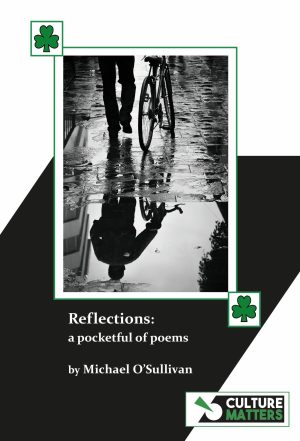
A 2026 book called Reflections from Culture Matters by Michael O’Sullivan says straightforwardly that “The poems reflect who I am, many of my experiences and some of what I feel about the people and the world around me.” The poems are lovely, simple, heartfelt snapshots of a life lived between England and Ireland. They talk of love, ageing, family, work, foodbanks, the Gazan genocide. The point that needs to be shouted from the rooftops is that those experiences are usually shut down, shut out, not heard. The reason why is simple – it’s not just that the culture industry isn’t interested in the life-experiences of ordinary people, as Quille notes, it’s because if we were able to tell our stories, and hear each other, we’d realise what we have in common – and commonality, common struggle, are the basis for a new world.
So, the cultural task is to give ourselves a voice, and to hear each other, without being filtered through the distorting megaphone provided by the techno-cultural monopoly. Moreover, as Michael O’ Sullivan makes clear, we cannot be satisfied with writing empty abstractions. As he puts it in his poem Help!:
Tears don’t help unless dried by change.
Words fail until the world is listening.
Sympathy is empty while aid stays away.
Children die hungry each day as we watch.
Mercy is needed to flow in with fuel.
Kindness has to carry in food.
Healing should rush in with water.
And love has to deliver true peace.
(p 49)
Poetry evades the algorithm
In a recent interview, the poet Lisa Robertson (10) says this:
For me, language derives from poetry; poetry does not derive from language. Poetry is the first language, in childhood and in the culture. The instrumentalization of language by means of algorithms is a subset of mathematics and economics, not linguistics. Language as poem, or poem as language, through recitation, formal play, historical transmission, sonic and scriptural innovation, shapely invention, moves intimately and concretely from mouth to mouth, from ear to ear, against the grain of the dominant measures and restrictions. Meaning is constituted and iterated through this movement, which produces its own ground.
Poetry, for Robertson, is how we evade the algorithm. There is, I’d contend, always a sense in which any poetry is unfinished, provisional; poetry is a snapshot of a thought in the process of its being thought and cannot be reduced to algorithmic content. One of the tasks before us is to recover a form of political language that does not belong to and cannot be reduced to, the algorithm. Poetry, because it is a language of symbols, of images, of lies, of feints, of truths, half-truths, memory and terror, can give us ways to convey the horror of the bombing of a school in Gaza, or someone slipping on ice in a cold Midlands street, or someone seeing the sun through a prison window, or a couple touching hands on their 50th wedding anniversary, that does not strip away the intensity of each instance, but pushes that intensity to the fore. It allows us to recover a way of talking about politics that is not reduced to abstractions.
In her long poem Snagged on Red Thread Jazmine Linklater crashes together images of surveillance, brutality, bureaucracy and appalling beauty, so that “The edges dissolve / contradicting within and without.” And this is how we experience the world – we are inundated by images that form structures of perspective designed to obscure and pre-define the world, erase from it our recognition of complicity in oppression. Linklater’s poem wants us to acknowledge all this and unpick it, so that in unravelling the murk we better grasp how ideology and its slop of bullshit and distraction work upon us, so that in working through her poem we recover our agency and our sense of ourselves as political subjects.
Maybe Linklater sets out our task right there. To turn the images we are given by the edgelord tech bros inside out. Try to find the real. Insist on cultural democracy: democratic ownership and control of technologies like AI, in order to protect and release its liberatory potential.